The Legacy Letter: The One Page Your Will Cannot Contain
A legacy letter is the one page that tells your heirs what the money was for and what you hoped it would make possible. It has no legal force, it costs nothing, and it is the single highest-return document in this entire subject.
An estate arrives as instructions. So many shares here, the property there, the residue divided as follows. The document is precise about ownership and completely silent about meaning.
Into that silence, heirs put their own interpretation. They decide what you would have wanted, what the money is for, what you were like about it. They are guessing, and they will act on the guess for decades. The letter is what removes the guess.
What it is, and what it is not
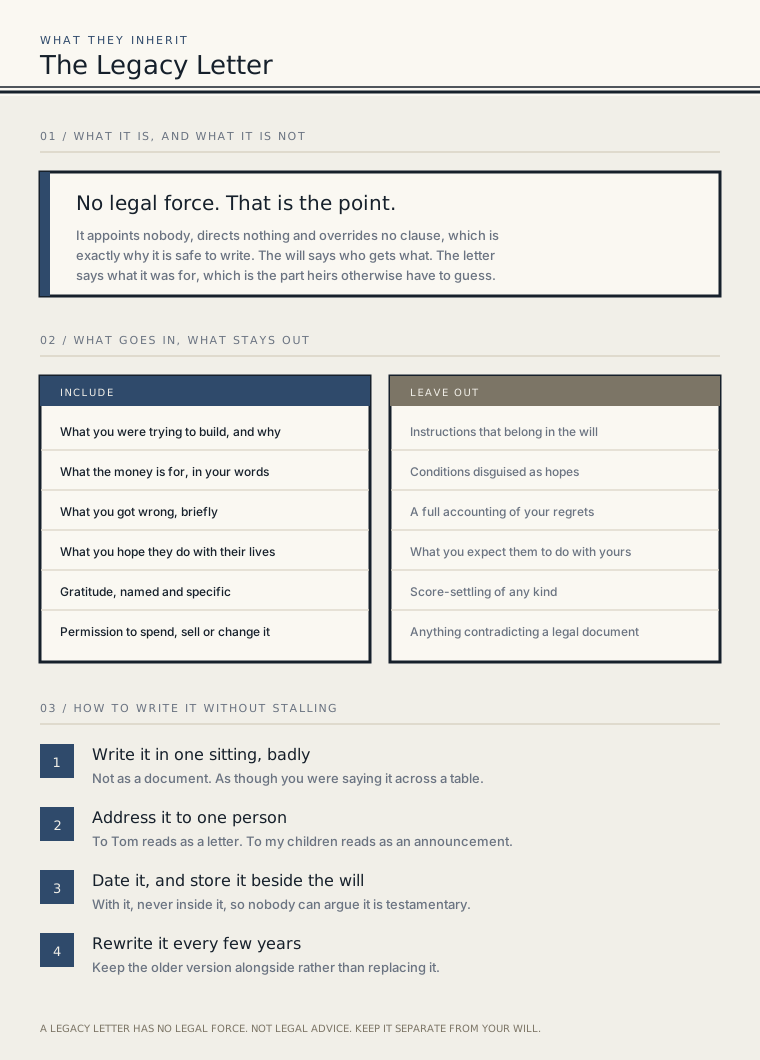
A legacy letter, sometimes called an ethical will, is a personal document written to the people who will outlive you. It carries no legal weight whatsoever. It appoints nobody, directs nothing and overrides no clause.
That absence of force is the feature. Because it cannot alter the distribution, it can be entirely honest without creating any risk of contradicting the legal documents. You are free to explain, and nothing you explain can accidentally reallocate an asset.
It is not a confession, not a settling of scores, and not a last set of conditions dressed up as sentiment. A letter that attaches invisible strings to money is worse than no letter, because heirs feel the strings and cannot renegotiate them with anyone.
Why the silence costs so much
Consider the position of a competent adult child, six weeks after the funeral, holding a set of legal documents.
They know what they own. They do not know whether their father would have wanted the house kept or sold. They do not know whether the business was a source of pride or a burden he would have been glad to see them released from. They do not know whether spending some of it would have delighted him or appalled him.
So they decide, and the decision hardens into family doctrine. Almost every family has one of these invented doctrines, often defended fiercely by people who never heard the man say it. Sometimes it produces paralysis, an estate nobody dares touch. Sometimes it produces the opposite, rapid disposal of something you spent thirty years building because nobody knew it mattered.
Both outcomes are caused by an absence of one page.
What goes in it
Keep it to a page. A long document gets read once, ceremonially, and filed. A short one gets read again.
| Include | Leave out |
|---|---|
| What you were actually trying to build, and why | Instructions that belong in the will |
| What the money is for, in your own words | Conditions disguised as hopes |
| What you got wrong, briefly and without drama | A full accounting of your regrets |
| What you hope they do with their own lives | What you expect them to do with yours |
| Gratitude, named and specific | Score-settling of any kind |
| Permission: to spend it, sell it, change it | Anything that contradicts a legal document |
The row that surprises men most is the last one on the left. Permission is often the most valuable sentence in the letter. Heirs freeze because they are frightened of dishonouring something. A plain line saying the house is yours to sell if it no longer fits your life releases a family from a decade of guilt about an asset that stopped being useful.
The row that does the most damage if ignored is the second on the right. Any hope phrased as an expectation becomes a condition in the reader's mind, and it is a condition they can never discuss with you. Write hopes as hopes and mean it.
How to write it without stalling
Most men do not stall because the letter is difficult. They stall because it requires saying plain things without the protection of a professional register, and that is unfamiliar.
Write it in one sitting, badly. Do not draft it as a document. Write it as though you were saying it to one person across a table, because that is the register that survives being read after your death.
Address it to someone specific rather than to a category. To my children reads as an announcement. To Tom reads as a letter, and it can be read by everyone regardless.
Date it and put it with the will, not inside it. The letter has no legal force and should never be attached in a way that invites an argument about whether it forms part of the testamentary document. Your executor should know it exists.
Rewrite it every few years. It is a snapshot of what you thought at one point, which is exactly what makes it valuable, and the version from twenty years earlier is worth keeping alongside rather than replacing. For the underlying picture of what American families actually hold, the Federal Reserve publishes the full Survey of Consumer Finances report.
Why this is the whole point of the publication
The legal work matters and it is genuinely important to get right, which is why the will is worth doing properly and why most family wealth comes apart at the handovers rather than in the markets.
But the structural work is a floor. Every family that handles an inheritance well had something else in place: a shared understanding of what the thing was for. Some families arrive at it through decades of open conversation. Most do not, and for most the letter is the cheapest available substitute.
Your children are already inheriting the part that does not appear in any document. How you spoke about money. Whether the house was tense about it. Whether you seemed to enjoy any of what you built. That is the transmitted set, and it is worth understanding how family values actually travel before you try to write yours down. That transfer is happening now and it is not optional. The letter is your only chance to add a note to it in your own voice.
Last reviewed by the What They Inherit Editorial Team on August 19, 2026. Our sourcing and AI-use rules are public on the editorial standards page. This is general editorial content and not legal, tax or financial advice. A legacy letter carries no legal force and is not a substitute for a properly drafted will.
FAQ
What is a legacy letter?
A legacy letter, sometimes called an ethical will, is a personal document written to the people who will outlive you, telling them what the money was for and what you hoped it would make possible. It carries no legal weight, appoints nobody and overrides no clause. That absence of force is the feature, because nothing it says can accidentally contradict the documents that do carry force.
Is an ethical will the same as a legacy letter?
Yes. Ethical will is an older name for the same document, and this piece uses the two interchangeably. Neither carries any legal weight, which is what separates both of them from a will proper. An ethical will appoints nobody, directs nothing and overrides no clause. It is a personal document written to the people who will outlive you, and its lack of legal force is exactly why it can be written honestly.
Is a legacy letter legally binding?
No, and it should not be. It directs nothing and cannot alter your will. That is precisely why it can be written honestly without professional review and without any risk of contradicting the documents that do carry force.
Where should it be kept?
With your will rather than inside it, so there is no argument about whether it forms part of the testamentary document. Your executor should know it exists and where to find it. Household and estate composition sits in the Federal Reserve's Survey of Consumer Finances, while the federal position on what forms an estate is set out by the Internal Revenue Service.
How long should it be?
One page. A long letter is read once and filed. A short one is read repeatedly, which is the entire objective, and brevity forces you to say the thing rather than approach it.
What if I have things to say that are not flattering to me?
Include them briefly if they are useful to the reader, and leave them out if they are useful only to you. A short admission of something you got wrong is a gift to a child who assumed you never doubted anything. A full accounting of your regrets is a burden handed to someone who cannot reply.
Should each child get a different letter?
One letter addressed to a named person, readable by all, works well and avoids the comparison problem. Separate letters are fine if the content genuinely differs, but assume every letter will eventually be read by everyone, because it will be.
How do you write a legacy letter?
Write it in one sitting, badly, as though you were saying it to one person across a table rather than drafting a document. Address it to someone specific rather than to a category, because to my children reads as an announcement while to Tom reads as a letter, and it can still be read by everyone. Keep it to a page, since a long document gets read once and filed while a short one gets read again. Say what you were actually trying to build and what the money is for, give explicit permission to spend, sell or change what you leave, and write hopes as hopes rather than as expectations, because any hope phrased as an expectation becomes a condition the reader can never discuss with you. Then date it and keep it with the will rather than inside it, make sure your executor knows it exists, and rewrite it every few years.
Sources
- Survey of Consumer Finances report (federalreserve.gov)
- Survey of Consumer Finances (federalreserve.gov)
- Internal Revenue Service (irs.gov)