Generational Wealth: Why Most of It Is Gone by the Grandchildren
Generational wealth is two things at once: a balance, meaning assets that outlive you, and a capability, meaning a family that can receive that balance, hold it, and hand it on again. When it fails to reach the grandchildren, it rarely evaporates through bad investing. It comes apart through handovers, and the three failures behind them are preparation, communication and governance rather than investment performance.
There is an old saying in family firms, repeated in almost every culture with its own wording: shirtsleeves to shirtsleeves in three generations. The first builds it, the second holds it, the third loses it.
It is repeated because it describes something people keep watching happen. What it does not explain is why, and the why matters, because the common assumption is wrong.
What generational wealth actually means
Worth being exact, because the phrase gets used for two different things.
The first is a balance. Assets that outlive you: property, a business, a portfolio, whatever sits on the statement. This is the version most men mean when they say they are building generational wealth, and it is the version that is comparatively easy. Balances are a solved problem. Earn more than you spend, invest the difference, wait.
The second is a capability. A family that can receive that balance, hold it, and hand it on again. That is not a number. It is a set of habits, conversations, roles and agreements distributed across people who did not build any of it and do not automatically know how it works.
You can be excellent at the first and produce nothing durable, because the balance is handed to a family with no capability. That combination is the entire subject of this article.
The three failures, in order
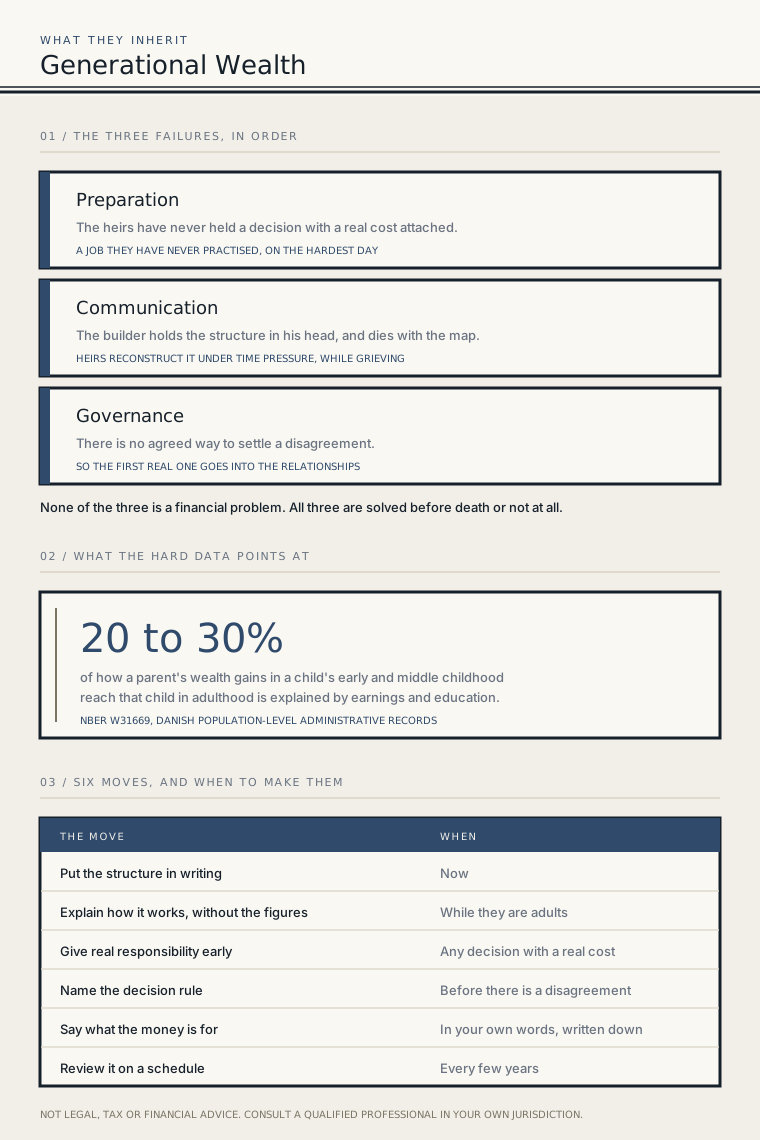
The preparation failure. The heirs have never been given responsibility for anything consequential. They have received money, often generously, but never a decision with a real cost attached. When the whole thing arrives at once, they are being asked to do a job they have never practised, on the hardest possible day.
The communication failure. Nobody knows what the plan is. The builder holds the entire structure in his head, treats discussing it as morbid or as an invitation to bad behaviour, and dies with the map. The heirs then reconstruct it under time pressure while grieving, which is where the family arguments start.
The governance failure. There is no agreed way to decide anything. When the family owns a thing together and has never agreed how disputes are settled, the first genuine disagreement has nowhere to go except into the relationships. That is how families end up selling a good asset at a bad time simply to stop the fighting.
None of these is a financial problem. All three are solved before death or not at all. The hard data points the same way: the NBER working paper The Intergenerational Transmission of Housing Wealth, built on population-level Danish administrative records, found that earnings and education together explain only 20 to 30 percent of how a parent's wealth gains during a child's early and middle childhood reach that child in adulthood. Its authors attribute most of the remainder to household environment and parental behaviour that children carry with them, and that shapes how they save as adults.
Why silence is the expensive choice
Most builders do not talk about the money. The reasons are usually decent ones. You do not want the children coasting. You do not want them counting. You grew up without it and it feels vulgar to discuss. You assume there is time.
The cost of the silence is that your heirs learn the structure at the worst possible moment, and they learn it from documents rather than from you.
There is a difference between telling your children what they will get and telling them how it works. The first can genuinely damage motivation and is worth being careful with. The second is pure transfer of capability and there is almost no argument for withholding it. A grown child can know that the family holds property in a trust, that a trust has trustees, that trustees have duties, and that the business has a succession plan, without knowing a single figure.
Most families that handle this well have separated those two disclosures. Most that handle it badly have treated them as one thing and withheld both.
What to actually do
| Move | What it prevents | When |
|---|---|---|
| Put the structure in writing | Heirs reconstructing your plan under grief | Now |
| Explain how it works, without the figures | Capability arriving decades late | While they are adults, not at the reading |
| Give real responsibility early | Practising on the whole estate | Any decision with a real cost |
| Name the decision rule | The first disagreement becoming permanent | Before there is a disagreement |
| Say what the money is for | Heirs inventing a purpose you would hate | In your own words, written down |
| Review it on a schedule | A plan that fits a family you no longer have | Every few years |
The one most often skipped is the last row of the middle column: saying what the money is for. An estate arrives with instructions about ownership and none about intent. Heirs then supply their own intent, and the version they invent is usually either paralysed reverence or rapid disposal. Neither is what you meant.
The part nobody costs properly
Everything above is administrative and can be arranged in a few months of deliberate effort. The part that takes years is the one that does not appear on any checklist.
Your children will inherit how you behaved about money long before they inherit any of it. Whether it was discussed or hidden. Whether it made the house tense. Whether generosity was normal. Whether work was a source of pride or a permanent absence. Whether the person who built it seemed to enjoy any of it.
That inheritance transfers with total reliability and it cannot be structured, insured or drafted around. It is already transferring, and it has been since they were small. It is the subject of what actually gets passed down, and it is the reason this publication is not a wealth-management site.
If you want the mechanical half done properly first, start with the will itself, which is the one document that fails most often for the dullest reasons. The wider set of instruments that sits around it is covered in what an estate plan is actually made of. Where the money is meant to reach grandchildren rather than children, the plan meets a second transfer tax and a basis rule the ordinary version never encounters, set out in estate planning built to reach a third generation.
Last reviewed by the What They Inherit Editorial Team on August 25, 2026. Our sourcing and AI-use rules are public on the editorial standards page. This is general editorial content and not legal, tax or financial advice. Speak to a qualified professional in your own jurisdiction before acting.
FAQ
What is generational wealth?
The phrase gets used for two different things. The first is a balance, meaning assets that outlive you: property, a business, a portfolio, whatever sits on the statement. The second is a capability, meaning a family that can receive that balance, hold it and hand it on again. You can be excellent at the first and produce nothing durable, because the balance is handed to a family with no capability.
What is the 3 generation wealth rule?
It is the folk observation that wealth is built by the first generation, held by the second and lost by the third, known in English as shirtsleeves to shirtsleeves in three generations. It describes an observed pattern rather than a measured statistic, and the failure it points at comes from the handovers between generations rather than from investment returns.
Is the shirtsleeves saying actually true?
It is folk wisdom rather than a measured statistic, and we cite it as folk wisdom. It has versions in many languages, which tells you families everywhere have observed the pattern. Treat it as a description of a real risk rather than as a number you can rely on.
What is the single biggest cause of family wealth disappearing?
Unprepared heirs and absent governance rather than poor investment returns, and we state that as this publication's editorial assessment rather than as a measured finding, because no single dataset ranks the causes. Household balance sheets and their composition are tracked in the Federal Reserve's Survey of Consumer Finances, which is the standard reference for how American wealth is actually held, and which measures what families hold rather than why they lose it.
Should I tell my children what they will inherit?
Separate the two questions. Telling them how the structure works is almost always right and costs nothing. Telling them the figures is a judgement call about their age and circumstances, and it is reasonable to delay it. Most families wrongly treat these as a single decision and withhold both.
Do I need a trust?
That depends entirely on your jurisdiction, your assets and your family, and it is exactly the sort of question this publication will not answer for you. The Internal Revenue Service publishes the federal position on estate tax, which is a starting point for reading, not a substitute for advice.
At what age should heirs be given responsibility?
Earlier than instinct suggests, and in units small enough that a mistake is survivable. The purpose is repetition rather than the amount. A person who has made twenty consequential decisions is a different heir from one who has made none, regardless of the sums involved.
How much money is considered generational wealth?
There is no threshold figure, and the question usually hides the more useful one. On the balance definition, generational wealth is any asset that outlives you and reaches the next generation, so the amount that qualifies is whatever your family actually receives. On the capability definition it is not a number at all, because a family that can receive that balance, hold it and hand it on again is a set of habits, conversations, roles and agreements rather than a sum. You can be excellent at building the balance and produce nothing durable, which is why the size of the transfer is the weaker of the two things to measure.
Sources
- The Intergenerational Transmission of Housing Wealth (nber.org)
- Survey of Consumer Finances (federalreserve.gov)
- estate tax (irs.gov)