Values in a Family: What Actually Transfers, and What Only Gets Said
Values in a family are the working rules a household actually runs on, and they transfer through repeated behaviour rather than through stated principle. Children learn them the way anyone learns a language, by exposure and pattern, long before anybody sits them down and explains anything.
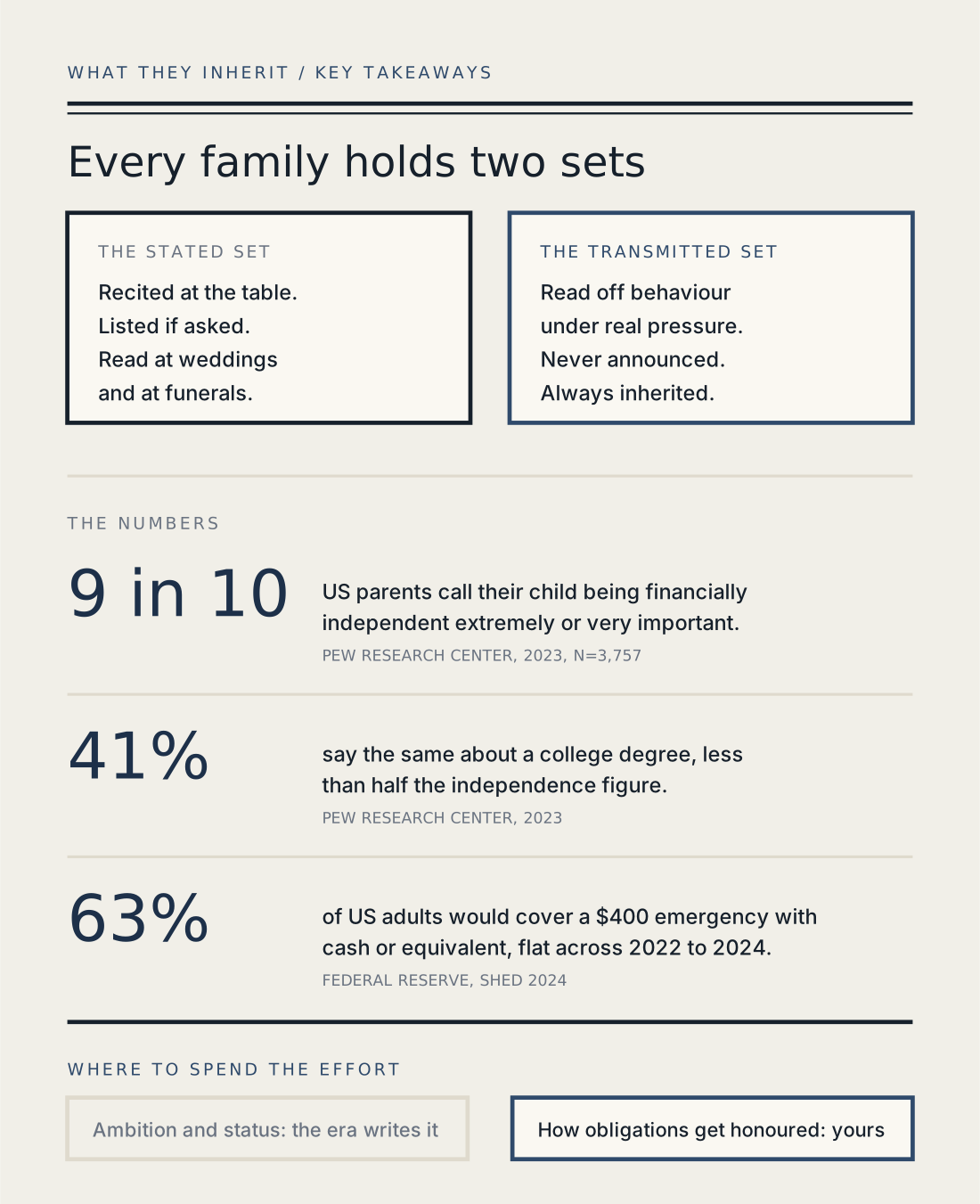
This creates a problem that almost nobody notices in time. Every family has two sets of values. There is the stated set, the one you would list if asked, the one that appears in speeches at weddings and funerals. Then there is the transmitted set, the one your children actually absorb from watching how you behave when money is tight, when work eats a Saturday that was promised to someone, when a relative needs help they did not earn.
Parents recite the stated set at the dinner table. Children learn the transmitted set from everything else that happens in the house.
What family values actually are
A family value is a rule your household applies under pressure. That is the whole definition, and the pressure clause is the part that matters.
Anyone can say they value generosity in a calm week. The value is what happens when a sibling's business fails and the ask arrives, when a bill lands that breaks the month, when an adult child wants to move back in. Whatever the household does in that moment is the value, regardless of what gets said afterwards.
This is why lists of family values written on a card tend to have no effect. They describe the stated set. Children are running a much better instrument than a card. They are watching thousands of small decisions and extracting the pattern, and the pattern is what they will reproduce in their own households thirty years later.
The Pew Research Center's Parenting in America Today survey of 3,757 US parents found that roughly nine in ten say it is extremely or very important that their children end up financially independent. According to the same survey an identical share say it matters that their children have jobs or careers they enjoy. Far fewer place that weight on marriage (21 percent) or on their children becoming parents themselves (20 percent). Independence is the near universal stated value of American parenting.
What almost no household states is what the independence is for. That gap is where the transmitted set does its work.
The research on what carries across a generation
Value transmission inside families is measurable, and the finding is more specific than the folk version of it.
A 2026 study in the Journal of Genetic Psychology, Family Influence or Zeitgeist? Evidence for Developmental Differences in the Intergenerational Transmission of Parent-Child Value Similarity, compared 1,055 real Chinese parent and child dyads against pseudo dyads, meaning parents and children randomly paired from the same sample. Real dyads showed significantly higher value similarity than pseudo dyads. That design is the clean way of showing a family transmits something rather than merely reflecting the era it lives in, and it is worth stating that the sample was Chinese adolescents and emerging adults rather than a US population, so the specific dimensions may not map one to one onto an American household.
The more useful part of the finding is where that family advantage disappeared. Among the emerging adults in the sample, real and pseudo dyads no longer differed significantly on certain dimensions, including distinction and achievement. On those dimensions the wider culture appeared to be doing the work, not the household. The paper does not publish a full roster of which dimensions held, so the honest reading is narrow rather than sweeping: the status flavoured values washed out into the surrounding era while a family specific signal survived elsewhere.
That is a division of labour. Some of what you want to pass on is genuinely yours to pass on. Some of it is being written by the environment your child lives in whatever you do, and effort spent there is mostly wasted.
A separate 2026 paper in the Journal of Family Psychology, Religion as a basis for the intergenerational transmission of altruistic values to emerging adults, shows how granular a real transmission pathway gets. Using data from 123 mothers, 76 fathers and 233 adolescent and young adult children across 149 families in the 2021 to 2022 wave of the Longitudinal Study of Generations, the researchers found mothers and fathers both influenced their children's altruistic values, but by different routes. Mothers' religiosity worked by raising their children's own religiosity. Fathers' religiosity worked by handing over their religiously formed values directly, a route the authors describe as potentially hidden from the fathers themselves.
The mechanism generalises past religion. Values travel through something the family actually does together, not through something the family says.
The stated set against the transmitted set
Here is the audit most families never run. On the left, what gets said. On the right, what the household actually did often enough for a child to notice.
| The stated value | What the child actually read |
|---|---|
| We work hard | Whether work was resented or enjoyed, and whether it was allowed to eat every weekend |
| We are careful with money | Whether careful meant calm and planned, or anxious and secretive |
| Family comes first | Which family member got helped, on what terms, and who was quietly written off |
| We are generous | Whether giving was visible and announced, or private and unremarked |
| Education matters | Whether curiosity was rewarded at home, or only marks on a report were |
| We do not talk about money | That money is dangerous, and that asking about it is a transgression |
The last row is the one that does the most structural damage, because it is a value nobody ever intends to hold. Silence about money is not neutral. It transmits perfectly and it transmits the wrong lesson, which is that the subject is unsafe. A household that has never once discussed what things cost produces adults who will not open a statement.
None of this requires a dramatic upbringing. The transmitted set is built out of ordinary weeks.
How to make a value legible
The practical question is not what your values are. It is which of them are visible enough to be inherited.
Say the reason out loud, once, at the moment. Not a lecture later. When you decline something you can afford, say why in one sentence while it is happening. A value attached to a live decision is legible. The same value stated in the abstract is decoration.
Show the money tradeoff, not just the answer. A child who only sees the outcome learns that the outcome was automatic. Saying that the no on one purchase is what funded the yes on another turns a preference into a value, because it exposes what the choice actually cost.
Pick something the family does and keep doing it. A fixed monthly amount the household gives away and then talks about at the table. A repair you do together on a Saturday instead of paying someone. The bill opened in front of them rather than after they go to bed. Any of those outrank a hundred stated principles, because they have a cadence and a real cost in time.
Be consistent about the small ones rather than heroic about the big ones. A single dramatic act of generosity teaches less than fifteen years of unremarkable fairness about who pays for what.
Write down the ones you want to survive you. That is what the legacy letter is for. It takes an afternoon, changes no legal instrument, and removes the guesswork heirs otherwise invent.
Where values meet the documents
A household needs a working set of values and a working set of documents. Neither one covers for the absence of the other, and the two failure modes are easy to tell apart.
Strong stated values with no legal structure produce a mess that consumes years and money. That is the case for writing a will properly, and for understanding that an estate plan is a set of pieces rather than one document. The opposite failure is a flawless structure with no shared understanding of what the money is for. That is the machinery behind the pattern where most family wealth is gone by the grandchildren, because a third generation ends up administering something whose purpose nobody ever explained to them.
The Federal Reserve's Survey of Household Economics and Decisionmaking found that 63 percent of US adults said they would cover a hypothetical $400 emergency expense entirely with cash or its equivalent, a figure unchanged across 2022, 2023 and 2024. For a large minority of households the values conversation and the survival conversation are the same conversation, and pretending every family is choosing between philosophies of abundance helps nobody.
The table above is not an abstraction. Run it on your own household this week. Take the six stated values on the left, write down what your family did the last time each one came under real pressure, and count how many rows match.
Last reviewed by the What They Inherit Editorial Team on August 21, 2026. Our sourcing and AI use rules are public on the editorial standards page. This is general editorial content and not legal, tax or financial advice. Rules on wills, trusts and estates vary by jurisdiction and change over time, so consult a qualified professional licensed where you live before acting on anything here. If family conflict here touches crisis territory, the 988 Suicide and Crisis Lifeline is available in the US by call or text, and a licensed therapist or family mediator is the right professional for estrangement, not an estate lawyer.
FAQ
What are values in a family?
A family value is a rule your household applies under pressure. That is the whole definition, and the pressure clause is the part that matters, because anyone can state a value in a calm week. You can find yours without waiting for a better definition. Pick one recent moment when the household was under real pressure, a bill that broke the month, a favour asked by someone who could not repay it, a holiday that turned into an argument about who travels. Write down what actually happened, not what you would have said beforehand. That written line is closer to your real family value than any list you could produce sitting calmly at a table.
How are family values passed down?
Through repetition inside a shared activity, which is why the pathway matters more than the message. The Journal of Family Psychology study of 149 families found mothers and fathers transmitting the same altruistic values by different routes, one through the child's own practice and one directly through the parent's formed values. Practically, that means picking one recurring low stakes decision, such as who covers what on a shared bill, and letting your child watch you make it the same way for years. The repetition does the work, not the explanation.
Can you change your family values once the children are older?
You can change what is transmitted from here forward. Older children will probably register the change faster, since they have more history to compare it against, though that is an inference rather than a measured finding. What you cannot do is overwrite two decades of pattern with one conversation. Name the change, say what prompted it, then be consistent about it long enough for the new pattern to register on its own.
Should family values be written down?
Written values do very little on their own and can be actively counterproductive if the household visibly contradicts them. Writing is useful in one specific form, which is a personal letter explaining what the money was for and what you hoped it would make possible. That document has no legal force and cannot contradict a will, which is exactly why it can be honest.
What is the most damaging family value?
Silence about money, covered above. The repair is smaller than it sounds. Saying one real number out loud, what a thing cost, what a decision saved or lost, what a month actually looks like, breaks the pattern faster than any conversation about values does, because it demonstrates that the subject can be raised without the room going tense.
Do family values matter if there is no inheritance to leave?
They matter more, because they are then the entire inheritance. Habits around work, spending and asking for help transfer whether or not any asset does, and they are what a child carries into a first job, a first joint account and a first serious financial mistake. A household with nothing to bequeath still decides what its children believe money is for.
Which family values are worth spending effort on?
The ones the household can still move. The value similarity research points at a split, with certain status linked dimensions in emerging adults looking more like a product of the surrounding era than of the family. That suggests effort aimed at making a child more ambitious is largely competing with the whole culture, while effort aimed at how obligations get honoured inside the house has a much shorter route to its target. Note that this evidence comes from a Chinese sample, so treat it as a direction to look rather than a rule.
What do children inherit from their parents besides money?
The transmitted set: the working rules the household actually ran on, which children read off repeated behaviour around money, work and time rather than off anything that was stated. In practice that is whether work was resented or enjoyed, whether being careful with money looked calm and planned or anxious and secretive, which family member got helped and on what terms, and whether giving was visible and announced or private and unremarked. Silence about money transfers as reliably as any of those, and what it transfers is the lesson that the subject is unsafe. The route is the part the research is specific about: values travel through something the family actually does together rather than through something the family says, and the Journal of Family Psychology study found fathers handing over their formed values directly by a pathway the authors describe as potentially hidden from the fathers themselves.
Sources
- Parenting in America Today (pewresearch.org)
- Family Influence or Zeitgeist? Evidence for Developmental Differences in the Intergenerational Transmission of Parent-Child Value Similarity (pubmed.ncbi.nlm.nih.gov)
- Religion as a basis for the intergenerational transmission of altruistic values to emerging adults (pubmed.ncbi.nlm.nih.gov)
- Survey of Household Economics and Decisionmaking (federalreserve.gov)