How to Write a Will: The Document Most Men Put Off Until It Is Written By Someone Else
A will is a written instruction that appoints someone to act for your estate, says who receives what, appoints guardians for any minor children, and states what happens to everything not specifically mentioned. It operates at the exact moment you are unavailable to clarify it, and everything that makes it a good or a bad document follows from that single fact.
A will is not a statement of wishes. That is the misunderstanding that keeps men from writing one, because wishes feel like something you can hold in your head and communicate later.
The default you already have
The most useful thing to understand first is that you are not choosing between having a will and having nothing.
Every jurisdiction has intestacy rules: a statutory order of who receives what when someone dies without a valid will. Write nothing and those rules apply. They were written for the average case, they vary enormously between countries and between American states, and they have no knowledge of your second marriage, your business partner, the child who needs more help, or the sibling you have not spoken to in a decade.
So the decision is not whether your estate is distributed by a rule. It is whether the rule is yours or the state's.
What the document has to do
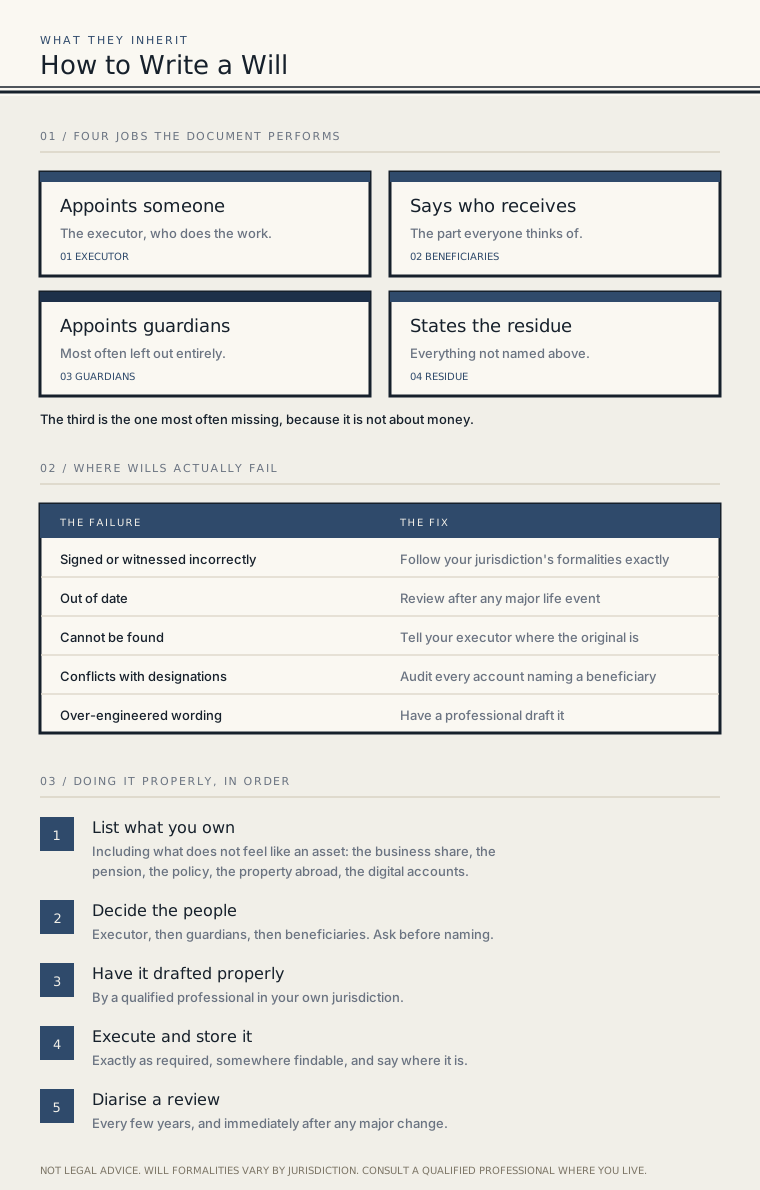
Strip away the jargon and a will performs four jobs.
It appoints someone to act. The executor, or personal representative, is the person who actually does the work: securing assets, paying debts, filing what needs filing, distributing what remains. This appointment matters more than most people expect, because a capable executor absorbs an enormous amount of friction and an unsuitable one generates it.
It says who receives what. The part everyone thinks of, and the part that goes wrong least often when the document is drafted properly. A recipient does not have to be a person, and a gift to charity is administered here alongside everything else.
It appoints guardians for minor children. For anyone with young children this is frequently the most important clause in the document, and it is the one most often left out because it has nothing to do with money.
It states the residue. What happens to everything not specifically mentioned. Estates change between drafting and death, and a missing residuary clause is one of the most common sources of a mess.
Where wills actually fail
The failures are almost never interesting. They are administrative, and that is precisely why they keep happening to careful people.
It was never properly executed. Signature and witnessing requirements are strict, formal, and vary by jurisdiction. A will that expresses your intentions perfectly and was signed incorrectly can fail entirely. This is the single most avoidable failure in the whole subject.
It was never updated. A will written before a divorce, a remarriage, a new child, a business sale or a move to another country can produce an outcome you would have hated. In several jurisdictions marriage itself revokes an existing will, which surprises almost everyone who hears it.
Nobody could find it. An original that cannot be located may as well not exist. Executors have hunted through houses for documents that were in a drawer nobody thought to open.
It contradicts the assets. Some assets pass outside the will entirely, by beneficiary designation or by survivorship. A will that gives an account to one child while its designation names another creates exactly the conflict you were trying to prevent.
It was too clever. Elaborate conditional structures written without advice produce ambiguity, and ambiguity is resolved by lawyers, slowly, out of the estate.
| Failure | What it costs | The fix |
|---|---|---|
| Signed or witnessed incorrectly | The whole document | Follow your jurisdiction's formalities exactly |
| Out of date | An outcome you would reject | Review after any major life event |
| Cannot be found | Delay and possible intestacy | Tell your executor where the original is |
| Conflicts with designations | Family dispute | Audit every account that names a beneficiary |
| Over-engineered wording | Legal fees and delay | Have a professional draft it |
Doing it properly, in order
Start by listing what you actually own, including the things that do not feel like assets: the business share, the pension, the policy, the property abroad, the digital accounts with value in them.
Then decide the people. Executor first, then guardians if you have young children, then beneficiaries. Ask your executor before naming them, which a surprising number of people skip.
Then have it drafted by a qualified professional in your jurisdiction. This publication is not going to pretend a template is equivalent, because the failure modes above are exactly the ones a template does not protect you from and a professional does.
Then execute it precisely as your jurisdiction requires, store the original somewhere findable, and tell your executor where it is.
Then diarise a review. Every few years, and immediately after any major change in the family or the assets. The Consumer Financial Protection Bureau publishes plain-language material on managing someone else's money, which is worth reading before you appoint anyone to do it for you.
The document is the floor, not the work
A correctly drafted will prevents disaster. It does not, on its own, produce a family that handles what arrives.
The document says who gets what. It says nothing about why you built it, what you hoped it would make possible, or how you would like it handled. Heirs who receive assets with no stated intent supply their own, and the version they invent is rarely the version you had. That is the gap a legacy letter exists to close.
And if the estate includes anything the family will hold together, the will is only the first of the arrangements you need. The rest is the subject of why generational wealth comes apart, which is almost always a governance problem rather than a drafting one. The will is also one instrument among several, and how the whole set is meant to fit together is treated on its own terms. Where a trust is being weighed alongside it, what a family trust actually creates, and who has to run it covers the ongoing office that a trust brings with it.
Last reviewed by the What They Inherit Editorial Team on August 19, 2026. Our sourcing and AI-use rules are public on the editorial standards page. This is general editorial content and not legal, tax or financial advice. Requirements differ by jurisdiction. Speak to a qualified professional where you live before acting.
FAQ
Can I write a will myself, or do I need a lawyer?
In many jurisdictions you legally can, and the risk is not the writing but the execution and the wording. Because the common failures are formalities and ambiguity, a self-drafted will is most likely to fail in exactly the places you cannot see. For anything beyond the simplest estate this is poor economics, and the document is better drafted by a qualified professional in your jurisdiction.
What makes a will invalid?
Most often, the execution. Signature and witnessing requirements are strict, formal, and vary by jurisdiction, and a will that expresses your intentions perfectly but was signed incorrectly can fail entirely. That is the single most avoidable failure in the whole subject. The other common failures do not void the document outright but damage it just as effectively: a will never updated after a marriage, divorce, birth, business sale or move to another jurisdiction, a will nobody could locate, a will that contradicts a beneficiary designation or a jointly held asset, and wording elaborate enough to produce ambiguity. In several jurisdictions marriage itself revokes an existing will. Follow your jurisdiction's formalities exactly, and have the document drafted by a qualified professional there.
What happens if I die without a will?
Your jurisdiction's intestacy rules distribute your estate according to a fixed statutory order. Those rules exist everywhere and differ substantially, and they take no account of your circumstances, your intentions or anything you told your family.
How often should I update my will?
On a schedule and on events. Review every few years, and immediately after a marriage, a divorce, a birth, a death among your beneficiaries, a business sale, or a move to a different jurisdiction. In some places marriage automatically revokes an existing will.
Do all my assets pass under the will?
No, and this catches people out. Assets with a named beneficiary, and assets held jointly with survivorship, commonly pass outside the will regardless of what it says. Audit those designations against your will so the two do not contradict each other. The Internal Revenue Service's estate tax pages and its estate tax FAQ cover the federal treatment of what forms the estate.
What is an executor, and what do they actually do?
The executor, also called the personal representative, is the person the will appoints to carry it out. The work is administrative rather than ceremonial: securing the assets, paying the debts, filing what needs filing, and distributing what remains to the people the will names. The appointment matters more than most people expect, because a capable executor absorbs an enormous amount of friction and an unsuitable one generates it. Two practical steps follow from that. Ask the person before naming them, which a surprising number of people skip. And tell them where the original document is, because an original nobody can locate produces the same practical outcome as having written nothing. What the office is called, who may hold it and what a court requires of the holder are set by the law of the place the person lived, so confirm those specifics with a qualified professional licensed there.
Where should the original will be kept?
Somewhere secure and findable, and your executor must know where. A perfectly drafted original will that nobody can locate creates the same practical outcome as having written nothing.
Sources
- Consumer Financial Protection Bureau (consumerfinance.gov)
- estate tax pages (irs.gov)
- estate tax FAQ (irs.gov)