Inheritance Dispute: Which Fight You Are Actually In
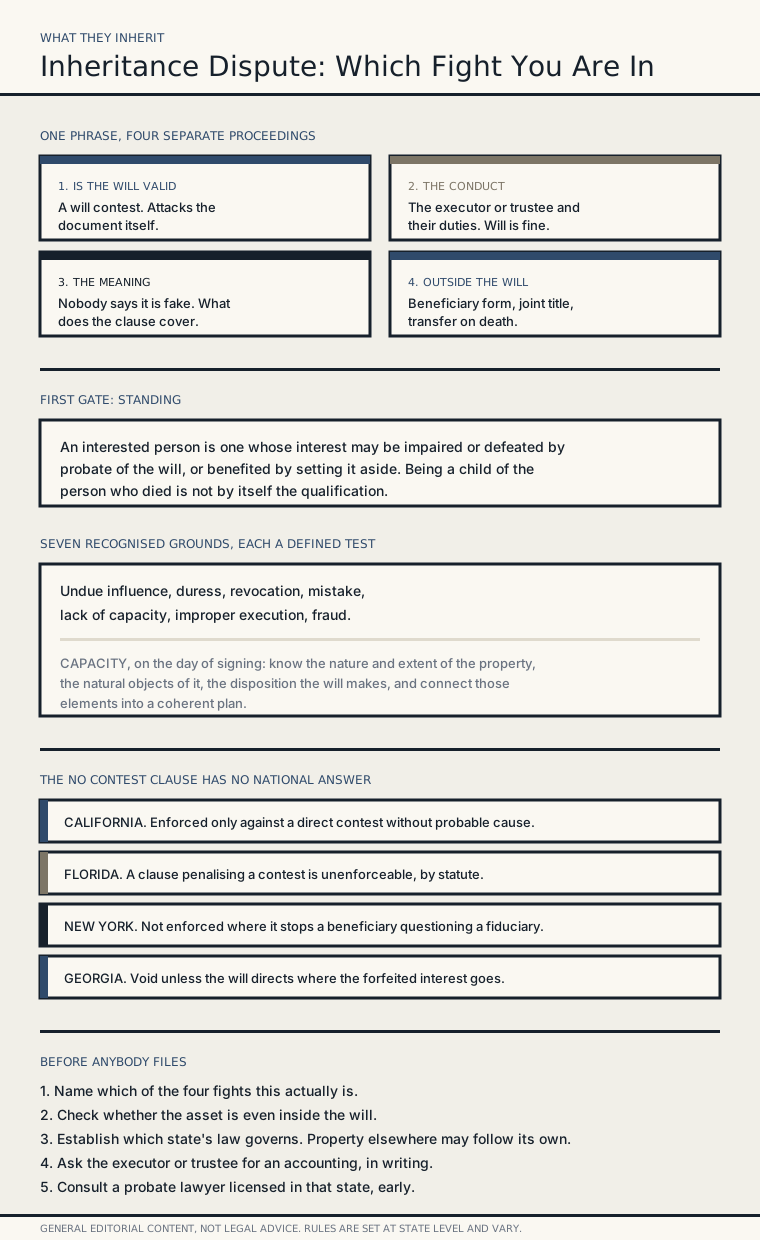
An inheritance dispute is rarely one argument. It is four separate proceedings that share a dinner table, and they ask four different questions of four different people. Is the will valid. Is the executor doing the job properly. What do the words in the document actually mean. And does the document reach this asset at all. Naming which of the four you are in is the first useful thing anybody in the family can do, because the test, the deadline and the risk of losing your own share are different in each one.
Families lose winnable positions by bringing the wrong fight. Someone furious that a sibling is stalling on the house files a challenge to the will, which is a proceeding about whether the document is genuine, when the document was never the problem.
One thing before any of it. If the strain around this death is reaching the point where someone in the family is struggling to cope, that is a separate matter from the estate and it needs separate help. In the United States the 988 Suicide and Crisis Lifeline is available by call or text. The rest of this page is about documents.
The four fights, and why the difference decides everything
Fight one is a will contest. Cornell Law School's Legal Information Institute defines a will contest as a probate proceeding where interested parties dispute the validity of a will. It is an attack on the document. The Institute also records a point from the California Supreme Court in In re Plaut's Estate that narrows what the proceeding is for: in a will contest the court will not interpret the meaning of the will, and the only issue before the court is whether the contested instrument is or is not the will of the person who died. In California, then, a contest asks one binary question and refuses the rest. Whether another state's courts draw that line in the same place is a question for a probate lawyer licensed there.
Fight two is about conduct, and the will is not in question. The complaint is that the executor is not communicating, is selling something at the wrong price, is paying themselves, or has gone quiet for eight months. That is a claim about a fiduciary, not about a document, and the ask is usually an accounting rather than a revocation.
Fight three is construction. Everyone accepts the will is genuine and nobody can agree what a clause covers. The furniture, the shares that were sold and replaced with different shares, the property described by an address that changed.
Fight four sits outside the will entirely. The life insurance policy, the retirement account, the jointly held house. These pay under a contract or pass by how the asset is titled, and working out which assets sit outside the will settles a good many arguments before anybody speaks to a lawyer. We set out how each of those routes actually delivers, and on what timetable separately. A will contest cannot reach an asset the will never controlled.
Whether you are allowed to bring it at all
Standing comes before grounds. The Legal Information Institute states that in order to commence a will contest a person must first have an interest in the will, and gives California Probate Code section 8000 as an example, which provides that at any time after a decedent's death any interested person may commence proceedings for administration of the estate by a petition to the court. The Institute records the California Supreme Court's clarification in In re Plaut's Estate that an interested person is one who has such an interest as may be impaired or defeated by the probate of the will, or benefited by setting it aside.
That test is narrower than family feeling. Being a child of the person who died is not by itself the qualification. The question is whether the outcome of the proceeding changes what you receive. A person cut out of a will who would inherit under an earlier will, or under state intestacy rules if no valid will survives, generally has something at stake. A person who receives the same amount either way generally does not.
The Institute also notes that a contest of a will is not an end in itself but the first in a series of proceedings which determine the various claims asserted under the will. Setting a will aside does not hand anybody a distribution. It reopens the question of which instrument governs, and something else then has to answer it.
The grounds, and what each one actually asks you to prove
The Legal Information Institute lists the most common legal grounds for disputing the validity of a will as undue influence by someone close to the person who died, duress, revocation, mistake, lack of capacity when the will was signed, improper execution of the will, and fraud. Two of those carry most of the real-world traffic, and both have a defined test rather than a feeling behind them.
Lack of testamentary capacity. The Institute defines testamentary capacity as the ability of a person to make a valid will, and states that most states have both an age requirement, usually 18 years old, and a mental capacity requirement. For mental capacity the person making the will must have the ability to know the nature and extent of their property, the natural objects of their property, the disposition their will is making, and the ability to connect all of these elements together to form a coherent plan. Read that list closely, because it is a test about a specific moment rather than a general condition. A person can hold a diagnosis and still meet it. A person can be entirely well the following week and have failed it on the day of signing.
Undue influence. The Institute defines undue influence first as a doctrine of contract law, where it describes excessive persuasion by one party on another which undermines their free will and leads to a contract benefiting only the influencer. The Institute then extends it, naming a will as one of the instruments that can be rendered unenforceable and voidable where undue influence is established. To prove it, the Institute states it must be shown that the influenced party had vulnerabilities making them susceptible to persuasion, and that the influencer was in a special relationship of trust, dependency or authority over the victim. Where undue influence is established, the Institute states the contract, will or legal instrument in question can be rendered unenforceable and voidable by the influenced party. The structure is two limbs and both are required. Suspicion that a sibling was around a lot is not the second limb, and it is not the first one either.
| The ground | What it claims about the will | Where this description comes from |
|---|---|---|
| Lack of testamentary capacity | On the day of signing the person could not know their property, their natural heirs, what the will was doing, or connect those into a plan | Defined by Cornell LII, testamentary capacity |
| Undue influence | Excessive persuasion overcame free will, by someone in a relationship of trust, dependency or authority, over a person with vulnerabilities | Defined by Cornell LII, undue influence |
| Improper execution | The signing formalities the state requires were not met | Named in the LII grounds list, not defined there. This description is our editorial summary |
| Fraud | The person was deceived about what they were signing or about a fact that drove the disposition | Named in the LII grounds list, not defined there. This description is our editorial summary |
| Duress | The will was procured by threat or coercion rather than persuasion | Named in the LII grounds list, not defined there. This description is our editorial summary |
| Revocation | This will was cancelled, generally by a later instrument or an act the state recognises | Named in the LII grounds list, not defined there. This description is our editorial summary |
| Mistake | The document does not say what the person making it understood it to say | Named in the LII grounds list, not defined there. This description is our editorial summary |
The formalities question deserves a note, because it is the least emotional ground and it decides real cases. A will drafted without professional help is more exposed to missing a state's execution formalities, which is one of several reasons why getting the mechanics of a will right in the first place is worth more than any clever provision inside it. Which state's formalities apply is a separate question, and it is not always answered by where the person lived. Real property in particular can be governed by the law of the state where it sits. Confirm it with a probate lawyer licensed where the person lived, and also where any property is located, rather than assuming one state's rule covers the whole estate.
The clock, and why a general answer to it is a dangerous answer
Deadlines in this area are set by state law and they are short. California publishes one: Probate Code section 8270 provides that within 120 days after a will is admitted to probate, any interested person, other than a party to a will contest and other than a person who had actual notice of a will contest in time to have joined in the contest, may petition the court to revoke the probate of the will, and that the petition shall include objections setting forth written grounds of opposition. The same section carries a carve out: a person who was a minor, or who was incompetent and had no guardian or conservator at the time the will was admitted, may petition at any time before entry of an order for final distribution.
That is one state's rule and it is offered as an example of the shape rather than as a number to rely on. Deadlines, the events that start them, and the exceptions differ from state to state. Two things follow that hold generally.
The first is that a deadline of this kind can be tied to a court event rather than to the date of death. California's is: it runs from the will being admitted to probate. Where that is how a state has written it, the notice that starts the clock can arrive while a family is still arranging a funeral, and nobody in that week is reading a probate notice carefully. Other states may start the clock on a different event, so find out what triggers yours rather than assuming either way.
The second is that a lawyer consulted at day thirty has options a lawyer consulted at day two hundred may not. An early consultation is not a commitment to fight. It is the only way to find out what your actual deadline is in your actual state, which is the one fact no article can give you.
The no contest clause, and why the answer is a state answer
A no contest clause is the provision that makes a challenge expensive to attempt. The Legal Information Institute describes in terrorem clauses, also known as contest clauses, no contest clauses, anti contest clauses and forfeiture clauses, as clauses imposing a condition on a beneficiary that they will not dispute the provisions of a will, used to discourage challenges by revoking a beneficiary's interest if they violate the clause. The Institute states these clauses are generally enforceable in most states but are often disfavoured and subject to strict construction, and that the extent of enforceability and the limitations on it differ greatly between states.
Differ greatly is doing a lot of work in that sentence, and the published examples show how much.
California limits the clause by statute. Probate Code section 21311 provides that a no contest clause shall only be enforced against three types of contest: a direct contest brought without probable cause, a pleading challenging a transfer of property on the grounds that it was not the transferor's property at the time of transfer, and the filing or prosecution of a creditor's claim. The second and third apply only where the clause expressly provides for that application. The section then defines the standard: probable cause exists if, at the time of filing a contest, the facts known to the contestant would cause a reasonable person to believe that there is a reasonable likelihood that the requested relief will be granted after an opportunity for further investigation or discovery.
Florida removes the clause by statute. Florida Statutes section 732.517, headed penalty clause for contest, provides that a provision in a will purporting to penalise any interested person for contesting the will or instituting other proceedings relating to the estate is unenforceable.
Two more positions come from the courts. The Legal Information Institute records that New York courts have held that clauses attempting to preclude a beneficiary from questioning the eligibility or conduct of a fiduciary will not be enforced, because doing so goes against public policy and is assumed to be against the intentions of the person who made the will. It also records that Georgia courts have held such clauses void unless the will contains directions as to how the property will be allocated if the clause is violated. On the probable cause question generally, the Institute notes that some jurisdictions have established such an exception and that not all have adopted one.
Nobody can tell you what your parent's no contest clause does without knowing which state's law governs the will, and no publication can do it from a distance.
The fight nobody names, because it is not about the will
What a family calls an inheritance dispute can in substance be a complaint about how the estate is being run rather than about the will at all. That is a different proceeding and it does not require anybody to say the will is invalid.
The Legal Information Institute describes a fiduciary duty as a legal obligation on a person given authority to act on behalf of another, requiring them to act in the best interests of that person and not for their own personal gain, and it names trustees and beneficiaries as one of the relationships giving rise to those duties. The three part framework that page sets out, obedience and loyalty and care, is stated there for agency relationships rather than for trusts, and for trustees the Institute lists a separate and more specific set of duties. What an executor owes is defined by the probate law of the state administering the estate, which is a question for a lawyer licensed there rather than one this page can answer.
For trusts the Institute is more specific about the mechanics. A trustee should perform their duties from the trust instrument and act solely in the best interest of the beneficiary, is forbidden from using trust assets for their own benefit, should act impartially rather than favouring one beneficiary over others where there are several, should invest prudently where they manage investments, cannot mix trust assets with their own and should hold separate accounts, and is required to keep clear and accurate records of asset management. That last item is the one that converts a family grievance into a specific and answerable request. Where that duty to keep clear and accurate records applies, asking to see the records is asking for something the person is already obliged to have. Where the estate is being administered through a structure rather than a plain will, how a family trust holds property and who has to run it sets out the same relationship from the other side.
Two things make this route worth understanding before anybody files a contest. It does not ask a court to void the document, so it is a different risk profile against a no contest clause, and the New York position recorded above turns specifically on protecting a beneficiary's ability to question a fiduciary. And the remedy people usually want, which is to know what is going on, is available here and is not available from a proceeding that only asks whether the will is genuine.
Name every layer before you decide anything
The recurring error in this territory is taking a rule that is true at one layer and treating it as the whole answer. Four layers can govern a single inheritance argument at the same time, and they can disagree.
| The layer | What it can decide | What it cannot tell you |
|---|---|---|
| The document | What the will or trust instrument says, including whether it carries a no contest clause | Whether that clause is enforceable where you are |
| State statute | Deadlines, execution formalities, standing, and in some states the enforceability of a no contest clause | How the courts of that state have read the statute in practice |
| State case law | Exceptions the statute does not spell out, such as a probable cause exception or a public policy limit | Anything about a state other than its own |
| Court rules and procedure | How and when notice has to be given, what the filing mechanics are, and what the court handling the estate can do while a matter is pending | Whether the underlying claim has any merit |
| Contract and title | Who receives a life insurance payout, a retirement account or a jointly held property, outside the will entirely | Anything about assets that do fall inside the probate estate |
A reader who checks only the first row concludes the clause forfeits their share and stays silent when they had grounds. A reader who checks only the last concludes the will settles the house when the deed already decided it. Any answer that names one layer and stops is incomplete by construction, and that includes an answer found on this page.
Before anybody files
The cost of a contested estate matter is one of the least published figures in this area, which is itself worth saying rather than filling the gap with a number. We have no verified national figure for what an inheritance dispute costs, and any specific dollar amount here would be an editorial working estimate rather than a sourced fact. What can be stated is structural. A contested proceeding adds court time to an estate that is already waiting, and it is fought with money that is at least partly the money being argued over.
The relationship cost is not speculative and it is the part families underweight. An estate fight puts siblings on opposite sides of a court file, in writing, permanently, over a period measured in months or years. Some of those relationships do not come back. If the strain around a death is reaching the point where someone in the family is struggling to cope, that is a separate matter from the estate and it should be treated separately. In the United States the 988 Suicide and Crisis Lifeline is available by call or text, and a licensed professional is the right person for the bereavement and family strain underneath the argument. A lawyer is the right person for the document.
| Do this first | Why it comes before a decision to fight |
|---|---|
| Write down which of the four fights you are actually in | The test, the clock and the risk are different in each, and the wrong proceeding can fail on grounds that had nothing to do with your complaint |
| Find out whether the asset is even in the will | Contract payments and jointly titled property are decided outside the document, so a will contest cannot reach them |
| Get a dated copy of the will and any no contest clause in it | Whether the clause bites depends on the exact wording read against the law of one specific state |
| Establish which state's law governs, asking about any property held in another state separately | Every number in this article changes with the state, including the deadline and the effect of the clause, and one estate can touch more than one state's law |
| Ask the executor or trustee for an accounting in writing, and keep the request | Record keeping is part of a trustee's duty, the ask is not a contest, and the answer can show you what is actually happening |
| Consult a probate lawyer licensed in that state early, even to be told you have no case | Deadlines run from a court event, and the option to act expires quietly rather than with a warning |
| Separate the money question from the family question and get different help for each | A legal win does not address bereavement, and a settled estate does not repair a relationship on its own |
Working out early which of the four fights is actually happening, then asking for the narrow thing that fight allows, is unglamorous and it is available to anybody. It costs an afternoon and no professional fee, and it is the one step that is entirely inside a family's own control before the lawyers, the clocks and four different states' rules take the decision away from them.
Last reviewed by the What They Inherit Editorial Team on September 5, 2026. Our sourcing and AI-use rules are public on the editorial standards page. This is general editorial content and not legal, tax or financial advice. Standing, grounds, deadlines and the enforceability of a no contest clause are set at state level and vary substantially. Speak to a qualified probate lawyer licensed in your own jurisdiction before acting on anything here.
FAQ
What counts as an inheritance dispute?
Four different proceedings get collapsed into the phrase. A will contest disputes whether the document is valid. A fiduciary claim accepts the will and complains about how the executor or trustee is behaving. A construction dispute accepts both and disagrees about what a clause means. And a fourth category sits outside the will entirely, covering life insurance, retirement accounts, joint property and transfer on death instructions, which pay by contract or pass by how the asset is titled. Each has its own test, its own deadline and its own risk. Identifying which one your argument is before you act is the step that changes outcomes.
Who is allowed to contest a will?
Only an interested person. Cornell's Legal Information Institute states that to commence a will contest a person must first have an interest in the will, and records the California Supreme Court's clarification in In re Plaut's Estate that an interested person is one who has such an interest as may be impaired or defeated by the probate of the will, or benefited by setting it aside. Being a child of the person who died does not by itself satisfy that test. The question is whether the result of the proceeding would change what you receive. Whether you qualify in your own state is a question for a probate lawyer licensed there.
What are the grounds for contesting a will?
The Legal Information Institute lists the most common as undue influence by someone close to the person who died, duress, revocation, mistake, lack of capacity when the will was signed, improper execution, and fraud. Each is a defined test rather than a general objection. Lack of capacity asks whether, on the day of signing, the person could know the nature and extent of their property, the natural objects of their property and the disposition the will was making, and connect those into a coherent plan. Undue influence requires both a vulnerability in the person influenced and a relationship of trust, dependency or authority held by the influencer.
How long do I have to contest a will?
The deadline is set by state law and it is short. California's Probate Code section 8270 gives an interested person 120 days after a will is admitted to probate to petition the court to revoke that probate, with an exception for a person who was a minor or was incompetent without a guardian or conservator at the time. That is one state's rule and it is not the national rule. The event that starts the clock, the length of it and the exceptions all vary. Find out your own deadline from a lawyer licensed in the relevant state rather than assuming any figure you read, and ask specifically about any property held in a state other than the one your parent lived in.
Will I lose my inheritance if I contest the will?
It depends entirely on the state whose law governs the will. The Legal Information Institute states that no contest clauses are generally enforceable in most states but are often disfavoured and subject to strict construction, and that enforceability and limitations differ greatly between states. California enforces such a clause only against a direct contest brought without probable cause, plus two narrow categories where the clause expressly says so. Florida makes a provision penalising an interested person for contesting a will unenforceable by statute. New York courts have declined to enforce clauses that stop a beneficiary questioning a fiduciary. Georgia courts have held such clauses void unless the will directs where the forfeited interest goes. The same clause therefore produces four different results across those four states. Which state's law governs your parent's will is itself a question for a lawyer, and it is not always answered simply by where they lived, so ask before assuming either way.
What is probable cause in the context of a no contest clause?
California defines it in statute, and it is worth reading because it is more forgiving than people expect. Probate Code section 21311 provides that probable cause exists if, at the time of filing a contest, the facts known to the contestant would cause a reasonable person to believe that there is a reasonable likelihood that the requested relief will be granted after an opportunity for further investigation or discovery. The Legal Information Institute notes that some jurisdictions have established a probable cause exception and that not all have adopted one, so the existence of the exception is itself a state question.
Can I do something about an executor who will not tell me anything?
That is a fiduciary question rather than a will contest, and it does not require anybody to say the will is invalid. Cornell's Legal Information Institute describes a fiduciary duty as an obligation to act in the best interests of another and not for personal gain. For trustees specifically it states that a trustee is required to keep clear and accurate records of asset management, must act impartially between multiple beneficiaries, cannot use trust assets for their own benefit and cannot mix trust assets with their own. Where those trustee duties apply, a written request for an accounting asks for something the person is already obliged to have. What an executor of a probate estate owes is set by the probate law of the state administering it, which is a different body of rules and one to check with a lawyer licensed there. What a beneficiary is entitled to demand and by what process is set by the law of the governing state.
My sibling was the carer and got more. Is that undue influence?
Not by itself, and the distinction matters because the accusation is serious. Undue influence as defined by the Legal Information Institute requires excessive persuasion that undermined free will, proof that the influenced person had vulnerabilities making them susceptible, and proof that the influencer held a special relationship of trust, dependency or authority. Proximity is not the test. A parent is also entitled to leave more to the child who provided care, and doing so is a common and entirely valid decision. Whether a specific set of facts crosses from care into influence is exactly the question a probate lawyer is for, and it is not one to settle at a family meeting.
Does contesting a will get me my share faster?
Generally not. A contest is one more proceeding on top of a process that already pays debts and taxes before it distributes anything, and it is funded in part by the estate everyone is waiting on. Whether the court handling the estate can authorise any distribution while a matter is pending is a question of that court's own procedure, and one to put to a probate lawyer where the estate is being administered. Cornell's Legal Information Institute also records that a will contest is not an end in itself, but the first in a series of proceedings which determine the claims asserted under the will. Setting a will aside does not distribute anything by itself, because something else then has to decide who receives what.
Sources
- Suicide and Crisis Lifeline (988lifeline.org)
- will contest (law.cornell.edu)
- testamentary capacity (law.cornell.edu)
- undue influence (law.cornell.edu)
- Probate Code section 8270 (leginfo.legislature.ca.gov)
- in terrorem clauses (law.cornell.edu)
- Probate Code section 21311 (leginfo.legislature.ca.gov)
- 732.517 (leg.state.fl.us)
- fiduciary duty (law.cornell.edu)
- trustee (law.cornell.edu)