The Uniform Probate Code: A Model Law That Is Not Law Anywhere Until a Legislature Says So
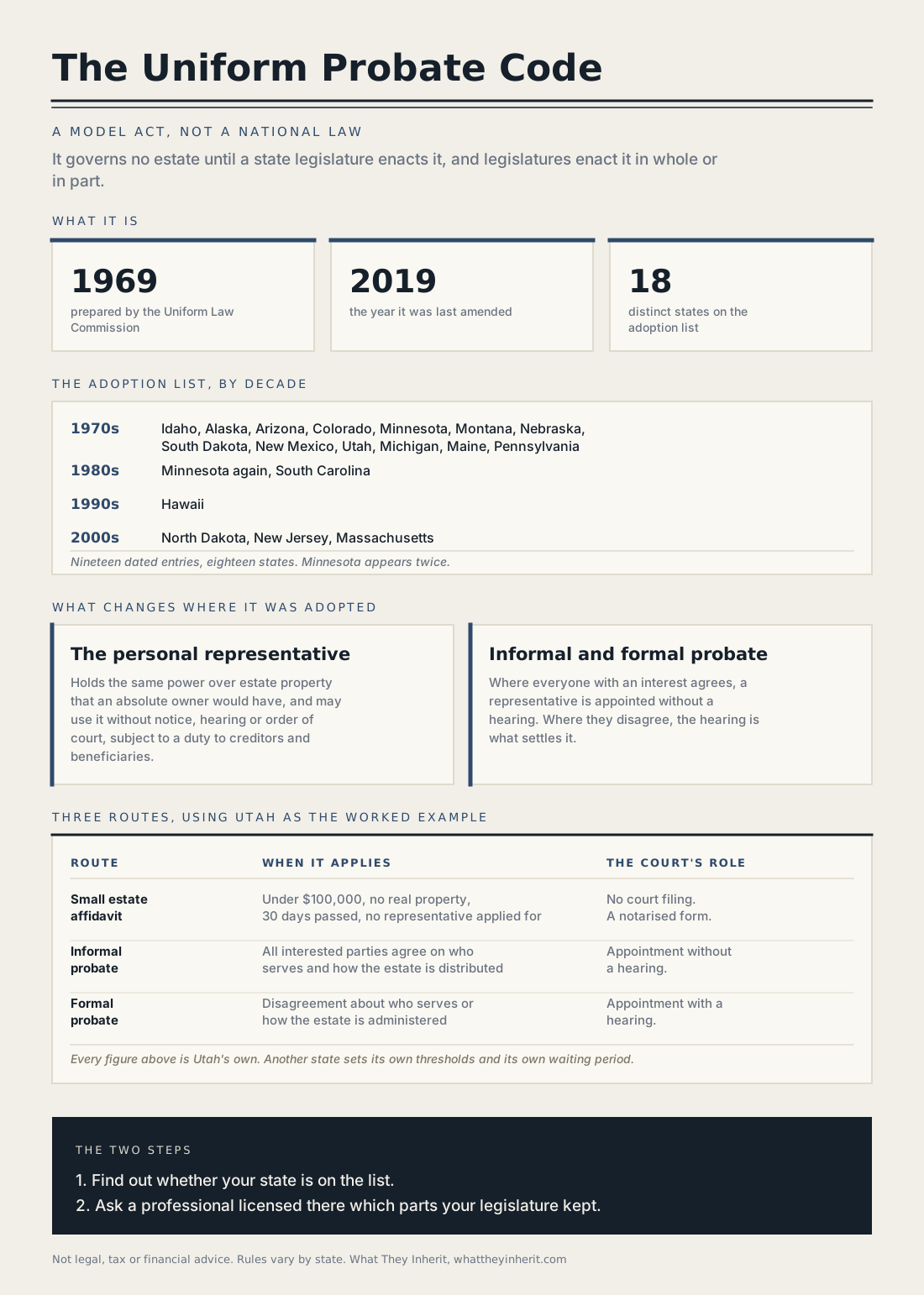
The Uniform Probate Code is a model law. The Uniform Law Commission prepared it in 1969 and last amended it in 2019, and on its own it governs no estate, binds no court and applies to nobody. It becomes law only where a state legislature passes it, and the Legal Information Institute's own phrasing for what states have done is that they have enacted it "in whole or in part".
Those four words carry the whole answer. There is no national probate law in the United States sitting behind your state's rules, waiting to be consulted. There is a drafting committee's recommendation, adopted by some states, ignored by others, and edited by nearly everyone who took it.
So the useful question is never what the Uniform Probate Code says. It is whether your state took it, and which parts survived the trip through that state's legislature.
Each of those figures undercuts the assumption that brought most readers here. The text is unsettled, the reach is wide wherever it applies, and fewer than half the states are on the list at all.
What a model act is, and why that word matters more than the contents
A statute is law because a legislature enacted it. A model act is a draft written by people who do not sit in any legislature, published in the hope that legislatures will pick it up.
The Uniform Law Commission, also known as the National Conference of Commissioners on Uniform State Laws, drafts model legislation that state legislatures are free to adopt, amend or ignore. That is a supply role. The demand side is fifty separate legislatures, each of which can take the draft whole, take a chapter, take a chapter and rewrite it, or decline.
The Legal Information Institute's entry on the code describes it as a comprehensive set of standard rules that the Commission has approved and recommended for enactment in all states. Recommended is the operative word. Recommendation is not adoption, and adoption is not adoption in full.
This is why a page that answers "what does the Uniform Probate Code say about X" is usually answering a question the reader did not need. What they needed was whether X is true where they live, and the code cannot tell them that.
The adoption list, and the honest way to read it
Here is the Institute's list of states that have enacted the code in whole or in part, with the years it records.
| Decade | States and the years recorded | What the clustering suggests |
|---|---|---|
| 1970s | Idaho 1971, Alaska 1972, Arizona 1973, Colorado 1974, Minnesota 1974, Montana 1974, Nebraska 1974, South Dakota 1974, New Mexico 1975, Utah 1975, Michigan 1978, Maine 1979, Pennsylvania 1979 | Thirteen of the entries land within a decade of publication, most of them in the mountain west and upper midwest |
| 1980s | Minnesota 1985, South Carolina 1986 | Minnesota's second appearance is the visible trace of a state revisiting what it took the first time |
| 1990s | Hawaii 1996 | A single entry across the decade |
| 2000s | North Dakota 1999 sits at the edge, then New Jersey 2004, Massachusetts 2009 | Adoption continues, slowly, three decades after the code was written |
That table supports two observations. Minnesota's second appearance reflects a state returning to the code eleven years after its first pass, which shows that a legislature can take a model act in stages.
The more important observation is that being on the list tells you almost nothing about how much of the code a state kept. Idaho in 1971 and Massachusetts in 2009 are both on it. They were enacting a document that had been amended repeatedly in between, into legislatures with their own existing probate law and their own drafting habits. The list only records that a legislature acted. It says nothing about how much of the text survived that legislature's edits.
What actually changes where the code was adopted
Two provisions change what settling an estate actually feels like, beyond the vocabulary used to describe it.
The first is the standing of the person put in charge. A personal representative is whoever the court appoints to administer the estate, whether that is the executor named in a will or an administrator appointed where no will named one, and the Institute notes that courts use those terms interchangeably. Under the code, in the Institute's account, "a personal representative has the same power over the title to property of the estate that an absolute owner would have", while holding that property in trust for "the benefit of the creditors and others interested in the estate". The sentence that follows is the one families feel: that power may be exercised without notice, hearing, or order of court.
Read the practical version of that. Selling the house, settling an account, dealing with a vehicle: those become acts the representative can perform, subject to the duty owed to creditors and beneficiaries. Elsewhere each one is an application a court has to grant. That is a design choice about where the friction sits, and it is why probate under an adopted code is often described as lighter.
The second is what the code does to the surviving spouse's protected minimum. The elective share, also called the spousal share, statutory share or forced share, exists to stop a spouse being disinherited, and it operates in separate property states rather than community property ones. Traditionally it hands the survivor a fixed fraction, usually one third of the estate, regardless of how long the marriage lasted. The code departs from that, and the Institute puts it carefully: it provides a more complicated scheme for determining the elective share. What that scheme produces in any given marriage is a question for the statute your state actually enacted, and this page does not have that number for you.
Informal and formal probate, which is the part you will notice
The clearest place to see the code at work is the split between two ways of opening an estate. Utah, which the Institute's list dates to 1975, codifies its probate law as Title 75, and its courts describe the two routes in plain terms.
The Utah state courts' guidance on informal probate defines informal probate as asking the court to appoint a personal representative without a hearing, used when all interested parties agree about who should be appointed and how the estate should be distributed. Formal probate is the same request with a hearing, used when there is disagreement about who should serve or how the estate should be administered and the parties need the court to decide.
That distinction is worth holding on to, because it reframes what probate costs. The hearing exists to resolve disagreement, and where everyone agrees it never has to happen. An adopted code offers a route around it, and the fights that push an estate into the formal route are the same fights that make everything else about a death slower.
Utah also publishes its own thresholds, and they are Utah's alone rather than a national rule. Probate is required there if the estate includes real property of any value, or if assets other than land and not counting cars have a net worth above $100,000. Below that, and with no real property, at least thirty days elapsed and no application for a personal representative filed, a successor may collect personal property using a small estate affidavit, which in Utah is not filed with the court at all. The successor completes it, signs before a notary, and hands it to the bank or other third party holding the asset.
| Route | When it applies in Utah | What it involves |
|---|---|---|
| Small estate affidavit | Estate under $100,000, no real property, 30 days since the death, no application for a personal representative filed | A notarised form given directly to the third party holding the asset, with no court filing |
| Informal probate | Interested parties agree on who serves and how the estate is distributed | Appointment of a personal representative without a hearing |
| Formal probate | Disagreement about who should serve or how the estate is administered | Appointment with a hearing, and the court deciding the contested points |
Every figure and condition in that table is Utah's. Another state on the adoption list will have its own numbers, its own waiting period, and its own view of whether the affidavit touches a court. The thresholds have to be looked up where you live.
What this means for the document you are actually writing
If you arrived here while writing a will, the code is background reading. What it changes is largely the administration that follows a death, which sits downstream of the drafting. The four jobs a will has to do do not change with your state's position on a model act, and neither does the test for whether a short document is safe for your estate.
Three conclusions follow from it.
Your state's rules are the only ones that bind you. The model does not bind you, and neither does a general article written about it. Where a page states a rule without naming a jurisdiction, treat it as background.
Adoption is a matter of degree, so the list only starts the enquiry. A state on the list may have kept a chapter and rewritten the rest. Whether the provision you care about survived is a question about your state's statute.
The default underneath everything is intestacy, and it is a state default. Dying without a will means the estate goes through probate court and the state's intestacy rules decide who takes, with the takers typically being relatives who survived the decedent. What arrives when a parent dies without a plan is decided by that default, and the code's influence on it depends entirely on whether your legislature enacted that part.
The federal layer sits separately and reaches very few families. The Internal Revenue Service publishes an estate tax filing threshold by year of death, set at $15,000,000 for deaths in 2026, below which a federal return is generally not required. That figure answers the federal tax question and touches none of the procedural questions above.
One step does not depend on any of this. Whoever ends up administering your estate has to be able to find the documents, and the National Institute on Aging's checklist on getting your affairs in order asks readers to gather the legal paperwork into a single location, make sure a trusted person could reach it, and revisit the plan yearly and on any major change rather than waiting for an anniversary. Authority to act without a court order, which is what an adopted code hands a personal representative, is worth very little to someone who cannot locate the will.
The model and the law are different objects
The search that brings people here usually assumes a single national rulebook exists and just needs looking up. It does not. What exists is a well-drafted proposal from 1969, revised through 2019, that eighteen states have taken up to some degree and that the rest have left alone.
Where it was adopted, it tends to hand the personal representative real authority to act without returning to court, and it offers a route through probate that a family in agreement can use without a hearing. Where it was not, none of that applies, and reading about it will mislead you about your own position. The useful work sits in the wider set of instruments this fits into, and in a conversation with somebody licensed where you live.
Last reviewed by the What They Inherit Editorial Team on September 10, 2026. Our sourcing and AI use rules are public on the editorial standards page. This is general editorial content and not legal, tax or financial advice. Whether the Uniform Probate Code applies to you at all, which provisions your legislature enacted, the thresholds for small estate procedures and the calculation of any spousal elective share are all set at state level and vary. Speak to a qualified professional licensed where you live before acting on anything here.
FAQ
What is the Uniform Probate Code?
It is a set of model rules for wills, intestacy, estate administration, non-testamentary transfers and guardianship, prepared by the Uniform Law Commission in 1969 and last amended in 2019. The Legal Information Institute describes it as a comprehensive set of standard rules the Commission approved and recommended for enactment in all states. Recommended is the important word. The code is a draft offered to legislatures. It reaches an estate only through a state statute that adopted it.
Is the Uniform Probate Code federal law?
No. There is no federal probate law governing who inherits or how an estate is settled. Probate is state law, and the code is a model that state legislatures may enact, edit or ignore. The one genuinely federal layer touching estates is tax, and even that reaches very few families: the Internal Revenue Service sets a filing threshold by year of death, at $15,000,000 for deaths in 2026, below which a return is generally not required.
Which states have adopted the Uniform Probate Code?
The Legal Information Institute's list names Idaho, Alaska, Arizona, Colorado, Minnesota, Montana, Nebraska, South Dakota, New Mexico, Utah, Michigan, Maine, Pennsylvania, South Carolina, Hawaii, North Dakota, New Jersey and Massachusetts, with years running from 1971 to 2009. That is eighteen distinct states across nineteen dated entries, Minnesota appearing twice. The Institute's own wording is that these states enacted the code "in whole or in part", so appearing on the list does not establish that any particular provision is in force there.
What does "in whole or in part" mean in practice?
It means a legislature is free to take the parts it wants. A state may adopt the administration chapters and keep its existing intestacy rules, or adopt broadly and rewrite the provisions that conflict with its own law. The consequence for a reader is that you cannot reason from the model to your position. Confirming that your state is on the list is the first step, and confirming that the specific provision you care about survived enactment is a separate one that needs someone looking at your state's statute.
How is informal probate different from formal probate?
Informal probate asks the court to appoint a personal representative without a hearing, and it is the route used when everyone with an interest agrees on who should serve and how the estate should be distributed. Formal probate is the same appointment with a hearing, used where there is disagreement about either question and the parties need the court to decide. The Utah state courts set out both in those terms. So the hearing is what a dispute costs. Families who agree do not pay it.
What power does a personal representative have under the code?
Considerable, and exercisable without going back to court each time. The Legal Information Institute records that under the code a personal representative has the same power over the title to estate property that an absolute owner would have, holding it in trust for the benefit of creditors and others interested in the estate, and that this power may be exercised without notice, hearing, or order of court. Selling or leasing property, for instance, falls inside it. The duty owed to creditors and beneficiaries is the constraint, and no court permission is required act by act.
Does the code change what a surviving spouse is entitled to?
It changes how the figure is worked out. The elective share, also called the spousal share or forced share, exists in separate property states to prevent a spouse being disinherited, and traditionally gives the survivor a fixed fraction, usually one third of the estate, regardless of the length of the marriage. The Legal Information Institute says the code provides a more complicated scheme for determining that share. What it produces in a specific marriage depends on the statute the state actually enacted, and it is a question for a professional licensed there.
If my state has not adopted it, what governs my estate?
Your state's own probate statutes, which existed before the code and continue whether or not the legislature ever looked at it. Every state has rules for executing a will, for appointing whoever administers the estate, and for who inherits when there is no will. Intestacy is the default underneath all of it: dying without a will sends the estate through probate court, where the state's intestacy rules decide who takes, and the takers are typically relatives who survived. A state that never adopted the code still has a full set of probate statutes governing the same events.
Do I need to know any of this to write a will?
Not to draft one. What the code mostly governs is the administration that happens after a death, which sits downstream of the document. The jobs a will has to do and the formalities for signing it are set by your state regardless. Where it becomes worth raising is with whoever drafts the document, as one question: whether this state adopted the code, and whether anything in it changes how you should name the person who will administer the estate.
Sources
- Legal Information Institute's entry on the code (law.cornell.edu)
- personal representative (law.cornell.edu)
- elective share (law.cornell.edu)
- informal probate (utcourts.gov)
- estate tax filing threshold by year of death (irs.gov)
- getting your affairs in order (nia.nih.gov)