Inheritance From Parents: What Arrives
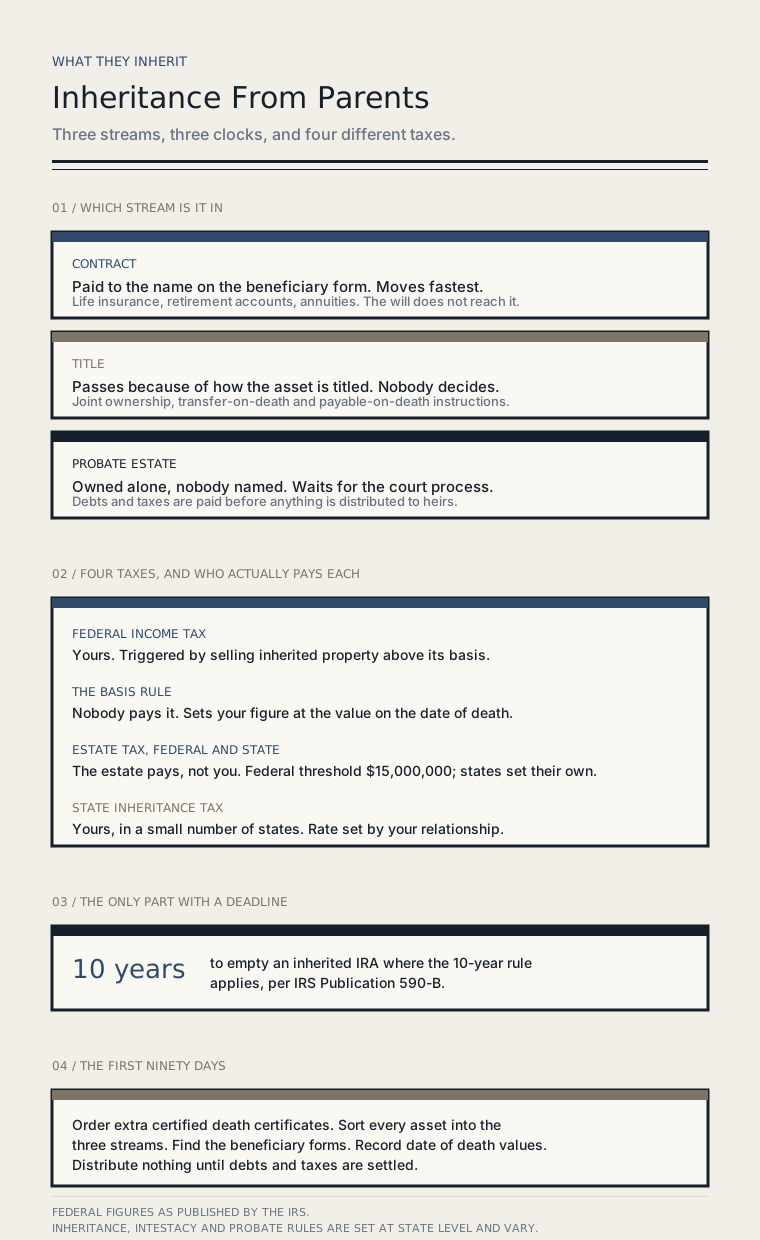
Only one of the three ways an inheritance from parents arrives waits for the will to be read. Money paid under a beneficiary designation moves first, under the contract, to whoever is named on a form the company holds. Property held jointly, or carrying a transfer-on-death instruction, moves next, because the title itself already says who receives it. Everything else waits for probate.
A recurring source of argument between adult children in the months after a parent dies is disagreement about which of those three an asset was in. Once you know which one a thing sits in, you know when it arrives, who controls it, and which tax question attaches to it.
The three streams, and which one your inheritance is in
Stream one is contract. Life insurance, retirement accounts, annuities and any account carrying a named beneficiary pay under the terms of the contract, to the person written on the form the company holds. A will does not reach these. If the form is out of date, the form generally still wins, because nothing updates it automatically. This catches families off guard in the weeks after a death, and it is why the beneficiary form on a parent's life insurance policy outranks the will in the ordinary case. Whether an out of date form can ever be set aside, for instance where a named ex-spouse stayed on it after a divorce, depends on the type of account and on which law governs it. Ask the company holding the policy, and a professional licensed where your parent lived, rather than assuming it either way.
Stream two is operation of law. Property held in joint tenancy with a right of survivorship, or an account carrying a transfer-on-death or payable-on-death instruction, passes to the survivor because of how the asset is titled. Nobody decides anything, because the paperwork already did.
Stream three is the probate estate. Everything a parent owned in their own name alone with nobody named to receive it. Cornell Law School's Legal Information Institute describes probate as the judicial process by which a court proves a testamentary document is a valid will, and also as the broader court proceedings that supervise the administration of a deceased person's estate, which includes collecting assets, paying debts and taxes, and distributing property to heirs or beneficiaries under court supervision. That sequence matters to an heir. Debts and taxes are settled before anything is distributed, so the number in the estate is not the number that reaches you. Sorting a parent's assets this way is also the clearest single view you will get of everything a completed estate plan has to cover.
What an inheritance from parents is actually taxed as
Four different taxes get collapsed into one question, and they are asking four different things of four different people.
Federal income tax on what you later sell. The Internal Revenue Service states that, generally, the gross proceeds from the sale of inherited property are included in gross income when considering the need to file, and that to work out whether the sale is taxable you must first determine your basis in the property. So the tax question attaches to the sale, and the basis decides how much of it is a gain.
The basis rule, which is the one that quietly saves families the most money. Under 26 U.S. Code section 1014, the basis of property in the hands of a person acquiring it from a decedent is the fair market value of the property at the date of the decedent's death, with alternative valuations available under certain elections. The IRS says the same thing in plainer words on its gifts and inheritances page, which gives the basis of inherited property as the fair market value on the date of the decedent's death whether or not the executor files an estate tax return. Basis means the figure your gain is measured from. In practice this means the decades of growth your parents saw in a house or a share portfolio are not taxed to you as gain, because your starting figure is the value on the day they died rather than the price they originally paid. Sell soon after the death and the gain is often close to nothing. Hold it for many years and the growth from that new starting figure is yours.
Federal estate tax, which is not your tax. The estate tax is levied on the estate and filed by the executor, not by the heir. The IRS publishes a filing threshold by year of death, which is $15,000,000 for a 2026 death, up from $13,990,000 for 2025. Below that figure no federal estate tax return is required, and it is worth naming plainly that a lot of anxious reading online concerns a federal tax which will not touch the reader.
State estate tax, which is the layer people skip because the federal number reassured them. A state can levy its own estate tax, paid by the estate exactly as the federal one is, at a threshold that state sets independently. Oregon publishes one example: the Oregon Department of Revenue requires an Oregon estate transfer tax return where the total value of all estate assets was $1 million or more when the person died and the estate contained property taxable by Oregon. That is a threshold fifteen times below the federal one, and an ordinary house plus retirement accounts can reach it. Being under $15,000,000 answers the federal question and answers nothing at the state level. Which state matters is the state where your parent lived, and confirming it is a job for the executor or an attorney licensed there.
State inheritance tax, which is a different instrument entirely and is your tax. A small number of states levy an inheritance tax on the person receiving, at a rate set by their relationship to the person who died. Pennsylvania publishes its rates: the Pennsylvania Department of Revenue states 0 percent on transfers to a surviving spouse or to a parent from a child aged 21 or younger, 4.5 percent on transfers to direct descendants and lineal heirs, 12 percent on transfers to siblings, and 15 percent on transfers to other heirs, with exceptions for charitable organisations, exempt institutions and exempt government entities. That is one state. Look up the state where your parent actually lived, because that is the state whose rule applies, and it may not be yours.
| The tax | Who pays it | What triggers it | Where the rule lives |
|---|---|---|---|
| Federal income tax | The heir | Selling inherited property for more than its basis | IRS gifts and inheritances guidance |
| Basis rule | Nobody, it sets the starting figure | Death of the owner | 26 U.S. Code section 1014 |
| Federal estate tax | The estate, filed by the executor | Estate value above the federal threshold for the year of death | IRS estate tax filing thresholds |
| State estate tax | The estate, filed by the executor | Estate value above a threshold the state sets on its own, which can be far lower | The revenue department of the state where the parent lived |
| State inheritance tax | The heir | Receiving, at a rate set by relationship | The revenue department of the state where the parent lived |
The rows that get confused are the two in the middle, because both carry the word estate and only one of them is federal. A state estate tax is paid by the estate, exactly like the federal version, at a threshold the state chose for itself. A state inheritance tax is paid by you, at a rate set by how you were related to the person who died. A single death can trigger both, one, or neither, and the federal figure predicts none of it.
The one part of an inheritance that has a deadline
An inherited retirement account is the piece of an inheritance most likely to arrive with a clock attached, and missing the deadline costs money.
IRS Publication 590-B sets out the 10-year rule: it requires IRA beneficiaries who are not taking life expectancy payments to withdraw the entire balance of the IRA by 31 December of the year containing the tenth anniversary of the owner's death. The publication gives its own example, that an owner who died in 2025 leaves a beneficiary who must fully distribute the IRA by 31 December 2035. The rule applies where the beneficiary is a designated beneficiary who is not an eligible designated beneficiary, and in certain cases where an eligible designated beneficiary elects it. The same publication warns that anything left in the IRA after that date is subject to an excise tax, which is a penalty charged on the amount that should have been withdrawn.
Two consequences follow, and neither is obvious.
The first is that ten years is a planning window, not a grace period. Every dollar you take out of an inherited traditional IRA is generally taxable in the year you take it. Emptying it in one go in year ten can push a decade of deferred tax into a single tax year. Spreading it deliberately across the window is a conversation for a tax professional, and it is worth having in year one rather than year nine. Tax taken at the wrong moment is one of the quiet mechanisms behind family money thinning out across generations.
The second is that the deadline depends on which category of beneficiary you are, and the categories are defined rather than intuitive. Publication 590-B states that an IRA beneficiary is an eligible designated beneficiary if the beneficiary is the owner's surviving spouse, the owner's minor child, a disabled individual, a chronically ill individual, or any other individual who is not more than 10 years younger than the IRA owner. A named individual who fits none of those is a designated beneficiary, and the hard ten-year deadline is written for that second group. Do not assume you are on the ten-year clock merely because you are named on the account. Confirm which category you are in, with a tax professional, before you make any withdrawal decision.
The house
The family home is often the largest single item, and the disagreement about it is often about timing rather than money.
The basis rule above is what makes an early sale relatively clean. Your starting figure is the fair market value at the date of death, so a sale in the months afterwards often produces little or no taxable gain. That is a genuine advantage of selling early, and it should be stated as such rather than hidden, because the family member who wants to keep the house is rarely the one who does the tax reading.
The counterweight is that a house is not only an asset. It is the last place your parents lived, and one sibling may feel that more sharply than the others. The honest version of this conversation puts the tax position and the feeling on the table at the same time and does not pretend either is the whole picture. Where the house sits inside a bigger structure, or a trust or a mortgage carrying other names is involved, the mechanics change enough that reading is not a substitute for asking. How a family trust holds property on behalf of the people it names is a useful starting point, and an attorney licensed in the state where the property sits is the person to speak to before anybody signs.
When a parent died without a will
If there is no valid will, the state decides. Cornell's Legal Information Institute describes intestate succession as the legal process that applies when someone dies without leaving a valid will, with the distribution of assets determined by the laws of intestacy in the state where the person died. Those laws establish an order of priority, typically giving a surviving spouse and children priority, followed by other close relatives such as parents and siblings, and where there are no surviving relatives the assets may escheat to the state, meaning ownership passes to the state permanently. The Institute is explicit that these rules vary widely from state to state and change over time.
What that means practically is that the outcome is a formula, not a judgement about what your parent would have wanted. Nothing in the intestacy rules accounts for the child who moved home to provide care, or for the estrangement nobody talked about. Those are exactly the situations that produce painful disputes, and the only reliable prevention is a will written while everyone is still here to explain it.
The first ninety days
A large share of the friction in an inheritance shows up in the first three months, and much of it is administrative rather than financial.
| Do this | Why it matters |
|---|---|
| Order more certified death certificates than you think you need | Every institution wants its own, and reordering adds weeks |
| List every account and label it contract, title or probate | This is the sorting that answers the timing question for everything else |
| Find the beneficiary forms before assuming the will controls | The forms outrank the will and are held by the companies, not the family |
| Do not distribute anything before debts and taxes are settled | Probate pays creditors and taxes first, and an early distribution can be clawed back |
| Note the date of death value of every significant asset | It becomes the basis figure, and reconstructing it later is difficult |
| Confirm which deadline applies to any inherited retirement account, then diary it | The ten-year rule does not cover every beneficiary type, and the wrong date in your head is worse than none |
| Say out loud who wants the house before anybody prices it | The argument you avoid is worth more than the price you optimise |
| Write down the reasoning, not just the amounts | A probate file records who received what and nothing about why, and that gap has a document of its own |
Keep that list with the rest of the paperwork rather than in your head, and tell one sibling where it is.
Last reviewed by the What They Inherit Editorial Team on September 3, 2026. Our sourcing and AI-use rules are public on the editorial standards page. This is general editorial content and not legal, tax or financial advice. Inheritance tax, intestacy and probate rules are set at state level and vary. Speak to a qualified professional licensed in your own jurisdiction before acting on anything here.
FAQ
Do I have to pay tax on an inheritance from my parents?
It depends which tax you mean, because more than one can be involved. Federal estate tax is paid by the estate rather than by you, and the IRS filing threshold is $15,000,000 for a 2026 death, so estates under that figure do not file federally. Separately, a state can levy its own estate tax, also paid by the estate, at a threshold it sets on its own. Oregon, for one, requires a return where estate assets reached $1 million. Being nowhere near $15,000,000 therefore does not by itself mean no estate tax applies. Federal income tax generally attaches when you later sell inherited property for more than its basis, not at the moment you receive it. A small number of states levy an inheritance tax on the recipient, at a rate set by your relationship to the person who died, and that one is yours to pay. Which state matters is the state where your parent lived. Check it with a professional licensed there.
What is inheritance tax?
Inheritance tax is a state tax paid by the person receiving, at a rate set by their relationship to the person who died. That is what separates it from estate tax, which is paid by the estate and filed by the executor. Only a small number of states levy one. Pennsylvania publishes its rates as an example: 0 percent on transfers to a surviving spouse or to a parent from a child aged 21 or younger, 4.5 percent to direct descendants and lineal heirs, 12 percent to siblings, and 15 percent to other heirs, with exceptions for charitable organisations, exempt institutions and exempt government entities. The state whose rule applies is the state where your parent actually lived, which may not be yours, so check that state's position with a professional licensed there.
How long does it take to receive an inheritance from a parent?
There is no single answer because the three streams run at different speeds. Money paid under a beneficiary designation is a contract payment and normally moves fastest, because it needs a death certificate and a claim form rather than a court. Jointly held property and transfer-on-death accounts pass by how the asset is titled. Anything in the probate estate waits for the court process, which collects assets and pays debts and taxes before distributing anything. Anyone who gives you a fixed number without asking which stream your inheritance is in is guessing.
What is the step-up in basis?
Basis is the figure a taxable gain is measured from. Under 26 U.S. Code section 1014, the basis of property acquired from a decedent is generally the fair market value at the date of death, with alternative valuations available under certain elections. So if your parents bought a house decades ago and it rose substantially in value, your starting figure is what it was worth on the day they died rather than what they paid. That growth is not taxed to you as a gain. Only the change in value after the death is.
Does my parent's will control their life insurance and retirement accounts?
Generally not. Those are contract payments that go to whoever is named on the beneficiary form the company holds, and the will does not override that form. This is why an out of date form causes so much damage: it directs real money to a person the family assumed had been removed years ago. Ask each company what name it holds rather than assuming the will settles it.
What is the 10-year rule on an inherited IRA?
IRS Publication 590-B states that the 10-year rule requires IRA beneficiaries who are not taking life expectancy payments to withdraw the entire balance by 31 December of the year containing the tenth anniversary of the owner's death. The publication's own example is an owner who died in 2025, leaving a beneficiary who must fully distribute by 31 December 2035. It applies to a designated beneficiary who is not an eligible designated beneficiary, and in some cases where an eligible designated beneficiary elects it. The publication defines an eligible designated beneficiary as the owner's surviving spouse, the owner's minor child, a disabled individual, a chronically ill individual, or any other individual not more than 10 years younger than the owner. Amounts left after the deadline are subject to an excise tax, a penalty on what should have been withdrawn. The definitions decide the outcome, so confirm which category you are in before withdrawing anything.
What happens if my parent died without a will?
State intestacy law decides. Cornell's Legal Information Institute explains that the distribution is then determined by the laws of the state where the person died, which set an order of priority that typically puts a surviving spouse and children first, followed by close relatives such as parents and siblings, and that assets may escheat to the state where there are no surviving relatives. The rules vary widely between states. The formula does not account for care given, promises made or anything anybody remembers being said.
Do I have to sell an inherited house?
Not as a matter of law, and the decision usually turns on two separate things. The tax side is that your basis is the value at the date of death, so selling soon after often produces little or no taxable gain, and that advantage narrows the longer you hold. The other side is what the house means to whoever wants to keep it. Where a mortgage, a trust or joint ownership is involved the mechanics change, and that is a conversation for an attorney licensed in the state where the property sits.
Can my siblings and I be made to split everything equally?
Equal is not the default, the document is. A valid will distributes according to its own terms, beneficiary forms pay whoever is named, jointly titled property passes to the surviving owner, and only where there is no will does state intestacy law apply its own formula. Any of those can produce an unequal result that is entirely valid. Disagreeing with the outcome and having grounds to challenge it are different things, and the second is a question for a lawyer.
What is the single most useful thing to do in the first month?
Sort every asset into the three streams: paid by contract to a named beneficiary, passing by how it is titled, or falling into the probate estate. It takes an afternoon, needs no professional, and answers most of the questions the family is about to argue about, including what arrives when and who actually controls it. Do that before anybody discusses who gets what.
What does intestate mean?
Intestate describes an estate left by someone who died without a valid will. The word names a condition rather than a document. There is nothing to read, so the state supplies a formula in place of instructions that were never written, and that formula runs on relationship alone rather than on anything anybody remembers being said. The point most often missed is the limit of its reach. Intestacy governs only what falls into the probate estate. An account with a named beneficiary still pays out under its own contract, and an asset whose title already records who receives it still passes that way, will or no will. So a parent dying intestate does not put everything they owned in front of the same rule, and the first useful question remains which of the three routes above a particular asset was travelling on.
Sources
- probate (law.cornell.edu)
- the gross proceeds from the sale of inherited property (irs.gov)
- 26 U.S. Code section 1014 (law.cornell.edu)
- filing threshold by year of death (irs.gov)
- Oregon Department of Revenue (oregon.gov)
- Pennsylvania Department of Revenue (pa.gov)
- 10-year rule (irs.gov)
- intestate succession (law.cornell.edu)