Charitable Gift Annuities: Part Gift, Part Purchase, and the Residue Belongs to the Charity
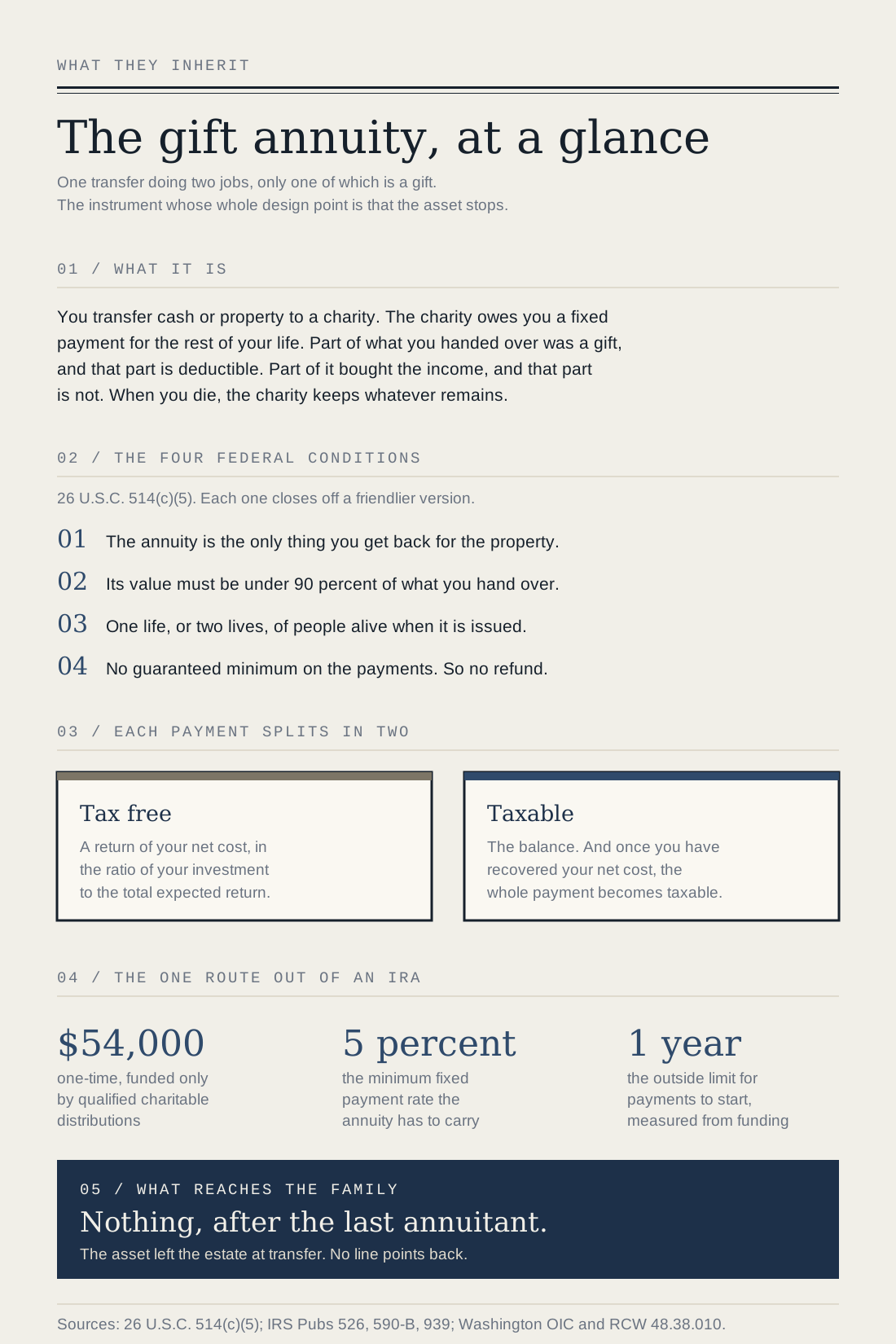
A charitable gift annuity is one transaction doing two jobs. You transfer cash or property to a charity, the charity takes on a contractual obligation to pay you a fixed amount for the rest of your life, and when you die the charity keeps whatever remains. Part of what you handed over was a gift. Part of it bought an income stream. The two parts are taxed differently, and only the gift part is deductible.
That last clause is the whole of the confusion. People describe a gift annuity as a donation, and it is not only a donation. They describe it as an annuity, and it is not the annuity an insurance company sells either. It sits between the two, and the parts of it that matter to a family are the parts that belong to neither description.
What a charitable gift annuity actually is
The Washington State Office of the Insurance Commissioner describes the arrangement plainly on its page for charitable gift annuities: donors agree to make a gift to the charity they want to support, the charity pays a fixed amount of income for the remainder of the donor's life, and when the donor passes away the charity keeps the remainder of the donor's gift of money or property.
Read the last clause of that on its own. The charity keeps the remainder. Not a share of it, not the growth on it, the remainder. There is no version of a gift annuity in which the unused balance returns to your estate.
That makes it the opposite instrument to most of what this publication covers. A will moves assets to people. A trust holds assets for people. A beneficiary form names a person. A gift annuity is the one arrangement in the ordinary estate toolkit whose entire design point is that the asset stops with an institution.
The two halves, and why only one of them is a gift
The reason a gift annuity is deductible at all is that you deliberately hand over more than the income stream is worth. Federal law fixes how much more.
Section 514 of the Internal Revenue Code, which governs when a nonprofit's borrowings taint its investment income, carves gift annuities out of the definition of acquisition indebtedness. The conditions sit at subsection (c)(5), and the Legal Information Institute's text of 26 U.S.C. 514 states the first of them as an annuity that "is the sole consideration (other than a mortgage to which paragraph (2)(B) applies) issued in exchange for property if, at the time of the exchange, the value of the annuity is less than 90 percent of the value of the property received in the exchange".
That 90 percent figure is the hinge. At least a tenth of what you transfer has to be, by construction, a completed gift rather than a purchase. The deduction follows that gift portion. It does not follow the whole transfer, and a charity that tells you otherwise is describing a different transaction. How far below the ceiling any particular charity prices is a question for that charity, and the rate it offers is the number to ask for rather than assume.
The same subsection sets three more conditions, and each one closes off a way the arrangement could have been made more favourable to you.
| The statutory condition | What it rules out |
|---|---|
| The annuity is "the sole consideration" issued in exchange for the property, per subsection (c)(5)(A) | Being paid partly in cash and partly in annuity payments |
| Its value is "less than 90 percent of the value of the property received in the exchange", per subsection (c)(5)(A) | Buying an income stream and calling the whole transfer a gift |
| It is "payable over the life of one individual in being at the time the annuity is issued, or over the lives of two individuals in being at such time", per subsection (c)(5)(B) | A term of years, a third life added later, or payments to a class of people |
| The contract "does not guarantee a minimum amount of payments or specify a maximum amount of payments" and does not adjust payments "by reference to the income received from the transferred property or any other property", per subsection (c)(5)(C) | A refund of unused principal to your estate, or payments that rise when the charity's investments do |
The third row is the one families ask about after the fact. Two lives are permitted. One life is permitted. The lives have to be in being when the annuity is issued, which is to say real people alive on the day. There is no mechanism for adding a grandchild born afterwards.
The fourth row is the one that ends the conversation about heirs. A refund of unused principal would require the contract to promise a floor under the total paid out, and a contract carrying that promise fails the condition. So there is no refund feature. If you set up a gift annuity and die eight months later, the payments stop and nothing is returned.
How the payments are taxed, and what changes if you live long enough
Each payment that arrives is not one thing. IRS Publication 939 covers the General Rule for pensions and annuities, and it puts the principle this way: "Generally, each of your monthly annuity payments is made up of two parts: the tax-free part that is a return of your net cost, and the taxable balance."
The size of each part is fixed by a ratio. The publication defines the General Rule as "one of the two methods used to figure the tax-free part of each annuity payment based on the ratio of your investment in the contract to the total expected return". Your investment in the contract and your net cost are the same figure under two names, which matters only because both names appear. Expected return it defines as "the total amount you and other eligible annuitants can expect to receive under the contract", a figure that for a life annuity comes out of actuarial tables rather than out of anything you choose.
Then there is the part that surprises people who plan around the tax-free portion. Publication 939 states that where the annuity starting date falls after 1986, the total that can be excluded across all the years cannot exceed the net cost. The tax-free portion is a recovery of what you put in, and once you have recovered it there is nothing left to recover. Live past the table and the payments carry on at the same dollar amount while becoming fully taxable.
You do not compute that ratio in the dark. Publication 939 carries worksheets for determining the taxable part of an annuity, and it sets out a route for asking the IRS to rule on the exclusion ratio itself, following the guidance in the annual revenue procedure it names. The figure the charity used to price your contract is a fair thing to ask the charity for in writing before you fund anything.
This is not a defect in the arrangement, and it is arguably the point of it. The charity keeps paying for as long as you live. What changes is the tax character of the money, not the amount, and a household budgeting on the after-tax figure should know which year that shift is expected to arrive.
Anyone who has read our note on how giving is taxed across the three mechanisms will recognise the shape of the problem. The mechanism decides the tax treatment, and the tax treatment is rarely what the marketing copy implies.
The one route out of a retirement account, and the 5 percent it carries
There is a specific and narrow route from an individual retirement arrangement into a gift annuity, and it is worth stating precisely because it is easy to overstate.
First, the term the rule is built on. A qualified charitable distribution, in IRS Publication 526, is "a distribution made directly by the trustee of your individual retirement arrangement (IRA), other than an ongoing SEP or SIMPLE IRA, to certain qualified organizations", and the same publication conditions it on having been at least age 70 and a half when the distribution was made. Directly is the operative word. Money that lands in your account first and is written out again is not one.
On that footing, Publication 526 states: "You can elect to make a one-time distribution up to $54,000 from an individual retirement arrangement to charities through a charitable remainder annuity trust, a charitable remainder unitrust, or a charitable gift annuity if it is funded only by qualified charitable distributions." Publication 590-B calls those three vehicles a split-interest entity, meaning an arrangement in which the income interest and the eventual charitable interest are separated, and it adds the condition specific to the annuity version: "In the case of the charitable gift annuity, the annuity must begin making fixed payments of 5% or greater not later than 1 year from the date of funding."
Four things in that are load-bearing. It is one-time, not annual. The vehicle has to be funded only by qualified charitable distributions, so it cannot be topped up from a taxable account. The payment rate carries a floor rather than a ceiling. And the clock runs from funding, not from some later date you find convenient.
In practice that means asking the custodian to pay the distribution to the charity directly, and asking the charity in advance whether it can issue an annuity funded this way at all, since adding outside money to reach its minimum would break the condition the election depends on.
The dollar figure is indexed and the publications carry more than one year's number in different places, so confirm the amount and the conditions for the year of the distribution rather than relying on a figure read anywhere, including here.
Who is actually on the hook, and what a state makes them prove
A commercial annuity is an obligation of an insurance company. A charitable gift annuity is an obligation of the charity, and that is a different kind of promise.
States treat it as insurance business anyway. Washington requires an organisation that wants to issue gift annuities to apply for a certificate of exemption and to submit annual financial filings, under chapter 48.38 of the Revised Code of Washington. RCW 48.38.010 sets out what the commissioner may grant that certificate on, and the list is more demanding than most donors assume.
| What Washington requires of the charity | Why a donor should care |
|---|---|
| That it "possesses a current tax exempt status under the laws of the United States", per subsection (2) | The deduction depends on the recipient qualifying, not on how the charity describes itself |
| Three years of active operation under the laws of its home state before it may even apply, per subsection (5) | A new organisation cannot start issuing lifetime obligations immediately |
| That it "has and maintains minimum net assets without donor restrictions of $500,000", per subsection (6) | There is a stated floor under the balance sheet that has to pay you |
| An appointment of the insurance commissioner as its attorney for service of process, which the statute makes irrevocable, per subsection (4) | There is a known place to bring a claim, for as long as any contract is in force |
| Submission to periodic examination by the commissioner, per subsection (8) | The supervision is not limited to the paperwork the charity chooses to file |
| An annual report within 60 days of the fiscal year end, carrying a qualified actuary's opinion on annuity reserves, per subsection (10) | Somebody with actuarial standing looks at whether the reserves are adequate, every year |
| Advance approval of any contract form before it may be offered in the state, per subsection (9) | The document you sign has been reviewed before it reaches you |
Those figures and requirements are Washington's. Another state may set a different asset floor, may require a permit rather than a certificate of exemption, or may impose no filing at all. Whether a particular charity is permitted to issue an annuity to a resident of your state is a question with a specific answer, and it is one to put to the charity and to your own state's insurance regulator before signing anything.
What none of this makes the arrangement is risk free. The protection here is a permitting and reporting regime, not a promise that the payments are guaranteed by somebody other than the charity. A donor concerned about the durability of the obligation should ask about the charity's reserve position directly and should treat the answer as a piece of financial due diligence rather than a formality.
What reaches the family
This is the section that belongs to this publication rather than to a tax guide, and the answer is unusually clean.
The asset is gone. It left your estate when the transfer was made, and because the contract cannot guarantee a minimum number of payments, there is no residual claim for anyone to inherit. The income stream is yours for life and, if you set it up over two lives, your co-annuitant's for theirs. After that, nothing.
For some families that is exactly the intention, and stating it plainly is a kindness. A gift annuity is a good fit for a household that has enough, wants a predictable payment, and has already decided that a particular institution rather than the children is the right destination for a specific slice of the money.
The failure mode is not financial. It is a family that finds out afterwards. Children who assumed a property or an account was part of the estate discover, during the worst month of their lives, that it was converted years ago into an income stream that has now stopped. Nothing improper happened. Nobody told them, which is a separate and entirely avoidable problem, and it is the same one that runs underneath most of what actually goes wrong when parents leave money.
Anyone who reads this and decides it fits should go to the charity's planned giving office rather than to a form. That office issues the rate quote for your age and the draft contract, and both of those belong in front of your own attorney and tax adviser before any money moves. Rates and minimum gift sizes are set by each charity rather than by any rule cited here, so there is no figure to bring to the conversation, only questions.
If the intention is to keep an asset working for a charity while still leaving something to the family, the comparison is with a trust rather than with a will. The instruments that can do both are drafted rather than filled in, and how trusts are structured and what they actually do is the starting point for that conversation. If the question is where a gift annuity sits alongside everything else that has to be in order, what an estate plan is actually made of covers the surrounding documents, and the will itself still has to account for the assets that did not go this route.
Last reviewed by the What They Inherit Editorial Team on September 8, 2026. Our sourcing and AI-use rules are public on the editorial standards page. This is general editorial content and not legal, tax or financial advice. Rules described here are federal unless stated, the state requirements cited are Washington's and are not national, and figures indexed for inflation change from year to year. Speak to a qualified professional in your own jurisdiction before acting.
FAQ
Can I change my mind and get the asset back?
No. What you hold after funding is a contractual right to a stream of payments, not a claim on the property, and the charity's duty is to pay rather than to keep anything set aside for you. There is no surrender value and no cancellation clause of the sort a commercial product might carry. That is the reason the arrangement is properly described as a gift first and an income second.
Can my children receive the payments after I die?
Only a person named as the second annuitant when the contract was issued, and only for that person's own lifetime. The federal conditions fix the annuitants at the moment of issue, so a child born later, a child you decide to add later, or a group such as your children collectively cannot be attached to a contract that already exists. If two lives are wanted, they have to be chosen before funding.
Do I get a deduction for the whole amount I hand over?
No. The deductible figure is the amount transferred less the value of the annuity coming back to you, which is a calculation rather than a share you can choose. Ask the charity for that figure in writing at the time of the gift. It is the number that goes on the return, and it is not the size of the cheque.
Are the payments tax free?
Not entirely, and not permanently. Part of each payment is treated as your own money coming back and is not taxed. The rest is. Once the untaxed portion has added up to what you originally put in, that treatment stops and the whole payment is taxable from then on, while the amount arriving in the account stays the same. Ask which year that crossover is expected, because the amount you can actually spend falls in that year even though the payment does not.
What happens if the charity gets into financial trouble?
The promise is the charity's own, standing on its balance sheet rather than on an insurer's. Where a state regulates this business it imposes entry requirements, reserve reporting and examination, and that is supervision rather than a guarantee that the payments continue. The useful question to put to a charity is how it holds and invests the funds behind its annuity obligations and what its current reserve position is, and to weigh the answer the way you would weigh any other counterparty you intend to rely on for decades.
Is a charitable gift annuity the same as a charitable remainder trust?
They are different instruments that IRS Publication 526 lists side by side as split-interest routes for the one-time retirement account election. A gift annuity is a contract with the charity that obliges it to pay a fixed amount. A charitable remainder annuity trust or unitrust is a drafted trust with its own trustee and terms. Which one fits a given situation is a question for an attorney and a tax adviser, not one to settle by comparing payment rates.
Can I fund one from my IRA?
Once, and only through a narrow gate. The route exists for a capped and inflation-indexed one-time amount, it works only where the money passes straight from the IRA custodian to the charity rather than through your hands, and the annuity it creates has to start paying at a stated minimum rate within a year of being funded. Whether your age, your account type and your chosen charity all clear those conditions is a question to settle with the custodian and the charity before the election is made, because it cannot be made a second time.
What is a charitable gift annuity?
A charitable gift annuity is a contract in which you hand a charity cash or property and the charity undertakes to pay you a set sum every year until you die, keeping whatever is left over afterwards. It is neither a straightforward donation nor a commercial annuity. It is one transaction performing both roles, which is why the two halves are taxed under separate rules and why only the portion that qualifies as a gift can be deducted. The part that bought the income cannot. Two features separate it from anything an insurer would sell you. The payment figure never moves, and there is no return of unused principal to your estate if you die early. The promise behind it also belongs to the charity itself rather than to a regulated insurer standing behind it, which makes the charity's own financial strength the thing worth examining before anything is signed.
Sources
- charitable gift annuities (insurance.wa.gov)
- 26 U.S.C. 514 (law.cornell.edu)
- Publication 939 (irs.gov)
- Publication 526 (irs.gov)
- Publication 590-B (irs.gov)
- RCW 48.38.010 (app.leg.wa.gov)