Charitable Giving and What Is Left Over
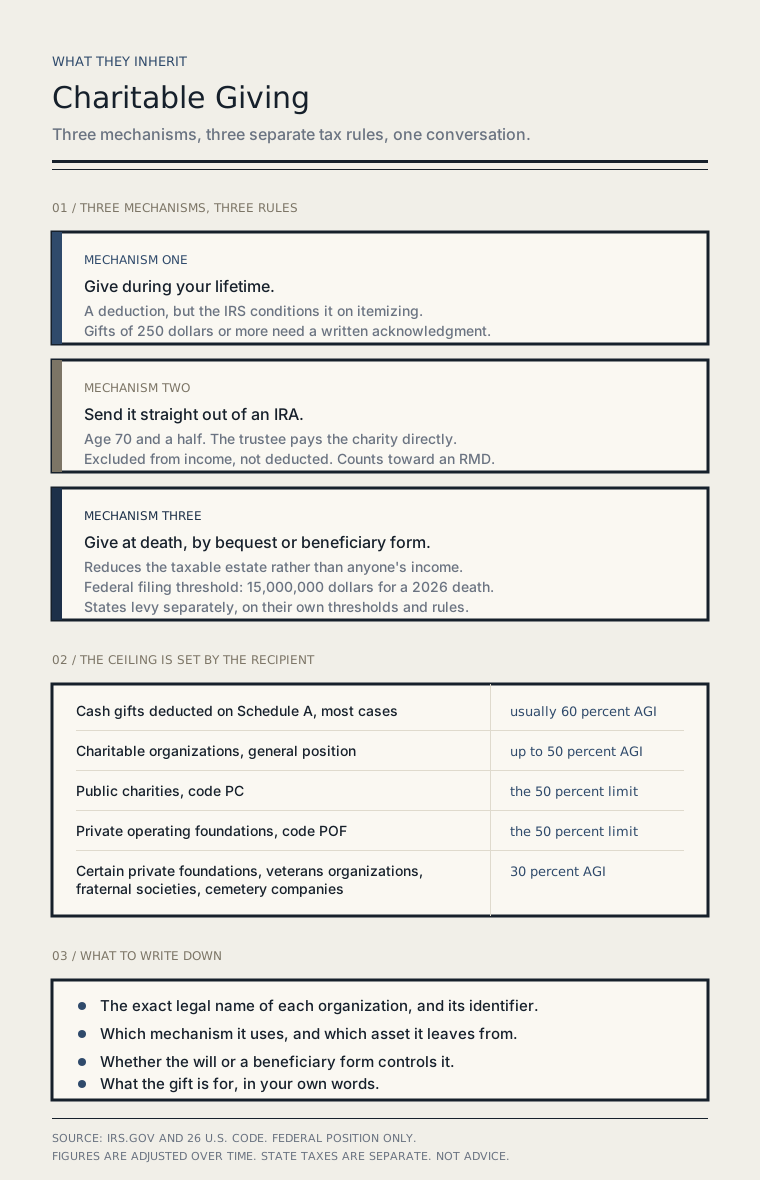
Charitable giving out of family money in the United States runs through three separate mechanisms, and each one is taxed under a different federal rule. You can give during your lifetime and claim a deduction, but only if you itemize, meaning you list your actual deductible expenses on Schedule A rather than taking the fixed standard deduction. You can send money straight out of an IRA to a charity once you are old enough, which is not a deduction at all and works whether you itemize or not. Or you can give at death, through a will, a trust or a beneficiary form, which reduces the taxable estate rather than your income.
The mechanisms are not three routes to the same place. They differ in who gets the tax benefit, in what year, and whether there is any tax benefit at all. There is also a fourth question that no tax rule covers, which is whether the people who expected to inherit the money find out from you or from a lawyer's office.
The gate that comes before any of it
The Internal Revenue Service states that you may deduct charitable contributions of money or property made to qualified organizations if you itemize your deductions. That condition does most of the work in this subject and it is the part people skip.
Read it in the direction that matters at the kitchen table. A household that takes the standard deduction arrives at the same federal income tax result whether it gave nothing that year or gave a great deal. The gift is real and the charity has the money. The deduction is not there, because the deduction only exists inside an itemized return. That gate is a federal income tax rule. Whether a state income tax return treats the same gift differently, including whether a state offers any deduction or credit outside federal itemizing, is set separately by that state, so confirm it there if a state benefit would change the decision. None of that is an argument against giving. It is an argument against budgeting for a tax benefit that the return will never show.
Two mechanical rules sit alongside the gate. The first is timing: contributions must actually be paid, in cash or other property, before the close of your tax year. A pledge is not a payment. The second is proof. Publication 526 states that you can claim a deduction for a contribution of $250 or more only if you have a contemporaneous written acknowledgment of it from the qualified organization, or certain payroll deduction records. A bank statement is not that acknowledgment. Ask the charity for the letter at the time, because a letter written years later is not contemporaneous.
The ceiling is set by the recipient, not by the giver
The second surprise is that the size of the deduction is capped, and the cap depends on what kind of organization received the money rather than on what you intended.
The IRS states more than one ceiling on the same page, and it is worth reading them as written rather than picking the one that sounds best. In most cases, it says, the amount of charitable cash contributions a taxpayer can deduct on Schedule A as an itemized deduction is limited to a percentage of adjusted gross income, usually 60 percent. Separately it states the general position that you may deduct up to 50 percent of adjusted gross income, with 20 percent and 30 percent limitations applying in some cases, and it then sorts those cases by organization type: contributions to certain private foundations, veterans organizations, fraternal societies and cemetery organizations are limited to 30 percent. The page names a 20 percent limitation without setting out where it lands.
So this article cannot tell you which single percentage caps a particular gift, and neither can any article that does not know the recipient's status and the tax year. What it can tell you is where to look. The agency's own Tax Exempt Organization Search carries deductibility status codes that signal which limit applies to a given organization, and Publication 526 is the document that resolves the percentage for a specific contribution. Settle the number there, or with a tax preparer, before relying on it.
| What the IRS states | The limit it attaches |
|---|---|
| Cash contributions deducted on Schedule A, most cases | Usually 60 percent of adjusted gross income |
| Contributions to charitable organizations, general position | Up to 50 percent of adjusted gross income |
| Public charities, code PC | The 50 percent limitation |
| Private operating foundations, code POF | The 50 percent limitation |
| Certain private foundations, veterans organizations, fraternal societies, cemetery organizations | 30 percent of adjusted gross income |
| Amounts above the applicable ceiling | Carry over to the next tax year |
Check the deductibility code before the money moves rather than after, and treat the carryover rule as the safety net it is rather than as a plan.
Gifts of property follow a separate track. The IRS states that if you donate property other than cash you may generally deduct its fair market value, with adjustments where the property has appreciated. That adjustment is where donated shares, land and collections stop being simple, and it is a question for a tax professional before the transfer rather than at filing.
Giving straight out of a retirement account
The second mechanism is easy to miss, because it is not a deduction and so it does not appear anywhere in the itemizing debate above.
IRS Publication 590-B states that a qualified charitable distribution is generally a nontaxable distribution made directly by the trustee of your IRA, other than an ongoing SEP or SIMPLE IRA, to an organization eligible to receive tax deductible contributions. You must be at least age 70 and a half when the distribution is made. The publication states a maximum annual exclusion of $108,000, notes that any amount above that is included in income like any other distribution, and states that a spouse filing a joint return can also have a qualified charitable distribution and exclude up to the same amount. That narrative figure is the one stated for 2025, and the same publication's worked example for 2026 caps qualified charitable distributions for the current year at $111,000 instead. The amount is adjusted year to year, so take the figure for the year the distribution is actually made rather than the one you read first.
Three details decide whether this mechanism fits a particular household.
The money must move directly from the trustee to the charity. A distribution that lands in your bank account first and is then written out as a personal check is a distribution followed by a gift, which is the ordinary route with the ordinary rules, not this one.
You cannot claim a charitable contribution deduction for any qualified charitable distribution that was not included in your income. The publication says so directly. The benefit is exclusion rather than deduction, and you get one or the other, never both.
It counts toward a required minimum distribution, which is the amount an account holder is required to withdraw from a tax deferred retirement account each year once they reach the age at which the rule starts, whether the money is needed or not. Publication 590-B carries the note plainly: a qualified charitable distribution will count towards your required minimum distribution. For an account holder who is required to draw money they do not need, that is the whole point of the mechanism. The amount never enters income, which is why it works for someone who takes the standard deduction and would get nothing from the deduction route.
The same publication also describes a one time election to distribute up to $54,000 from an individual retirement account to charities through a split interest entity, meaning a charitable remainder annuity trust, a charitable remainder unitrust or a charitable gift annuity funded by qualified charitable distributions. Confirm that figure and the conditions attached to it for the year in question before relying on either. Those are drafted instruments rather than forms, and anyone considering one should start with how trusts are structured and what they do, then take the question to a professional. The acknowledgment requirement does not disappear here either. The publication states you must have the same type of acknowledgment you would need to claim a deduction.
Giving at death, and the two routes it can take
The third mechanism reduces the taxable estate rather than anyone's income.
Under 26 U.S. Code section 2055, the value of the taxable estate is determined by deducting from the gross estate the amount of bequests, legacies, devises or transfers to qualifying recipients, including the United States or a State for exclusively public purposes and corporations organized and operated exclusively for religious, charitable, scientific, literary or educational purposes. The IRS states the same thing in plainer language on its estate tax page, where the deductions allowed in arriving at the taxable estate include property that passes to surviving spouses and qualified charities.
The same IRS page sets the federal filing threshold at $15,000,000 for a 2026 death. Below that figure the federal estate tax question generally does not arise, and a charitable bequest changes nothing about federal estate tax because there was no federal estate tax to reduce. The federal layer is only one layer. Individual states levy their own estate and inheritance taxes under their own thresholds and their own treatment of charitable recipients, so whether either bites is a matter for someone licensed where the person actually lived.
Which leaves the honest version for most households: a charitable bequest is a decision about where the money goes, and the tax result is usually not the reason to make it.
There are two routes for the gift itself and they are not interchangeable. The first is a bequest written into the will or the trust, which is administered with everything else. The second is a beneficiary designation on an account, where you name the charity on the form the institution holds. That second route pays under the contract with the institution and is not redirected by the will, which is the same mechanism that makes a beneficiary form outrank the will on life insurance. A will that leaves a percentage to charity does not change a retirement account whose beneficiary form names three children.
Which asset the gift comes out of also has consequences that differ between a charity and a human heir, because a pre tax retirement account and a taxable account do not reach a beneficiary on the same terms. That question belongs with a tax professional rather than a search result. What belongs here is the warning that the choice of asset is a decision and not an administrative detail, and that it should be made deliberately alongside everything else an estate plan has to hold together. The same choice sharpens again where the plan is meant to carry past the children, because a gift that skips a generation meets a separate transfer tax on top of the estate tax.
The fund that holds the gift before the charity sees it
A donor advised fund separates the moment of the deduction from the moment the charity receives anything.
The IRS describes a donor advised fund as a separately identified fund or account maintained and operated by a section 501(c)(3) organization, called the sponsoring organization, with each account composed of contributions from individual donors. The sentence that matters is the next one. Once the donor makes the contribution, the organization has legal control over it. The donor, or the donor's representative, retains advisory privileges over how the funds are distributed and how the assets are invested.
Advisory privileges are not ownership and not a right of recall. The money is gone in the legal sense on the day it goes in, and what remains is influence over where it lands and when. For a household that wants to commit funds in one year and decide the recipients over several, that is precisely the arrangement they are looking for. For a household that thinks of it as a savings account with a tax benefit attached, it is not what they think it is.
The IRS also states on the same page that it is aware of a number of organizations that appeared to have abused the basic concepts underlying donor advised funds, describes them as promoted arrangements set up to generate questionable charitable deductions and impermissible economic benefits, and lists what it may do about them, including disallowing the deductions and imposing excise taxes. Read that as a reason to look closely at a sponsoring organization rather than as a verdict on the structure.
What it costs the people who expected to inherit
Every rule above is a tax rule, and none of them touches the part that actually damages families.
A charitable gift is not neutral to an inheritance. Money given is money not inherited, and the estate tax deduction is a tax outcome rather than a way of making the gift free. A family that has quietly assumed a number for years does not experience a bequest as generosity. It experiences it as a subtraction, and it discovers it only once the person who decided it can no longer be asked a single question.
That timing is the whole problem and it is fixable at no cost. The decision is yours to make. What it requires is that the reasoning survives you. A charitable bequest that arrives with an explanation is a decision the family can disagree with. The same bequest arriving unexplained is a puzzle they will solve with a theory, and a theory built in the dark tends to be about who was favoured rather than about the gift.
A charitable bequest is close to the strongest case there is for writing a letter alongside the paperwork, because no legal document has anywhere to put a reason. Name the gift, name the organization, and say plainly what drew you to it. Told, a family can disagree about a decision. Untold, it is left disagreeing about the person who made it, which is the more corrosive of the two and the version money seldom survives intact. It is also why the values a household can actually name out loud end up carrying more weight than the schedule of assets.
The one page that makes this administrable
Everything above compresses into a single sheet, and it is the sheet that is missing when a family sits down to work out what a parent actually intended.
| Write down | Why it matters |
|---|---|
| The exact legal name of each organization | Charities merge, rename and dissolve, and a wrong name is a contested gift |
| The organization's identifying number | Names are ambiguous, identifiers are not |
| Which mechanism each gift uses | Lifetime gift, IRA distribution and bequest are administered by different people |
| Which account or asset the gift comes from | Determines the tax question and who inherits what is left |
| Where the acknowledgment letters are | Without them the deduction is not claimable |
| Whether the will or a beneficiary form controls it | A beneficiary form is not redirected by the will |
| What the gift is for, in your own words | The only part of this that answers the question the family will actually ask |
File that sheet with the estate documents rather than in the tax file, since a tax file gets thinned out on its own schedule and an estate folder does not. Reference it by name when the will gets drafted, so whoever writes it is working from the list of gifts rather than reconstructing it from memory.
Last reviewed by the What They Inherit Editorial Team on September 1, 2026. Our sourcing and AI-use rules are public on the editorial standards page. This is general editorial content and not legal, tax or financial advice. Tax figures cited are the federal position as published by the IRS and are adjusted over time. State estate, inheritance and income tax rules are separate from these federal rules and vary by state, including whether a state allows any charitable deduction or credit outside federal itemizing. Speak to a qualified professional licensed in your own jurisdiction before acting.
FAQ
Can you deduct charitable giving if you take the standard deduction?
No. The IRS conditions the charitable contribution deduction on itemizing your deductions, so a filer who takes the standard deduction does not deduct the gift. There is a separate route that works regardless of itemizing, which is a qualified charitable distribution paid directly from an IRA to a charity by the trustee. That amount is excluded from income rather than deducted, so the itemizing question never arises.
How much charitable giving can you deduct?
The IRS states that cash contributions deducted on Schedule A are in most cases limited to a percentage of adjusted gross income, usually 60 percent, and separately states a general position of up to 50 percent with 20 percent and 30 percent limitations in some cases. Contributions to certain private foundations, veterans organizations, fraternal societies and cemetery organizations are limited to 30 percent. Amounts above the applicable ceiling carry over to the next tax year.
What is a qualified charitable distribution?
IRS Publication 590-B describes it as a generally nontaxable distribution made directly by the trustee of your IRA, other than an ongoing SEP or SIMPLE IRA, to an organization eligible to receive tax deductible contributions. You must be at least age 70 and a half when the distribution is made, and you must hold the same acknowledgment you would need to claim a deduction.
Can you make charitable donations directly from an IRA?
Yes, if you are at least age 70 and a half and the trustee sends the money directly to the eligible organization. Publication 590-B states a maximum annual exclusion of $108,000 for 2025, with any excess included in income like any other distribution, and allows a spouse filing jointly to exclude up to the same amount separately. Its 2026 worked example caps the current year at $111,000 instead, so use the figure for the year the distribution is made. A distribution paid to you first and then given away is not a qualified charitable distribution.
What is a required minimum distribution?
A required minimum distribution is the amount an account holder is required to withdraw from a tax deferred retirement account each year once they reach the age at which the rule starts, whether the money is needed or not. It matters on this page because of what the withdrawal can be pointed at. Publication 590-B states that a qualified charitable distribution will count towards your required minimum distribution, so an account holder forced to draw money they do not need can send it straight to an eligible organization instead. The amount never enters income, which is why the route works for someone who takes the standard deduction and would get nothing from deducting the gift.
Does a charitable gift from an IRA count toward a required minimum distribution?
Yes. Publication 590-B states that a qualified charitable distribution will count towards your required minimum distribution. This is the main reason the mechanism exists for account holders who are required to draw money they do not need, since the amount never enters income at all.
Can you claim a deduction as well for money given from an IRA?
No. Publication 590-B states that you cannot claim a charitable contribution deduction for any qualified charitable distribution that was not included in your income. The benefit is exclusion or deduction, never both on the same money.
What is a donor advised fund?
The IRS describes it as a separately identified fund or account maintained and operated by a section 501(c)(3) sponsoring organization, composed of contributions from individual donors. Once the donor contributes, the sponsoring organization has legal control of the money, and the donor retains advisory privileges over how it is distributed and invested. The IRS has also stated that some organizations promoted as donor advised funds appeared to abuse the concept, so the sponsoring organization is worth examining closely.
Do charitable bequests reduce estate tax?
Under 26 U.S. Code section 2055 the taxable estate is calculated by deducting qualifying charitable transfers from the gross estate, and the IRS lists property passing to qualified charities among the deductions allowed. Whether that changes anything depends on size. The IRS sets the federal filing threshold at $15,000,000 for a 2026 death, so most estates never reach the federal tax the deduction reduces. States levy their own estate and inheritance taxes with separate rules, so confirm the position where the person lived.
What receipt do you need for a charitable donation?
Publication 526 states that a contribution of $250 or more is deductible only if you hold a contemporaneous written acknowledgment from the qualified organization, or certain payroll deduction records. Request it at the time of the gift. An acknowledgment produced long afterwards does not meet the contemporaneous requirement.
Should a charity be named in the will or on a beneficiary form?
Both routes work, and the choice is mostly about which asset the gift should leave from rather than which document is stronger. A bequest in the will or trust is administered with the rest of the estate and can be expressed as a percentage of what is left. A beneficiary designation names the charity directly on the account and pays under the contract with the institution, which makes it fast but also fixed at whatever that one account holds. The tax consequences of sending a given asset to a charity rather than to a human heir differ, and that question belongs with a tax professional before either form is signed.
Sources
- if you itemize your deductions (irs.gov)
- $250 or more (irs.gov)
- qualified charitable distribution (irs.gov)
- 26 U.S. Code section 2055 (law.cornell.edu)
- estate tax (irs.gov)
- donor advised fund (irs.gov)