Life Insurance for Parents: Two Different Questions
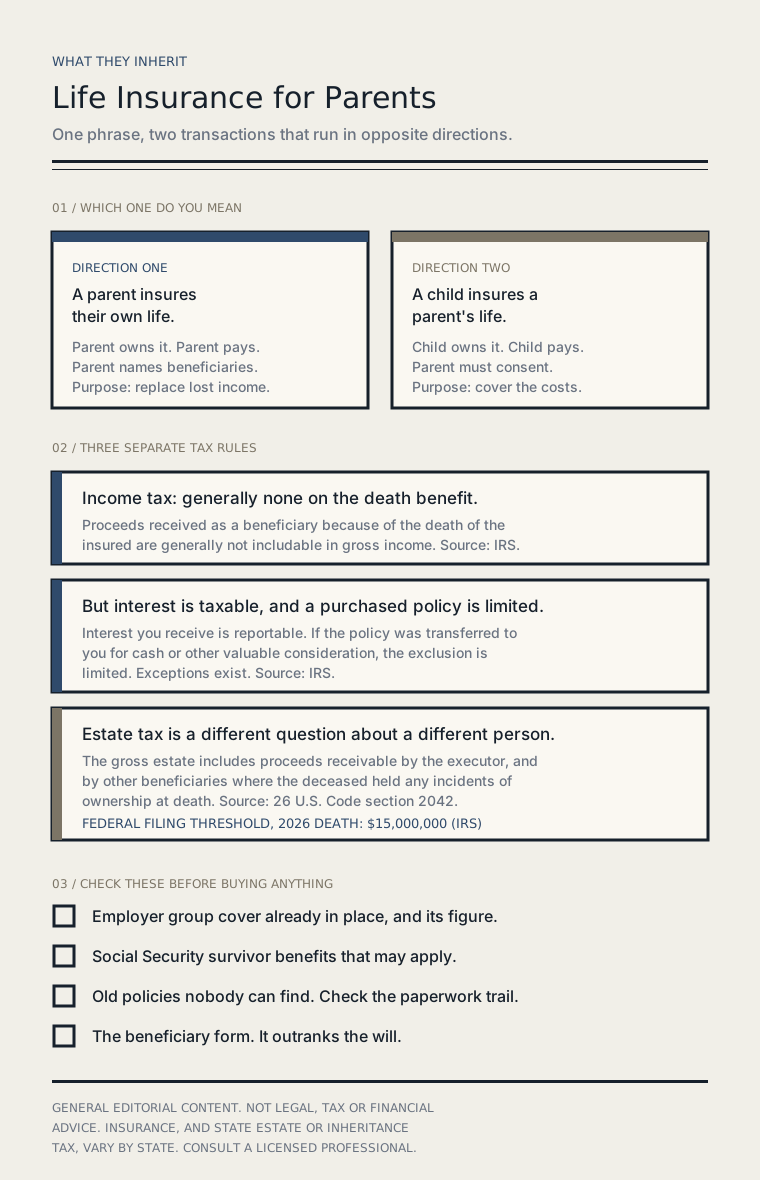
Life insurance for parents means two different transactions, and almost every argument about it starts with the two people meaning opposite things. The first is a parent insuring their own life so that the household keeps running without their income. The second is an adult child arranging cover on a parent's life so that a death does not arrive as a bill. Same phrase, opposite direction of travel.
The confusion is not the reader's fault. A search for this phrase returns both, mixed together. So the first job of this article is to separate them, because the paperwork, the money, the tax treatment and the question of who has to agree are different in each case.
The two questions hiding in one phrase
Direction one is provision. A parent with dependants is buying a replacement for their own earnings. The money is meant to arrive fast, go to named people, and cover the years in which the household would otherwise have to sell something to survive.
Direction two is cost cover. An adult child is looking at a parent who has a funeral coming, possibly a mortgage that will outlive them, possibly care costs, and no obvious money behind any of it. The money is meant to arrive fast and go to whoever is going to be handed the invoices.
These sound similar because both end with a payout. They are not similar. In direction one the insured person owns the policy, chooses the beneficiary, and pays. In direction two the insured person is not usually the owner and is not usually paying, but their signature is still required and their health still sets the price. Everything difficult about direction two comes from that split.
Direction one: a parent insuring their own life
The question a parent is really answering is not how much cover to buy. It is how many years the household would need to absorb the loss without selling the house or moving the children.
Term cover pays out only if death happens inside a fixed number of years. Permanent cover, sold under names including whole life and universal life, is designed to pay whenever death happens and usually builds an internal cash value you can borrow against or surrender, which means cancelling the policy in exchange for that cash value. Term is cheaper for the same face amount, meaning the payout the policy promises, because most term policies expire without paying anything. Which is right depends on whether the need has an end date. A mortgage has an end date. A child with a lifelong disability does not.
A structural failure in direction one is not about which product was bought. It is that the paperwork was never revisited afterwards.
The beneficiary form outranks the will
A life insurance death benefit is normally paid under the contract, to the person named on the beneficiary designation held by the insurer. That form is not part of your will and is not overridden by it. A will that says everything goes to the current spouse does not redirect a policy whose beneficiary form still names a spouse from a marriage that ended a decade ago.
This is the reason a policy is worth checking on a schedule rather than filing away. The trigger events are the obvious ones: a marriage, a divorce, a birth, a death among the named people, or a beneficiary who is now an adult and no longer needs a guardian attached. The same discipline applies to every account with a named beneficiary, which is why this belongs in the same review as the wider set of documents an estate is actually made of rather than being treated as an insurance chore.
Two details are worth writing down while you are in there. Name a contingent beneficiary, because a primary beneficiary who dies first turns a contract payment into an estate matter. And think carefully before naming a minor child directly, because insurers generally cannot pay a large sum to a child, and the result is usually a court-supervised arrangement nobody chose. A trust is one of the structures used to hold money for a child in that situation, and what a family trust actually is is worth understanding before anybody drafts one.
Direction two: insuring a parent's life
You cannot insure a stranger. Insurance law in the United States generally requires an insurable interest, which broadly means you must stand to suffer a real loss from the death, and the specifics of who qualifies and when the interest must exist are set at state level rather than federally. An adult child usually clears that bar. Do not assume it, and do not assume the rule is the same across state lines.
The second requirement is the harder one to clear: the parent has to know and has to agree. A policy on an adult's life normally requires that adult's written consent and, for anything but the smallest face amounts, their participation in underwriting. That can mean a health questionnaire, a phone interview, access to medical records, sometimes a paramedical exam. There is no version of this you can arrange quietly.
That conversation is the actual obstacle, and it is worth naming what makes it hard. You are asking a parent to sign a document that prices their death. The more defensible framing is the honest one, which is that the paperwork exists so that the family is not making financial decisions in the week of a funeral, rather than one that leads with the money.
Then there is the ownership question, which sounds administrative and is not. If the child applies as the owner, the child pays the premiums, controls the policy, and is normally the one who receives the benefit. If the parent owns a policy and simply names the child as beneficiary, the parent controls it and can change it, and the policy sits in the parent's estate. Those are different arrangements with different consequences, and the difference is the subject of the next section.
What the money is actually taxed as
Three separate rules do most of the work here.
The first is income tax. The Internal Revenue Service states that, generally, life insurance proceeds you receive as a beneficiary due to the death of the insured are not includable in gross income and do not have to be reported. That is the rule people are thinking of when they say life insurance is tax free.
The second is that the same IRS page carries two limits on it. Any interest you receive is taxable and reportable as interest received, which matters when a payout sits with the insurer before it is released. And if the policy was transferred to you for cash or other valuable consideration, the exclusion is limited to the sum of what you paid, plus additional premiums you paid, plus certain other amounts. There are exceptions to that rule. Buying an existing policy from someone, rather than applying for a new one, is precisely the situation it is written for, and it is a point to raise with a tax professional before money changes hands rather than after.
The third rule is the estate tax one, and it is the rule that surprises people, because it is not about the beneficiary at all. Under 26 U.S. Code section 2042, the value of the gross estate, meaning everything owned or controlled at death before debts and deductions come off, includes life insurance proceeds receivable by the executor, and also proceeds receivable by any other beneficiary under policies on the life of the deceased where the deceased held any of the incidents of ownership at death. Incidents of ownership means the control rights over the policy, such as being able to change the beneficiary, borrow against it, cancel it or assign it away, rather than merely being the person insured. The IRS makes the same point on its estate tax page, which lists insurance among the includible property making up the gross estate, and which sets a federal filing threshold of $15,000,000 for a 2026 death.
Read those two together and the practical shape appears. A death benefit can be entirely free of income tax in the beneficiary's hands and still be counted in the deceased person's gross estate, because they are two different taxes asking two different questions. For most families the $15,000,000 threshold means the federal version of this question never arises. That is not the whole picture, because states set their own estate and inheritance tax rules, and those are separate instruments with their own thresholds. Whether either applies to you is a question for a professional licensed in your own state. For the families where it does, who owns the policy stops being administrative detail. That is the whole reason ownership structures exist around life insurance, and it is a question for an estate attorney rather than an insurance agent.
| Parent insures self | Child insures parent | |
|---|---|---|
| Who owns the contract | The parent | Usually the adult child |
| Who pays the premium | The parent | Usually the adult child |
| Whose consent is needed | The parent's own | The parent must consent, and usually be underwritten |
| Whose health sets the price | The parent | The parent |
| Who can change the beneficiary | The parent | The owner, so usually the child |
| Typical purpose | Replace lost income | Cover funeral, debts, care costs |
| Counted in the parent's gross estate | If they held incidents of ownership at death | Depends on ownership, see section 2042 |
The last row is the one to take to a professional. The rest you can settle at the kitchen table.
What already exists before you buy anything
Before either direction, find out what is already in place. Households can buy cover they already had.
Employer group life is the usual example. Many working parents already carry a multiple of salary through work, and many do not know the figure or who is named on it. It also usually ends when the job does, which is worth knowing before you count on it.
Public entitlements are the second. The Social Security Administration states that you may qualify for survivor benefits if you are the spouse, divorced spouse, child, or dependent parent of someone who worked and paid Social Security taxes before they died. The dependent parent category in particular is one families miss, and none of it is automatic, so it is worth reading what applies before assuming private cover has to carry the whole load.
Third, and most overlooked, is the policy that already exists and that nobody can find. Coverage bought decades ago, from an insurer that has since been bought twice, complicates a claim. Where military service is in the family history, the Department of Veterans Affairs maintains a searchable database of unclaimed insurance funds for veterans. That such a facility has to exist at all is the point: policies separate from the people meant to claim them.
What to write down
Insurance is the part of an estate that pays fastest and gets lost most easily, because it lives entirely in a file at a company you do not think about. Everything below can be written on one page.
| Write down | Why it matters |
|---|---|
| Insurer name and policy number | Without it, a claim starts with a search |
| Type of policy and face amount | Tells survivors whether it covers the actual gap |
| Who owns it and who pays | Determines who can change anything, and the estate question |
| Named beneficiaries, primary and contingent | The form that outranks the will |
| Where the policy document is | Not inside the safe nobody can open |
| Review date | Because a beneficiary form is only correct on the day it is signed |
Keep that page with the rest of the plan rather than with the policy, and tell one person it exists.
There is a version of this that goes further than the numbers, which is telling the people involved what the money is for. That is not a financial instruction and it does not belong in the policy. It belongs in the letter that says what you actually meant, and it is the difference between heirs who follow a plan and heirs who guess at one. The same gap is what turns a solved balance sheet into wealth that does not survive the handover, and the paperwork half of it is the will itself.
Last reviewed by the What They Inherit Editorial Team on August 30, 2026. Our sourcing and AI-use rules are public on the editorial standards page. This is general editorial content and not legal, tax or financial advice. Insurance and insurable interest rules are set at state level and vary. Speak to a qualified professional licensed in your own jurisdiction before acting.
FAQ
Can I get life insurance for my parents?
Usually yes, but only with their knowledge and their signature. You generally need an insurable interest, meaning you would suffer a real loss from the death, and an adult child normally qualifies. The rules on who has an insurable interest and when it must exist are set at state level rather than federally. Beyond that, your parent has to consent in writing and, for most face amounts, take part in underwriting, which can mean a health questionnaire, an interview or a medical exam. There is no way to arrange it without them.
Can I get life insurance on my parents without them knowing?
No, not as a practical matter. A policy on another adult's life normally requires that adult's written consent, and their health information is what prices the policy. Consent and insurable interest rules are set at state level, so confirm the position where your parent actually lives. An application arranged without the insured person's knowledge is not a private arrangement, it is a defective one, and an insurer that discovers it can contest the claim at exactly the moment the money is needed.
Is life insurance for parents taxable?
The IRS states that, generally, life insurance proceeds received as a beneficiary because of the death of the insured are not includable in gross income and do not have to be reported. Two limits sit on that. Interest you receive is taxable and reported as interest received. And if the policy was transferred to you for cash or other valuable consideration, the exclusion is limited to what you paid plus additional premiums and certain other amounts, with exceptions.
Does life insurance count as part of the estate?
It can, and this is separate from the income tax question. Under 26 U.S. Code section 2042 the gross estate includes proceeds receivable by the executor, and proceeds receivable by other beneficiaries where the deceased held any incidents of ownership at death. The IRS lists insurance among includible property and sets a federal filing threshold of $15,000,000 for a 2026 death, so for most families the federal version never comes up. States set their own estate and inheritance tax rules on top of that, with their own thresholds. Where either might apply, ownership is the detail that matters and it is a question for an estate attorney licensed in your own state.
What is the difference between term and whole life insurance?
Term cover pays out only if the death happens inside a fixed number of years. Permanent cover, sold under names including whole life and universal life, is designed to pay whenever the death happens, and it usually builds an internal cash value the owner can borrow against or surrender, meaning cancel the policy in exchange for that cash value. For the same face amount, meaning the payout the policy promises, term is the cheaper of the two, because most term policies expire without ever paying anything. The question that decides between them is whether the need has an end date. A mortgage has an end date. A child with a lifelong disability does not. Product names, guarantees and the way a cash value behaves vary between insurers and between states, so read the policy itself and ask an adviser licensed where you live before committing to either.
How much life insurance should a parent have?
There is no formula this publication will give you, because the honest answer depends on what the household would have to sell. The more useful framing is a number of years rather than a multiple of salary. Work out what the household spends, how long it would need to keep spending it without the lost income, and what other money would arrive. Then check what is already in place through an employer before buying anything new.
Should I name my estate as the life insurance beneficiary?
Generally not, if a named person will do. A benefit paid to a named beneficiary is a contract payment that goes straight to them. Naming the estate instead can pull the money into probate, the court process that settles an estate, which is slower and more exposed than a direct payment. Name a contingent beneficiary as well, because a primary beneficiary who dies first sends the money back to the estate by default, which produces the outcome you were trying to avoid.
What is a contingent beneficiary?
A contingent beneficiary is the backup named on the beneficiary form, the person who receives the money if the primary beneficiary cannot. Naming one matters because a primary beneficiary who dies first sends the payment back to the estate by default, which turns a contract payment into an estate matter and produces the outcome that naming a beneficiary was meant to avoid. It is one extra line on the same form, filled in at the same time as the primary.
Can I name my child as beneficiary?
You can name a minor, but insurers generally cannot pay a substantial sum directly to a child, so what usually follows is a court-supervised arrangement your family did not choose. The alternatives involve naming an adult or a trust to receive and hold it, which is a drafting question rather than an insurance one. Raise it with an attorney while the form is still blank. Once a claim is filed, the only options left are the ones the policy already allowed.
What if we think a parent had a life insurance policy but cannot find it?
Start with the paperwork trail rather than the insurers: bank statements showing regular premium payments, tax records, old employer benefit statements, and any correspondence from a company you do not recognise. Where there is military service in the family, the Department of Veterans Affairs runs a searchable database of unclaimed insurance funds for veterans. Insurers get bought and renamed, so the company on a decades-old document may not be the company holding the file today.
Sources
- life insurance proceeds you receive as a beneficiary due to the death of the insured (irs.gov)
- 26 U.S. Code section 2042 (law.cornell.edu)
- estate tax (irs.gov)
- survivor benefits (ssa.gov)
- unclaimed insurance funds (insurance.va.gov)