Probate Only Reaches What Nobody Else Is Already Entitled To
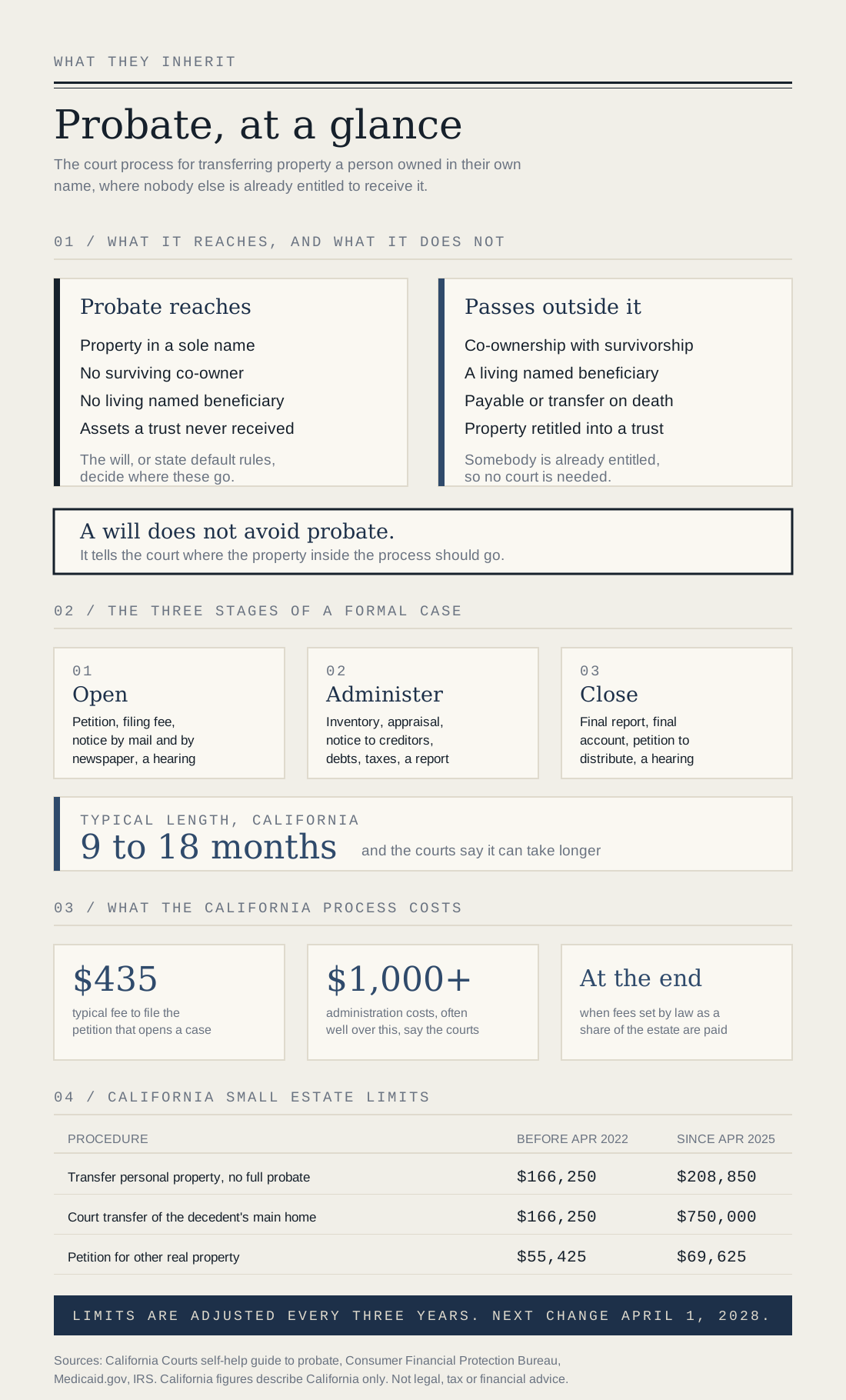
Probate is the court process for transferring property that a person owned in their own name, where nobody else is already legally entitled to receive it. Everything outside that description passes some other way, often within days, without a judge ever hearing about it.
California's courts put the first half of that plainly: probate is the legal process that you must follow to transfer or inherit property after the person who owned the property has passed away. Their guide to property after someone dies then adds the sentence that catches most families off guard. A person's estate may need to go through probate even if they had a will.
None of this is legal, tax or financial advice. Two things to fix in your head before the detail. Probate is created state by state, so there is no national rule. And every figure below is California's unless stated otherwise, quoted because that state publishes clear numbers of its own, not because they apply where you live. Ask a lawyer licensed where the person lived and where the property sits.
Why the process exists at all
Strip away the dread and probate is solving a clerical problem. A dead person cannot sign anything. A county recorder will generally not change a deed on the word of a grieving daughter. A brokerage will generally not release a six figure account because a son says he was promised it. Somebody has to be given legal authority to act for property whose owner no longer exists, and only a court can hand that authority out.
So the court appoints one. The California guide describes the role in one line: to start a probate case you go to court and ask a judge to appoint a personal representative, who collects the property of the person who died, pays their bills, and then distributes what is left to the people with a legal right to receive it. That person is what a bank is actually asking for when it refuses to talk to you.
Read in that light, the length and the cost stop looking arbitrary. The months are what it takes to notify everyone with a possible claim, value what there is, let creditors come forward, and have a judge confirm that the person holding the estate handled it properly before the money leaves. Probate is slow because it is a public accounting.
What probate never touches
This is the half of the subject that gets skipped, and it is the half that decides how much of an estate is actually exposed.
Probate reaches property that has nobody else already entitled to it. Property that does have somebody else entitled to it passes to that person directly, under the arrangement that was set up while the owner was alive, and it does so whatever the will says. California's guide states the consequence without fanfare: even if someone was not named in a will, the person who died might have named them as a beneficiary, on a retirement or bank account for example, and those people may have their own steps to take to claim the property.
| What is owned | What decides where it goes | Does probate reach it? |
|---|---|---|
| House in one name only | The will, or state default rules if there is no will | Yes, unless a small estate procedure fits (a simplified route for lower value estates, set out below) |
| House held with a surviving co-owner who has a right of survivorship | The form of co-ownership on the deed | Generally no |
| Retirement account with a living named beneficiary | The beneficiary form held by the plan or institution | Generally no |
| Life insurance policy with a living named beneficiary | The policy's own beneficiary designation | Generally no |
| Bank account with a payable on death instruction | The instruction recorded with the bank | Generally no |
| Property actually retitled into a living trust | The trust's terms, administered by the trustee | Generally no |
| Property the owner meant to put in a trust but never retitled | The will, or state default rules | Yes |
| Car, furniture, cash, personal effects in a sole name | The will, or state default rules | Yes, though small estate procedures often cover these first |
A beneficiary designation is not a suggestion the will can overrule. It is an instruction sitting with the institution that holds the asset, and it pays on death without consulting anything else. A form filled in twenty years ago and never revisited will be honoured exactly as written. We set out what those forms are and where they hide in our guide to what estate planning actually consists of.
The second row is the unfunded trust, and it is the single most expensive gap in this whole subject. A trust only governs what was actually retitled into it. Anything the owner intended to move and never moved stays in their own name, which means it lands in exactly the court process the trust was bought to avoid. We walk through that failure asset by asset in a living trust does nothing until something is moved into it.
The three parts of a formal case, and where the months go
California's courts divide a formal probate into opening the case, administering the estate, and closing it, and state that the whole thing typically runs nine to eighteen months. Reading what sits inside each part makes the timeline legible rather than mysterious.
| Stage | What has to happen | What creates the wait |
|---|---|---|
| Open the case | File a Petition for Probate in the county where the person lived, pay the fee or apply for a waiver, and take the hearing date the clerk assigns | The court's own calendar sets the first hearing date, and nobody can be appointed before it |
| Notify everyone | Mail notice of the hearing to family members and to anyone who may have a right to part of the estate, and publish notice in a newspaper of general circulation | Notice has to be mailed by another adult who is not a party, and publication runs on the newspaper's schedule |
| Appointment | A judge decides who to appoint as personal representative and grants the petition if the paperwork, the notice and the publication are in order | The court grants the petition only once it has no questions about the paperwork, the notice and the publication, and nobody is appointed before that |
| Inventory and appraisal | The representative gathers the assets and files an Inventory and Appraisal, usually involving a court appointed appraiser called a probate referee to value the non cash property | Third party valuation of a house, a business interest or a collection takes as long as it takes |
| Creditors and debts | Formal notice of administration goes to creditors, and debts are paid from the estate where there is money to pay them | Creditors are given a window to come forward, and distributing before it closes is the representative's own risk |
| Taxes | A final individual income tax return is prepared for the person who died, and an estate return if the estate itself earned money | Filing seasons and deadlines are not negotiable |
| Report to the court | The representative reports on how the estate was handled, at a hearing the court usually sets a year after appointment | That review point is roughly twelve months after appointment by default |
| Close the estate | File a final report, a final account and a petition for final distribution, then attend the hearing where the judge approves distribution | Another hearing date, another round of notice |
One line in California's guidance saves a lot of guessing about why nobody gets paid early: fees are usually not paid until the end of the entire probate case, and the representative often has to pay costs up front and be reimbursed from the estate later. The person doing the work is frequently out of pocket for months, which is worth knowing before agreeing to take the job.
A final account can sometimes be skipped, and this is one of the few genuine accelerators available inside the process. Where everyone entitled to a distribution signs a written waiver of account, or a written acknowledgment that they received their share, the final account does not have to be filed. One way to read that provision: some of the steps that lengthen a contested estate become optional once everybody entitled to a share agrees in writing.
Who the court appoints, and the order it works down
Where there is a will, the person named in it is generally appointed. Where there is not, or where that person cannot or will not serve, California's guide sets out the order of priority the court works down: a surviving spouse or domestic partner, then a child, then a grandchild, then a parent, then a sibling. A judge decides who has priority.
Two people can represent an estate together, and the guide is emphatic about the consequence. They must always act together. Co representatives who stop speaking bring an estate to a halt rather than merely slowing it. That is worth weighing when naming two children in the name of fairness, and it is the quiet origin of a good share of the conflicts we describe in what actually happens in an inheritance dispute.
The small estate door, and why its numbers move
Not every estate needs the formal process. California allows what it calls summary succession procedures where the property is worth less than a set amount, and these are faster and simpler routes that avoid the full court process altogether. Whether one fits depends on the value of the property, the date of death, and which section of the Probate Code applies.
The amounts are adjusted every three years by the Judicial Council under a formula in the code itself. They changed on April 1, 2022 and again on April 1, 2025, and they are next due to change on April 1, 2028.
| Procedure | Limit for deaths before Apr 1, 2022 | Apr 1, 2022 to Mar 31, 2025 | On or after Apr 1, 2025 |
|---|---|---|---|
| Collect or transfer personal property without full probate | $166,250 | $184,500 | $208,850 |
| Court transfer of the decedent's main home | $166,250 | $184,500 | $750,000 |
| Petition for real property under a set amount | $55,425 | $61,500 | $69,625 |
| Set aside for immediate needs of spouse and minor children | $85,900 | $95,325 | $107,900 |
| Spouse collecting unpaid earnings from an employer | $16,625 | $18,450 | $20,875 |
The jump in the second row is the one to notice. Assembly Bill 2016 raised the ceiling for certain real property petitions to $750,000 and limited that procedure to the decedent's main home in California. The practical effect is that a band of California homes worth between the old $184,500 line and $750,000 now falls under a petition rather than a full case, provided the property was the person's main home.
It also carries the warning that applies to every number on this page. These are California's figures, tied to California's code sections, revised on California's schedule. Every state runs its own thresholds and its own simplified procedures, and some run none at all. The instruction that travels is the question, not the answer: ask what the small estate route is where the person lived, and ask it before assuming a full case is required. Where a state has adopted parts of a model code, the vocabulary and the shortcuts can look different again, which we cover in what the Uniform Probate Code actually is.
Who probate is actually for
Families experience probate as something being done to them. It is more accurate to say it is being done for the people who are not in the room.
Creditors are the first of those. The Consumer Financial Protection Bureau describes the mechanism from the survivor's side, in its answer on whether you are responsible for a spouse's debts after they die. When someone dies with an unpaid debt, and the debt needs to be paid, it should be paid from the money or property they left behind, according to state law. That pot is the estate. And where there is no money or property left in an estate, or the estate cannot pay, the debt generally goes unpaid. The Bureau also notes that debt collectors may contact a personal representative about the deceased person's debts, but are not allowed to say or hint that the representative is responsible for paying them out of their own money.
That is the bargain hiding inside the process. Probate gives creditors an orderly window to be paid out of the estate, and in exchange it draws a line around what they can reach. Skipping the process does not make that line clearer, it makes it vaguer.
The second party outside the room is the state. Medicaid estate recovery is the clearest case, and the rule is federal. Medicaid.gov states that state Medicaid programmes must recover certain benefits paid on behalf of an enrollee, and that for people aged 55 or older, states are required to seek recovery from the individual's estate for nursing facility services, home and community based services, and related hospital and prescription drug services. Recovery of all other Medicaid services provided to those individuals is at the state's option, with one bar the page states outright: Medicare cost sharing paid on behalf of a Medicare Savings Program beneficiary cannot be recovered.
The protections attached to that rule matter as much as the rule. States may not recover from the estate of a deceased enrollee who is survived by a spouse, by a child under 21, or by a blind or disabled child of any age. States are also required to establish procedures for waiving estate recovery where it would cause undue hardship. A family being told the house is simply gone is being told something the federal rule does not say, and the hardship waiver is a procedure the state is obliged to have.
Two tax returns, not one
The other surprise inside administration is that a death generally produces filings on two separate tracks, and mixing them up costs time.
The first is the deceased person's own final return. The IRS guidance on filing the final income tax returns of a deceased person says to prepare it much as you would if the person were alive: report all income up to the date of death and claim all eligible credits and deductions. If returns were not filed for earlier years, those may be owed too. Paying any balance due and submitting a claim if there is a refund both fall to whoever is handling the affairs, and a refund is claimed with Form 1310. The IRS points executors and administrators to Publication 559 for the whole sequence.
The second track is the estate itself, which becomes its own taxpayer once it starts earning. California's courts put the practical trigger in one clause: if the estate earned any money, such as interest or profit on a sale, the representative will have to turn in an estate return as well. A house that sits unsold for nine months while collecting nothing is one situation. A house that sells in month seven for more than its appraised value is another.
Neither of these is the federal estate tax, which is a separate question the guidance above does not cover. Treat all three as separate questions and put them to a tax professional rather than assuming one filing covers everything.
What actually shortens it
Almost everything that reduces exposure to probate happens while the owner is still alive, and almost none of it is exotic.
Keep beneficiary designations current, on every retirement account, every policy and every account that offers a payable on death instruction. An hour spent on this moves assets out of the court queue by filling in forms the institutions already hold.
Retitle deliberately rather than intending to. If a trust exists, finish funding it. If it does not, understand which assets are in a sole name and what would happen to each one.
Write the will anyway, and treat it as the backstop rather than the plan. Whatever the designations and the trust miss lands there, and a clear will keeps the thing that does go to court from going badly. Our guide to writing a will covers what that document can and cannot do.
Leave an inventory. Much of the delay in the administration stage is a representative discovering what exists, one statement at a time, from an unfamiliar filing cabinet.
And accept the part that no arrangement removes. If two people who are entitled to the estate disagree, the process lengthens, because the steps that create the delay are the same steps through which a disagreement gets resolved.
Last reviewed by the What They Inherit Editorial Team on September 12, 2026. Our sourcing and AI-use rules are public on the editorial standards page. This is general editorial content and not legal, tax or financial advice. Probate is created and governed by state law, and the procedures, thresholds, creditor windows, fees and timescales described here are California's and do not describe any other state. Federal rules on Medicaid estate recovery and on filing for a person who has died are summarised from the agencies' own guidance and are not a substitute for advice on your situation. Speak to a lawyer and a tax professional licensed in the state where the person lived and where the property is held.
FAQ
What is probate?
Probate is the court supervised process for transferring property that a person owned in their own name, where nobody else is already legally entitled to receive it. California's courts describe it as the legal process you must follow to transfer or inherit property after the owner has died, handled by the probate division of the superior court. The court appoints a personal representative, who collects the property, pays the debts, and distributes what is left to the people with a legal right to it.
How long does probate take?
In California, the state's own courts say a formal probate case typically takes nine to eighteen months, and can sometimes take longer. The length is driven by court calendars rather than by paperwork speed: a hearing to appoint the representative, a creditor window, a report to the court usually set a year after appointment, and a further hearing to approve the final distribution. Timescales are set state by state, so check what applies where the person lived.
How much does probate cost?
In California the filing fee to open a formal case is typically $435, and the courts describe the costs of administration, which include publication, appraisal and other expenses, as often well over $1,000 and sometimes much more. On top of that, the fees payable to the personal representative and to an attorney are generally set by law as a percentage of the total value of the estate. Expect to be out of pocket in the meantime: the courts note that the representative usually pays costs up front and is reimbursed from the estate later.
Does having a will avoid probate?
No. California's guide states directly that an estate may need to go through probate even if the person had a will. A will does not move property outside the court process, it tells the court where the property inside the process should go. What keeps property out of probate is a different owner or a named recipient already being in place, through survivorship co-ownership, a beneficiary designation, a payable on death instruction, or a trust that was actually funded.
What property skips probate entirely?
Broadly, property that already has somebody else entitled to it. That typically covers real estate held with a surviving co-owner who has a right of survivorship, retirement accounts and life insurance policies with a living named beneficiary, bank and brokerage accounts carrying a payable on death or transfer on death instruction, and property properly retitled into a trust. The forms of co-ownership and the instructions available differ by state and by institution, so confirm each asset's own paperwork rather than assuming.
What is a transfer on death or payable on death designation, and does it avoid probate?
It is an instruction recorded with the institution that holds an account, naming who receives the balance when the owner dies. Because the recipient is already identified in the institution's own records, the asset generally passes to them directly rather than through the court process, and the will does not redirect it. The trade off is that it is invisible unless somebody checks: a designation made years ago and never reviewed is honoured exactly as written, including where the named person has died or the relationship has changed. What is available, and for which asset types, varies by state and by provider.
Do I have to pay my parents' debts when they die?
Generally not out of your own money. The Consumer Financial Protection Bureau's position is that you are generally not responsible for someone else's debt, and that a debt which needs to be paid should be paid from the money or property the person left behind, under state law. Where nothing is left, or the estate cannot pay, the debt generally goes unpaid. Shared debts are the exception, and the Bureau lists co-signed loans, joint credit card accounts, community property states, and states with necessaries statutes, meaning laws that can make a spouse or parent responsible for certain necessary costs such as healthcare, as situations where a survivor can be responsible. Debt collectors may contact a personal representative about the debts, but are not allowed to say or imply that the representative owes them personally. Because the exceptions are state specific, put your own situation to a lawyer rather than to a collector.
What is the difference between an heir and a beneficiary?
In everyday use the words overlap, and California's guidance uses both for the people entitled to receive what is left. The distinction worth keeping is the source of the entitlement. An heir is someone who inherits under a state's default succession rules, which apply when there is no valid will covering the property. A beneficiary is someone named in a document, whether that is a will, a trust, or a form held by a bank or insurer. The same person can be both, and someone can be a beneficiary of an account while having no claim on the rest of the estate at all.
Can an executor pay themselves from the estate?
An executor is the personal representative this article has been describing, in the case where a will named them. In California the fees payable to a personal representative are generally set by law as a percentage of the total value of the estate, and are paid from the estate rather than by the family personally. The timing is the part people get wrong: the fee arrives at the end, through a final distribution a judge approves at a hearing. A representative who takes money along the way, outside that process, is the kind of thing that turns an administration into litigation.
Can I handle probate without a lawyer?
California's guide treats hiring a lawyer as optional for a personal representative, notes that legal fees are set by law and generally paid from the estate at the end of the case, and suggests a middle path: representing yourself while paying for a consultation when a specific question comes up. Whether that is wise depends on the estate. A single house, a couple of accounts and a family that agrees is a different proposition from a business interest, an out of state property, or a relative threatening to contest. The courts also point people towards free or low cost legal help, which may be available depending on income.
What is a pour over will and do I need one alongside a living trust?
A pour over will is the common name for a will whose main job is to catch whatever never made it into the trust and direct it there. It exists because a trust governs only the property actually retitled into it, so anything left in the owner's sole name has to be dealt with some other way. Property caught this way still generally goes through the court process first, which is why a pour over will is a safety net rather than a substitute for finishing the funding. Whether you need one, and how it should be drafted, is a question for a lawyer licensed where you live.
Can Medicaid take the house through probate?
Federal rules require state Medicaid programmes to seek recovery from the estate of an enrollee aged 55 or older for nursing facility services, home and community based services, and related hospital and prescription drug services, with recovery of other services at the state's option. There are firm limits. States may not recover from the estate of someone survived by a spouse, by a child under 21, or by a blind or disabled child of any age, and states are required to have procedures for waiving recovery where it would cause undue hardship. If a family is told the home is lost, ask the state Medicaid agency what its estate recovery and undue hardship waiver procedure is, in writing, and put the survivor protections to a lawyer as well.
Do I have to file a tax return for someone who has died?
Usually yes, and often two separate ones. The IRS says to prepare the deceased person's final individual return much as you would if they were alive, reporting all income up to the date of death, and that earlier unfiled years may also be owed. A refund is claimed using Form 1310, and Publication 559 is written for the people handling this. Separately, if the estate itself earns money, for example interest or a profit on a sale, an estate return is also due. The federal estate tax is a third question again, and one the guidance cited here does not address. Put all of it to a tax professional.
What is probate court?
Probate court is usually not a separate courthouse, it is the part of the ordinary trial court that handles estates. In California it is the probate division of the superior court. What makes this a court process rather than an administrative one is that a judge decides who is allowed to act: the court appoints a personal representative, and that appointment is what a bank is really asking for when it refuses to release an account. The court then supervises the rest, and its calendar rather than your paperwork sets the pace. A petition is filed in the county where the person lived, the clerk assigns a hearing date, a judge grants the appointment once the paperwork, the notice and the publication are in order, and the representative reports back at a hearing usually set a year after appointment. Where there is no will, or the person named cannot serve, California's order of priority runs surviving spouse or domestic partner, then child, then grandchild, then parent, then sibling. The name of the court, that order of priority and the timescales are all set state by state, so check the state where the person actually lived.
Sources
- guide to property after someone dies (selfhelp.courts.ca.gov)
- a formal probate (selfhelp.courts.ca.gov)
- summary succession procedures (selfhelp.courts.ca.gov)
- whether you are responsible for a spouse's debts after they die (consumerfinance.gov)
- Medicaid.gov (medicaid.gov)
- filing the final income tax returns of a deceased person (irs.gov)
- free or low cost legal help (selfhelp.courts.ca.gov)