A Living Trust Does Nothing Until Something Is Moved Into It
A living trust is ineffective unless the person who made it puts their money or property into it. That is the Consumer Financial Protection Bureau's own sentence, not a paraphrase.
That sentence is in Managing Someone Else's Money: Help for trustees under a revocable living trust, a federal guide written for family and friends rather than for lawyers, and it is doing more work than it looks like. It means the signing appointment is not the finish line. A living trust that has been drafted, witnessed, notarised and filed in a drawer, and that has never had a single asset moved into it, governs nothing at all. The same guide is blunt about what that leaves the trustee holding: you have no legal authority over any money or property that is not in the trust.
Families pay for the document. They rarely finish the step after it.
None of this is legal, tax or financial advice. Trusts are governed by state law, and what follows is drawn from federal guides and, where marked, from California's courts. It is not a substitute for a professional licensed in your own state.
What the document creates, briefly
Three roles, and the federal guide names all three plainly.
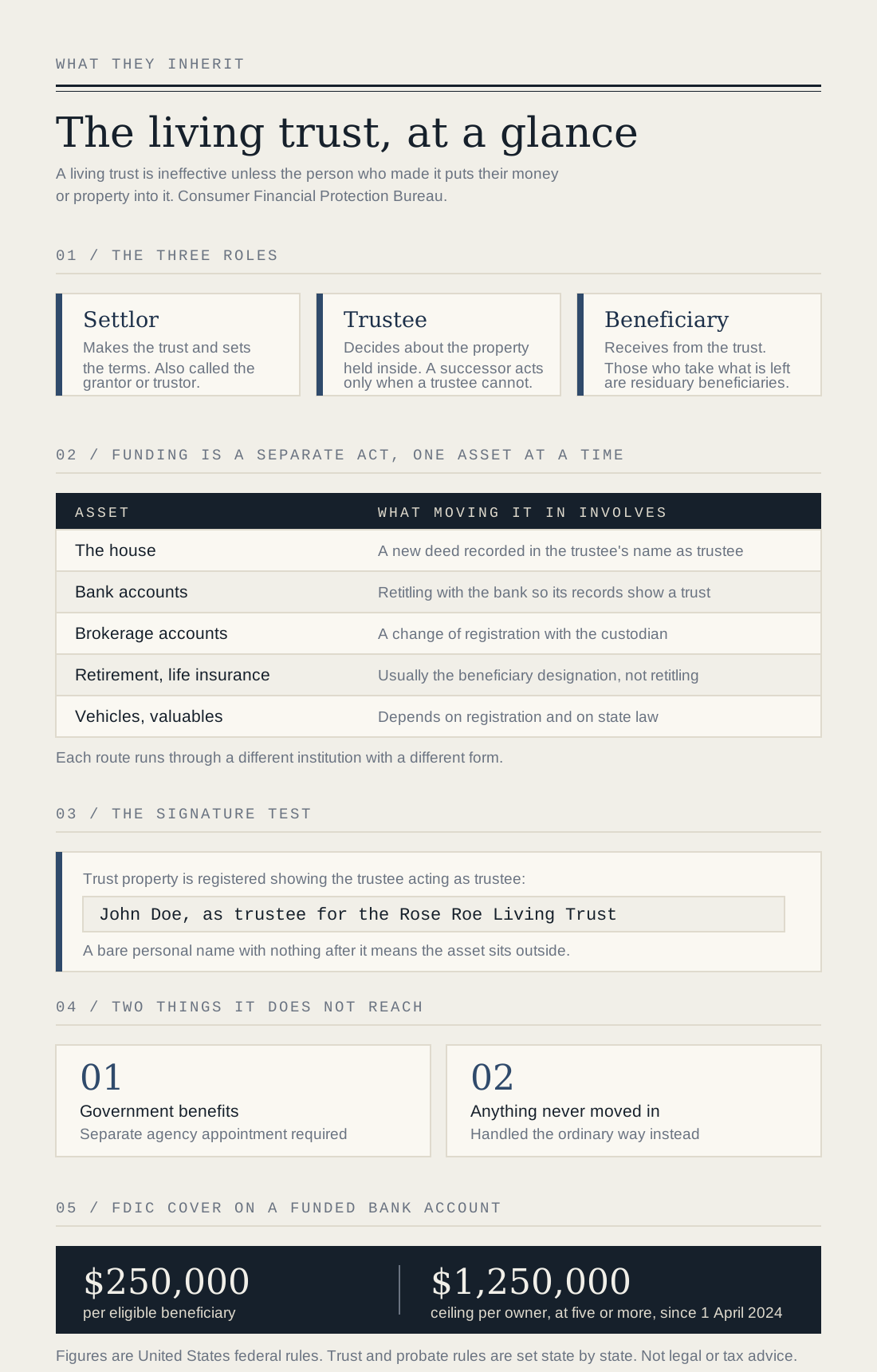
The person who makes the trust is the settlor, also called the grantor or trustor. The person who makes decisions about the money or property inside it is the trustee, which can be an individual or a financial institution, and where there is more than one they are co-trustees. A successor trustee may also be named, and acts only when a trustee can no longer fulfil the role. The person who receives money or property is a beneficiary, and the people who receive what is left after the settlor dies are called residuary beneficiaries.
The arrangement that these three roles sit inside is what we set out at length in what a family trust actually creates, including what the trustee is really taking on. That piece is about the job. This one is about the property, because the job does not start until the property arrives.
One feature of a living trust is worth stating before anything else, because it explains why so many people can sign one and then forget it exists. The settlor can name themselves as trustee. Rose, the fictional trust-maker the CFPB guide follows, can serve as her own trustee and name a relative as co-trustee immediately, or she can name that relative as a successor trustee who acts only when she can no longer make her own decisions. So on the day it is signed, a living trust very often changes nothing about who controls anything. The same person still runs the same money. That is the point of it, and it is also exactly why the funding step gets postponed indefinitely: nothing appears to break when it is skipped.
Funding is a separate act, and it is a retitling
The CFPB guide describes the mechanism without ceremony. When she set up the trust, the settlor should have transferred ownership of some or all of her money and property from her name to the name of the trustee, unless state law indicates otherwise.
Read that again as an instruction rather than as a description. Ownership moves. The deed changes. The account changes. The registration changes. Every asset is moved one at a time, by whatever process that particular kind of asset requires, and each of those processes involves a different institution with a different form.
People often call the result a trust fund, and that phrase carries assumptions this arrangement does not. What a living trust fund actually is covers the terminology before you use it with a bank.
There is no single act of funding. There is a list, and the list has to be worked through.
| Asset | What moving it in usually involves | What happens if it is skipped |
|---|---|---|
| The house | A new deed prepared and recorded, transferring title from the owner's own name to the trustee's name as trustee of the trust | The house is outside the trust and is dealt with by whatever process applies where it sits |
| Bank and savings accounts | Retitling the account with the bank so its records identify it as a trust account | The account stays in the owner's individual name, and the trustee has no authority over it |
| Investment and brokerage accounts | A change-of-registration request with the custodian, in the trustee's name as trustee | The account remains individually owned |
| Retirement accounts and life insurance | Usually governed by the beneficiary designation on the account itself, not by retitling | Payment follows the designation form on file, which may be older than the trust |
| Vehicles, valuables, personal property | Depends entirely on how each item is registered and on state law | Each item is treated individually, on its own terms |
| Government benefits | Generally cannot be managed by the trustee at all, see below | A separate appointment is required, and there is no way around it |
Nothing in that table is exotic. It is a day of phone calls and a set of forms, spread over a few weeks. What makes it the failure point is that it is administrative, it is nobody's billable specialism after the drafting is done, and no deadline enforces it.
The signature test
There is a small, concrete habit the CFPB guide teaches trustees that doubles as a test of whether an asset was ever properly moved in.
Every document should show the owner of the assets as the trustee's name as trustee of the named trust, unless state law indicates otherwise, and a trustee signing for the trust signs that way too. The guide's own example is signing as "John Doe, as trustee for the Rose Roe Living Trust", never simply as "Rose Roe". The reason it gives is practical rather than ceremonial: so that anyone looking at the paperwork can see immediately that the money and property belong to the trust and not to the trustee personally.
Turn that around and it becomes a diagnostic you can run this afternoon. Pull the deed, the bank statement, the brokerage registration. Read the name on each one. If the name is a person's name with nothing after it, that is usually a sign the asset was never moved in. The exact titling requirement varies by state, so treat it as a prompt to check with the institution that holds the asset rather than as a final answer.
Where the test fails, the fix is the table above. Go back to the row for that kind of asset, contact the institution it names, the bank, the brokerage or the county recorder, and complete the retitling it describes.
The same rule generates the other duty families collide with. The CFPB is direct that a trustee must never mix trust money or property with their own, never deposit trust money into a personal account, and never hold title to trust property in their own name. Mixing makes it unclear who owns what, and confused records can create problems not just with the family but with adult protective services and law enforcement. A trustee who pays a bill from their own account and reimburses themselves later has not committed a wrong, but they have made a record that is harder to defend than one that never needed defending.
Two things a living trust does not reach
Government benefits. This one surprises people who assumed a trust was a universal key. As trustee, you cannot manage benefits such as Social Security or veterans benefits unless either the benefits are paid directly into the trust, or you have been appointed by that agency in a separate capacity, for example as a representative payee or a VA fiduciary. A trust instrument does not confer that. It is a different application to a different body, and a family that does not know this discovers it at the worst possible moment.
Anything never moved in. The trustee's authority runs only to property actually transferred to the trust. Everything else is handled the ordinary way, which for many families means the process the trust was bought to avoid.
That second limit is why a living trust is normally paired with a will rather than replacing one. The will catches what the funding missed. If you have not written one, how to write a will sets out what the document has to contain to function, and what estate planning actually consists of shows where a trust sits among the other pieces.
What the FDIC rules do to a funded bank account
Once accounts are genuinely retitled, one rule changes underneath them, and it changed recently enough that a lot of older advice is out of date.
The FDIC's Your Insured Deposits brochure sets out the current position. Formal revocable trusts, which the FDIC notes are known as living or family trusts, sit in the Trust Accounts category along with informal arrangements such as payable-on-death and in-trust-for accounts and with irrevocable trusts. As of April 1, 2024, an owner's trust deposits are insured for $250,000 per eligible beneficiary, up to a maximum of $1,250,000 per owner at the same bank, reached at five or more eligible beneficiaries. A depositor can name as many beneficiaries as they wish, and the coverage ceiling does not move above $1,250,000 regardless.
Two practical consequences follow, and both cut in directions people do not expect.
For a trust with several beneficiaries and a large cash position at one institution, coverage can stop well short of the balance. For a trust naming one or two beneficiaries, the ceiling is lower than the headline number suggests, because the cap scales with eligible beneficiaries rather than sitting at $1,250,000 by default. The FDIC also notes a requirement that is easy to fail on paperwork alone: for a formal revocable trust account to be insured in this category, the account title must include terminology sufficient to identify it as a trust account, or the bank's own deposit account records must do so. Read the name on the account.
The tax question, which is usually the least of it
For a living trust that the settlor can still change, the tax treatment generally follows the control rather than the name on the cover.
The IRS explains in its questions and answers on abusive trust tax schemes, which sets out the ordinary grantor-trust rule along the way, that where the grantor keeps the power to control or direct the trust's income or assets, including the power to revoke, the income is generally taxed to the grantor. That is the ordinary case while the person who made the trust is alive and competent, and it is why funding a revocable living trust does not usually change anybody's tax return in the year it happens.
That treatment is not permanent and it is not universal. A trust's filing obligations turn on its type and its income, the rules differ by state on top of the federal position, and the point at which a revocable trust stops being revocable changes the analysis. This is the part to take to a professional rather than to settle from a web page, including ours.
Nine months, and what it is actually buying
The clearest statement of what a funded living trust is for comes from the California courts, in their own self-help guidance on wills, estates and advance care planning. Writing about a home, they say a living trust helps make sure the home goes to the people you want after your death without them going to probate court and waiting for a judge to decide who gets it, and they put a number on the wait: the fastest that typically happens in California is around 9 months, a length of time that can create problems for the people left behind. A living trust, they say, helps loved ones bypass that waiting period as well as the expense of the court process.
That number is California's, and only California's. Probate is a creature of state law, and both the timescale and the name of the process vary by jurisdiction, which is the subject of the Uniform Probate Code and why it is not law until a legislature adopts it. Do not carry the nine months across a state line and do not carry it across a border.
What travels is the shape of the argument. The instrument is buying time and privacy for the people who survive you, on the assets it actually holds, in the jurisdiction where those assets sit.
Two questions before anyone drafts
Will the funding actually get done, and by whom, by when? This is the question that decides whether the money was well spent. If the answer is a vague intention to sort out the deed at some point, the honest forecast is that the trust will be found unfunded. Name the person responsible for each asset class, put a date on it, and treat the retitling as part of the job rather than as homework issued afterwards.
Who is going to run this, and do they know? The CFPB guide exists because trustees are usually family members with no prior experience of the role, who inherit four fiduciary duties the moment they start acting: act only in the beneficiary's interest, manage the property carefully, keep trust property separate from their own, and keep good records. Read the guide before naming someone, and then give it to them. The reasoning behind your choices does not fit inside the trust instrument, which is the argument for writing it down separately in a legacy letter addressed to the people who will read the document without you there to explain it.
A trust that is funded and administered by someone who understands the role does what it was bought to do.
Last reviewed by the What They Inherit Editorial Team on September 11, 2026. Our sourcing and AI-use rules are public on the editorial standards page. This is general editorial content and not legal, tax or financial advice. Trusts are formed under state law, and the rules governing them, the probate process they interact with, and their tax treatment all differ by jurisdiction and change over time. The nine-month figure quoted here is California's and does not describe any other state. Speak to a qualified professional licensed where you live, and where your assets are held, before creating, funding or amending a trust.
FAQ
Nothing below is legal or tax advice, and the rules vary by state.
What is a living trust?
A revocable living trust is a legal document that gives a named person legal authority to make decisions about your money or property held in the trust if you become unable to make them yourself, and that says who receives that money or property after you die. The CFPB, which wrote a federal guide for people serving as trustees, notes that some states use the term "living trust" to mean something different from a "revocable living trust", so the label alone does not settle what you have. What settles it is what the document says about who can change it and who controls the assets.
Does a living trust avoid probate?
Only for the property actually held in it. California's courts describe a living trust as helping a home go to the people you want without their having to wait for probate court, where the fastest typical wait in that state is around nine months. That benefit attaches to assets that were retitled into the trust. Anything left in your own name is dealt with by the ordinary process for your jurisdiction, which is why an unfunded trust does not avoid probate at all. Probate rules and timescales are set state by state, so confirm what applies where you live.
What does it mean to fund a living trust?
Funding means transferring ownership of assets from your own name into the name of the trustee, who holds them for the trust. In practice that is a separate act for each asset: a new recorded deed for real estate, a retitling request at the bank, a change of registration with a brokerage. The CFPB guide states the consequence of skipping it directly, that a living trust is ineffective unless the person who made it puts money or property into it, and that the trustee has no legal authority over anything that is not in the trust.
How do I check whether my trust was ever funded?
Read the owner name on each asset's own paperwork rather than relying on the trust document or on memory. Trust-held property should generally be registered showing the trustee's name as trustee of the named trust, unless state law indicates otherwise, and the CFPB gives the signing convention as an example: "John Doe, as trustee for the Rose Roe Living Trust". Where a deed, a bank statement or an account registration shows only an individual's name with nothing after it, that is a sign the asset was never moved in. Take anything ambiguous to the institution that holds it, or to a lawyer.
Can I be the trustee of my own living trust?
Yes, and it is common. The CFPB guide describes a trust-maker naming herself as trustee with a relative as co-trustee immediately, or naming that relative as a successor trustee who acts only once she can no longer make her own decisions. This is also why the funding step gets forgotten: when you are your own trustee, nothing about your daily control of the money changes on the day you sign, so nothing signals that a step is outstanding.
Does a living trust need its own tax return?
While the trust remains revocable and you retain control, generally not as a separate taxpayer. The IRS explains that where the grantor keeps the power to control or direct the trust's income or assets, including the power to revoke it, the income is generally taxed to the grantor. That changes as the trust's character changes, a trust's own filing obligations depend on its type and its income, and state rules sit on top of the federal ones. Confirm your own position with a tax professional rather than assuming the revocable treatment lasts forever.
Is money in a living trust still FDIC insured?
Yes, within limits that changed on April 1, 2024. The FDIC places formal revocable trusts, which it notes are known as living or family trusts, in the Trust Accounts category, and insures an owner's trust deposits for $250,000 per eligible beneficiary up to a maximum of $1,250,000 per owner at the same bank, reached at five or more eligible beneficiaries. Naming more beneficiaries than five does not raise that ceiling. The FDIC also requires that the account title, or the bank's own records, identify the account as a trust account, so the retitling has to have been done properly for the coverage to apply as expected.
Can my trustee manage my Social Security or veterans benefits?
Generally not by virtue of the trust alone. The CFPB guide states that a trustee cannot manage government benefits such as Social Security or veterans benefits unless the benefits are paid directly into the trust, or the trustee has been appointed by the relevant agency in a separate capacity, such as a representative payee or a VA fiduciary. That is a separate application to a separate body. Families who assume the trust covers it find out at the point the benefit needs managing, which is usually the point at which nobody has time to apply.
What happens to assets I never move into the trust?
They are handled as though the trust did not exist, because as to those assets it effectively does not. They pass under your will if you have one, or under your state's default rules if you do not, and they go through whatever transfer process your jurisdiction requires. This is the main reason a living trust is normally paired with a will rather than replacing it: the will is the backstop for whatever the funding missed. If the funding missed most of the estate, the backstop is doing all the work and the trust is doing none.
Should I get a living trust at all?
That depends on what you own, where it sits, and whether the funding will realistically get done, and it is a question for a professional licensed in your jurisdiction rather than for an article. What is worth settling before you pay anyone is the second half of that: an unfunded trust delivers none of the benefits it was bought for while costing the full price. If nobody in the picture is going to work through the deed, the accounts and the registrations, that is useful information to have before the drafting fee rather than after it.
What is the difference between a living trust and a will?
They do different jobs, and most families end up with both rather than choosing between them. A will speaks only after death, and it has to go through your jurisdiction's transfer process to do it. A living trust can act before then: the settlor commonly serves as their own trustee and names a successor trustee who steps in when they can no longer make their own decisions, so the trust covers a stretch of time a will cannot reach. The second difference is what the property avoids. California's courts describe a funded living trust as letting a home reach the people you want without waiting for probate court, where the fastest that typically happens in that state is around nine months. That benefit attaches only to property actually retitled into the trust. Anything still held in your own name is dealt with by the ordinary process, which is why a living trust is normally paired with a will rather than replacing one: the will is the backstop for whatever the funding missed. The nine-month figure is California's alone, and both instruments are governed by state law, so confirm how they interact where you live.
What are the disadvantages of a living trust?
Every one of them is downstream of a single fact: the trust governs only what was actually moved into it. That makes funding the real cost, and it is not one appointment. It is a deed, every account and every registration retitled one at a time, and an unfunded trust delivers none of the benefits it was bought for while costing the full price. Three further limits are worth knowing before you pay. A revocable trust does not reduce your income tax while you keep control, because the IRS generally taxes that income to you as grantor. It does not by itself give your trustee authority over Social Security or veterans benefits, which is a separate application to a separate agency. And FDIC coverage on trust deposits scales with eligible beneficiaries rather than sitting at the headline ceiling, so a large cash position at one bank can be insured well short of its balance. Anything you never retitle is dealt with as though the trust did not exist. All of this is governed by state law, so confirm your own position with a professional licensed where you live.
Sources
- Managing Someone Else's Money: Help for trustees under a revocable living trust (files.consumerfinance.gov)
- Your Insured Deposits (fdic.gov)
- questions and answers on abusive trust tax schemes (irs.gov)
- wills, estates and advance care planning (selfhelp.courts.ca.gov)