How to Write a Simple Will: Simple Describes Your Estate, Not the Document
A simple will is a will that makes outright gifts, creates no trust, names one executor, and closes with a residuary clause covering anything not specifically mentioned. Nothing about it is a lower grade of document. It is the same legal instrument as a long one, doing less work, because the estate underneath it needs less work done.
That is the part the phrase hides. Almost everybody who searches for a simple will is asking for a shorter document. What actually decides whether a short document is safe is not your preference for brevity. It is a set of facts about your family and your assets, and those facts either qualify you or they do not.
So the work of writing a simple will is mostly the test, not the writing. This page is the test, then the formalities that a short will still has to clear, which are exactly the same formalities a long one clears.
Read those three together and the shape of the problem appears. The tax question drops out for most families. The execution question does not, and it is governed by whichever state you happen to live in.
What makes a will simple, and what makes it stop being simple
Strip the label off and a simple will contains the same four working parts as any other. It appoints an executor, it names who receives what, it appoints guardians for minor children if there are any, and it states the residue. Those four jobs and the ways they fail are the subject of a separate page, and they do not change with the length of the document.
What makes it simple is what it leaves out. No trust holding money back and releasing it over time. No conditions on a gift. No staged distribution at ages twenty five and thirty. No provisions for a business. No tax planning structure. Every gift lands outright, in full, on the day the estate is settled, in the hands of a person who is then free to do whatever they like with it.
That last sentence is the whole risk. A simple will gives money to someone with no strings, no supervision and no timetable. When that is fine, a simple will is the correct instrument and paying for anything more elaborate is waste. When it is not fine, no amount of careful drafting inside a simple will fixes it, because the fix is a structure the simple will does not contain.
The test is on your estate, not on the document
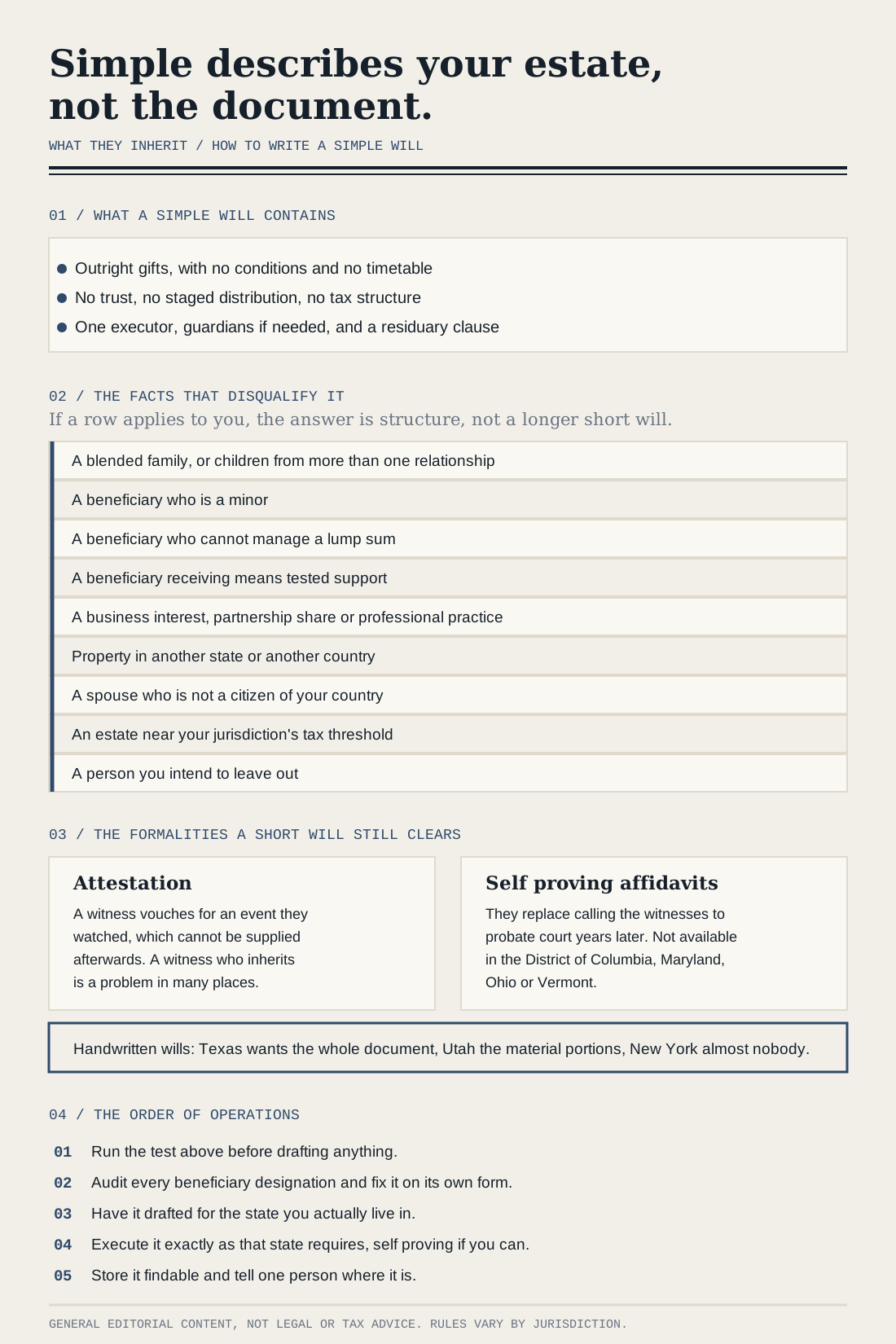
Here is the honest version of the qualifying test. Read down the left column. If none of these describe you, a simple will is very likely the right instrument. If one of them does, the answer is not a longer simple will, it is a different conversation.
| The fact | Why it disqualifies a simple will | What it points toward instead |
|---|---|---|
| A blended family, or children from more than one relationship | An outright gift to a surviving spouse relies on that spouse later passing it on to your children, which nothing in the document requires | A structure that gives the spouse use of the assets while fixing where they go afterwards |
| A beneficiary who is a minor | A minor cannot receive an outright gift and hold it, so the court supplies a mechanism you did not choose | A trust provision, or at minimum ask what your state's standard mechanism for holding a minor's gift is called before assuming an outright gift works |
| A beneficiary who cannot manage money, or who is in an unstable situation | The gift lands in full on day one, with no supervision, and it is gone before anyone notices | A structure that releases funds over time or through a trustee |
| A beneficiary receiving means-tested support | A lump sum can disturb eligibility for benefits that depend on assets | Specialist advice before any gift is drafted at all |
| A business interest, a partnership share, or a professional practice | Ownership, control and the money to pay for the handover move separately | The succession arrangements that sit outside the will |
| Property in another country or another state | A second jurisdiction's rules can apply to that asset, and its formalities may differ from yours | Advice in both places, not one document written in one of them |
| A spouse who is not a citizen of your country | Transfers between spouses can be treated differently where the recipient is not a citizen | Telling the professional who drafts the will that your spouse is not a citizen, before any gift to them is written |
| An estate near or above your jurisdiction's tax threshold | Structure starts to change the outcome, and a simple will has no structure | Planning, and how the whole set of instruments fits together |
| A person you intend to leave out | Exclusions are the most commonly challenged part of any will | Drafting done deliberately, with the challenge in mind |
Notice what is not on that list. The size of your house is not on it. Whether you feel your affairs are complicated is not on it. People with modest estates and blended families need structure. People with substantial estates and one straightforward line of descent often do not. The test runs on the shape of the family, not on the size of the number.
A short will clears exactly the same formalities as a long one
This is where writing your own goes wrong, and it goes wrong quietly. Nothing about a simple will relaxes the execution rules. A three page document signed incorrectly fails in precisely the way a thirty page document signed incorrectly fails.
The mechanism is attestation. The Legal Information Institute describes attestation as a kind of testimony or confirmation, and treats witnessing a will as the customary form of it: somebody watches you sign, then signs themselves to vouch for the document and for whose signature that is. The witness's own signature, on the Institute's account, is what may later confirm that they saw you sign. Its separate entry on wills puts the general practice more concretely, saying a validly executed will should be in writing and signed by the testator, that the making of it should be witnessed by two individuals, and that a valid will has to comply with the law of the place where it is executed or where the testator is domiciled.
Two things follow from that.
The witnesses are testifying to an event, so they have to be present for the event. A signature collected afterwards from someone who did not see you sign is not the thing the rule is asking for. And because the witness may later be asked to confirm what they saw, a witness who stands to inherit under the document is a problem in many places, which is why the person most likely to be in the room is often the person who should not be holding the pen. What your own state does about it is a question to put to the professional drafting the will, before you decide who signs.
There is also a step almost nobody writing their own will knows about, and it costs almost nothing. The Legal Information Institute describes a self-proving will as a regular will that meets certain requirements allowing it to be validated without the usual trip through probate court, and it explains the mechanism: in most states this is done by attaching two self-proving affidavits by the witnesses to the signing, signed in front of a notary public and stamped. In a few states the witnesses instead sign statements attached to the will testifying under penalty of perjury. Either way, those affidavits replace the usual method of proving the will, which is calling the witnesses to testify in probate court after the testator has died.
Consider what that removes. Without it, somebody has to find two people years later, establish that they are alive and locatable, and get them to court. With it, the document proves itself. The Institute also names four places that are outside this: the District of Columbia, Maryland, Ohio and Vermont. Everywhere else in the United States, on its account, the route is open. If you live in one of the four, it is not, and that is worth knowing before you go looking for it.
The handwritten shortcut, and the three rules it runs into
The shortest possible will is one written out by hand. It is also the one whose validity depends most sharply on where you happen to be standing.
The Legal Information Institute defines a holographic will as an unattested will written and signed in the testator's own handwriting, and it makes the key point directly: by definition it does not need witnesses to be valid, so it has no attestation requirement. It then says the thing that matters more than the definition. Some states and jurisdictions do not recognise holographic wills at all, and the requirements for a valid one vary according to state law.
The three examples it gives show how wide that variation runs.
| Jurisdiction | The rule the Legal Information Institute records |
|---|---|
| Texas | Texas Estates Code Title 2 Section 251.001, as the Institute quotes it: "a will written wholly in the testator's handwriting is not required to be attested by subscribing witnesses" |
| Utah | Under Utah Code Section 75-2-502, quoted by the Institute, a will "is valid as a holographic will, whether or not witnessed, if the signature and material portions of the document are in the testator's handwriting" |
| New York | Holographic wills are valid only when made by armed forces members in actual military or naval service during an armed conflict, by a person serving with or accompanying such a force, or by "a mariner while at sea" |
Three neighbours in a single country, three different answers. Texas wants the whole thing in your hand. Utah asks only for the signature and the material portions. New York restricts the form to people in circumstances most readers will never be in. And a fourth state may not entertain the idea at all.
That is the argument against treating a handwritten note as a plan. It may be a valid will where you live. It may be worth nothing four hundred miles away, or after you move, and the person who finds out is not you. If nothing survives, your state's intestacy rules apply instead, which is the default this whole exercise exists to displace.
What a simple will does not reach, and why the audit is part of writing one
A simple will is short partly because a meaningful share of what you own may never pass through it. Assets with a named beneficiary and assets held jointly with a right of survivorship commonly move by their own mechanism, on their own paperwork, regardless of what the will says.
The federal government's own life insurance programme is a clean illustration of how independent that mechanism is. The Office of Personnel Management says of the federal employees' programme that when a covered person dies the insurer will pay benefits "in a particular order set by law", and it sends readers to a handbook chapter titled "Order of Precedence and Designation of Beneficiary". A statutory order and a form on file. The will appears in neither, because it is not part of that process at all.
Private arrangements work on the same principle. A retirement account, a life policy, a payable on death account: each names a recipient on its own form, and that form is what gets read. The two directions a life insurance question can run are treated separately, and the beneficiary form is the operative document in both.
So the audit is not an optional extra. Before a simple will is signed, list every account and policy that names somebody, and read what each one currently says. A will leaving everything equally to three children, sitting alongside a retirement account still naming a former spouse, is not a simple estate. It is a contradiction with a short document on top of it, and the short document loses.
Changing it later
Plans change, and the instinct is to amend rather than start again. The formal tool for that is a codicil. The Legal Information Institute's entry on the codicil runs to two sentences, and the second is the one that gets missed. A codicil is a supplement that amends or revokes a will, wholly or partly, and, in the Institute's words, "a codicil does not replace the underlying will". The original stands. You have added to it.
For a simple will, that is usually an argument against using one. What it adds is a second document that has to survive, be found, and be reconciled with the first, and a second chance for the pair to be read as contradicting each other. Whether your state lets you amend a will more cheaply than you can replace one is a question for whoever drafts it, and this page does not have the answer for your jurisdiction. When the document is only a few pages, re-executing a clean replacement is normally the tidier route, and it leaves one authoritative version rather than a stack.
Whichever route you take, the trigger is the event rather than the calendar. The National Institute on Aging's guidance on getting your affairs in order asks readers to revisit the plan yearly, and again on any big change rather than waiting for the anniversary. The examples it reaches for are a divorce, a move, and a serious turn in someone's health.
Doing it in order
Five steps, and only one of them is writing.
Run the test first. Read the table above before you draft anything. If a row applies, the honest outcome is that you are not writing a simple will today, and finding that out before you pay for a document is the cheapest possible discovery.
Audit every beneficiary designation. Every policy, every retirement account, every account with a payable on death instruction. Get each one in front of you and read the name on it. Fix the contradictions there, on their own forms, because the will cannot fix them.
Have it drafted properly for where you live. The failures in this article are formalities and jurisdiction, which are exactly the two things a template cannot see and a qualified professional in your state can. A simple estate is the case where this costs least, which is a poor reason to skip it.
Execute it exactly as your state requires, and make it self-proving if you can. The specifics come from the same professional as the step above, because state by state formalities are precisely what a template cannot see. Witnesses present for the signing, none of them inheriting under the document, and the affidavits attached and notarised if your state offers that route.
Store it findable and tell one person. The National Institute on Aging is blunt about the mechanics. Gather the legal paperwork into a single location rather than four, make sure at least one person you trust, or your lawyer, could walk to it without hunting, and if the originals live in a bank box, leave duplicates in a file at the house. The reason is unglamorous. A document nobody can reach on the weekend it is needed produces the same practical result as never having written one.
The document is short, the thinking is not
The appeal of the phrase is that it promises less work. It delivers less document, which is a different thing.
What a simple will actually gives you is a clean instrument for an estate that has already been made simple, by a family shape that does not need structure and a set of designations that do not contradict each other. Getting to that position is the work. The drafting afterwards is the easy part, and it is the part the search term is asking about.
If the test sends you the other way, that is not a failure and it does not mean an expensive process. It means the money is better spent on the structure than on the pages. And whichever document you end up with, it decides who receives, never why. That remains the gap a legacy letter exists to close, and no will of any length closes it.
Last reviewed by the What They Inherit Editorial Team on September 9, 2026. Our sourcing and AI use rules are public on the editorial standards page. This is general editorial content and not legal, tax or financial advice. The formalities for signing and witnessing a will, the recognition of handwritten wills, the availability of self proving affidavits and the treatment of estate tax are all set at state or national level and vary. Speak to a qualified professional licensed where you live before acting on anything here.
FAQ
What is a simple will?
It is the version that hands every gift straight to the recipient on the day the estate is settled, with nothing holding the money back and no condition attached to receiving it. There is one executor, a clause catching whatever was not listed by name, and guardians where there are young children. What earns a will that label is never the page count. It is whether handing money over with no supervision is safe for the people receiving it, which is a question about your family rather than about your drafting preferences.
Can I write a simple will myself?
In many places you legally can, and the exposure is not in the words. It is in the signing, which is the one part you cannot inspect for yourself afterwards. The Legal Information Institute's account of attestation shows why. What a witness vouches for is an event they observed, which is not something a person can supply after the fact, so a signature collected later from somebody who was not in the room does not do the job the custom exists to do. A shorter document does not lower that bar by a single requirement. The other thing a professional does that a template cannot is tell you whether any of the disqualifying facts in this article actually applies to you, which is the answer you came for.
Does a simple will need witnesses?
Ordinarily yes, and how many and in what manner is set by the law of the place you live. There is one recognised exception, and it is narrower than it sounds. The Legal Information Institute records that a handwritten will is unattested by definition and so carries no attestation requirement, while also noting that some states and jurisdictions do not recognise such a will at all and that the requirements vary according to state law. So the exception is not a route you can choose. It is a route your state either offers you or does not, and you cannot tell which from the document in front of you.
What is a self-proving will and should mine be one?
Start with what happens if yours is not one. Somebody has to trace your two witnesses years after the signing, establish that they are alive and reachable, and get them in front of a probate court to say what they saw. The Legal Information Institute describes the alternative as a regular will meeting requirements that let it be validated without that trip, generally through two witness affidavits notarised and attached to it, though the Institute notes a handful of states take a sworn statement instead of a notary's stamp. Four places sit outside it on the Institute's account, those being Vermont, Ohio, Maryland and the District of Columbia. If you are not in one of them, the trade is a single notary appointment against a step removed from a slow process, which makes it worth raising with whoever drafts the document.
How much money is too much for a simple will?
There is no dollar figure, and the question usually points at the wrong variable. For federal estate tax the Internal Revenue Service publishes a filing threshold by year of death, set at $15,000,000 for deaths in 2026, and estates below it generally do not require a return. That threshold answers the tax question and nothing else. What actually disqualifies a simple will is the shape of the family: a blended household, a minor beneficiary, a beneficiary who cannot manage a lump sum, a business interest, or property in a second jurisdiction. A modest estate can need structure and a large one may not. The federal figure above is the only tax threshold this page cites, and whether anything further applies where you live is a question for a professional licensed there.
Does a simple will cover my life insurance and my retirement account?
Usually not, and the way to see it is to imagine the two disagreeing. Suppose the will divides everything between a brother and a sister, while the pension form filled in years earlier still names a parent who is now dead. The will does not reach the pension. The form does, and the form is what the provider reads. The Office of Personnel Management sets out the federal version of the same logic, describing an insurer that pays out on a statutory order of precedence and on whatever designation is on file. Private policies and accounts run on that principle too. Which is why reading every designation you have on file is a step in writing the will, not a task for afterwards.
Should I use a codicil to change a simple will?
Generally not, once the document is only a few pages. A codicil is the formal instrument for amending a will without rewriting it, and the Legal Information Institute's entry on it is careful to say what it does not do: the will it amends stays in force underneath. So you finish holding two documents where you meant to hold one, and both of them have to survive and be found for the result to come out as intended. For something only a few pages long, replacing it outright leaves less to lose track of than amending it. What each route costs in signing and witnessing where you live is a question for the professional drafting it.
What happens to a simple will if I move to another state?
It does not automatically fail, but it stops being a document written for the rules that now apply to you. Execution formalities, the recognition of handwritten wills and the availability of self proving affidavits all vary by state, and the Legal Information Institute's own examples show three states treating handwritten wills three different ways. A move is one of the events the National Institute on Aging names as a trigger for review. Have the document looked at by a qualified professional licensed in the new state rather than assuming it travelled with you.
What is a holographic will?
One written out and signed by hand by the person whose will it is, with no witnesses attesting to it. The Legal Information Institute treats the absence of attestation as part of the definition rather than a defect, which is why the handwriting itself carries the weight. The catch is recognition. Whether such a will counts at all is decided entirely by state law, and the range is wide: Utah accepts one, witnessed or not, where the signature and the material portions are in the testator's own hand, while New York confines it to members of the armed forces during an armed conflict, people serving alongside them, and a mariner at sea. Some states do not permit them at all. Find out where your state sits before treating handwriting as a shortcut.
Sources
- attestation (law.cornell.edu)
- wills (law.cornell.edu)
- self-proving will (law.cornell.edu)
- holographic will (law.cornell.edu)
- "in a particular order set by law" (opm.gov)
- codicil (law.cornell.edu)
- getting your affairs in order (nia.nih.gov)
- filing threshold by year of death (irs.gov)