A Living Trust Fund Is Not One Thing, and the Version You Mean Changes Every Answer
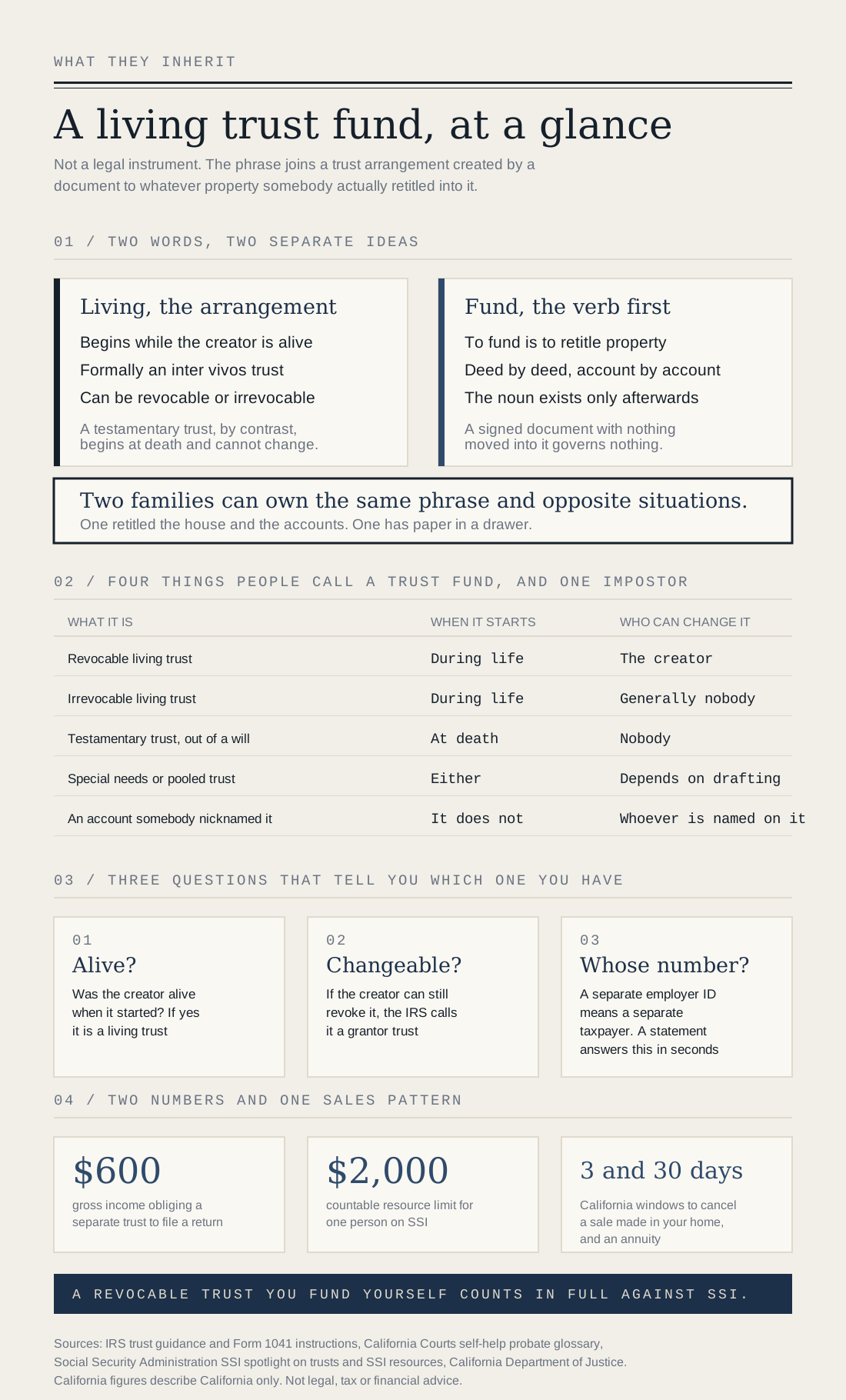
There is no legal instrument called a living trust fund. The phrase welds two separate ideas together. A living trust is the arrangement, created by a document, while a person is still alive. A fund is whatever property somebody actually moved into it. People use the joined phrase for at least four arrangements that behave nothing alike, and the answer to every practical question you have, who controls the money, whether it can still be changed, who pays the tax on it, whether a beneficiary keeps their disability benefits, flips depending on which one you are actually looking at.
California's courts define the two halves separately and plainly. In their glossary of probate terms, a trust is an arrangement where property is given to someone to be held for the benefit of another person, and a living trust is a trust created during the life of a person to distribute money or property to another person or organization. Neither definition contains the word fund.
None of this is legal, tax or financial advice. Trusts are creatures of state law, so there is no single national rule, and the figures below are federal unless stated otherwise. Before you act on any of it, speak to a lawyer and a tax professional licensed where the person who created the trust lives or lived and where the property sits.
The word fund is a verb before it is a noun
Most of the confusion sits in that one word. People hear fund as a noun, a pot of money with a name on it, like a pension fund or a hedge fund. In trust law it is first a verb. To fund a trust is to retitle property into the name of the trust, deed by deed and account by account. The noun only exists afterwards, and only to the extent somebody did the verb.
This is why two families can both say they have a living trust fund and mean opposite situations. One has a signed document and a house, a brokerage account and three bank accounts all retitled into the trust. The other has a signed document in a drawer and everything still held in a personal name. The second family owns a piece of paper. We walk through that failure asset by asset in a living trust does nothing until something is moved into it.
Living means the person was alive when it started
The other half of the phrase is doing real work too, and it is the cleanest line in the whole subject.
The IRS draws it in one paragraph. In its questions and answers on trust arrangements, a testamentary trust is created by a will, begins its existence upon the death of the person making the will, and is irrevocable by definition because it comes into being at the death of its creator. An inter vivos trust, which is the formal name for a living trust, is created by a living person during that person's lifetime, and can be set up as either revocable or irrevocable.
So a living trust starts while somebody is alive and breathing, and there is a period, often decades long, in which the creator is watching it operate. A testamentary trust starts at a funeral. The trust fund of popular imagination, the one a young adult inherits at twenty five under conditions a parent set, is usually a testamentary trust, not a living one.
The four things people call a living trust fund, and one impostor
Each row below is a real arrangement somebody has described to a bank using that phrase. Read across and the differences stop being academic.
| What it actually is | When it starts | Who can change it | Whose income tax return reports it |
|---|---|---|---|
| Revocable living trust, the standard estate planning version | While the creator is alive, on the day the document is signed | The creator, at will, for as long as they have capacity | The creator's own personal return, because the IRS treats every revocable trust as a grantor trust |
| Irrevocable living trust, created during life but given away for good | While the creator is alive | Generally nobody, though state law and the document occasionally allow narrow changes | Usually the trust's own return, though it depends on which powers the creator kept |
| Testamentary trust, the classic inheritance trust fund | At the creator's death, out of the estate | Nobody, because its creator is dead | The trust's own return |
| Special needs or pooled trust, holding money for a person with a disability | Either during life or at death, depending on who set it up | Depends entirely on the drafting and the statute it was built under | Depends on the structure, and the benefits question usually matters more than the tax one |
| A bank account somebody nicknamed the trust fund | It does not, because it is not a trust | Whoever is on the account | Whoever is on the account |
That last row is not a joke. Families label a savings account the college fund or the trust fund, and the label carries no legal weight whatsoever. When the person who opened it dies, the account passes on whatever the paperwork says, a surviving co-owner or a payable on death instruction, or it lands in the court process described in what probate reaches and what it never touches.
Three questions that tell you which one you have
You do not need the document to work out which row you are in. Three questions get you there.
Was the person who created it alive when it started? If yes, it is a living trust, whatever the family calls it. If it came into existence at a death, out of a will, it is testamentary and it is already irrevocable.
Can anybody change it, and who? A trust the creator can still amend or revoke is a revocable living trust, and the IRS says that by definition makes it a grantor trust, with the creator treated as the owner of the assets and the trust disregarded as a separate tax entity. A trust nobody can change is either irrevocable by drafting or irrevocable because its creator died.
Whose taxpayer number is on the accounts? This is the fastest test, because a bank statement answers it in seconds. A revocable living trust usually runs on the creator's own Social Security number. A trust with its own employer identification number is being treated as a separate taxpayer, which tells you it is not a simple revocable arrangement.
Who pays the tax changes with the answer
The tax consequence follows directly from the second question, and it is the single most common surprise.
A revocable living trust generates no separate tax life at all. The IRS is explicit that where a trust is a grantor trust, it is not required to file a Form 1041 as long as the individual grantor reports all items of income and allowable expenses on their own personal return. People who set up a revocable trust expecting a tax benefit have bought something that does nothing on that front, by design.
Once a trust is genuinely separate, the picture changes. The IRS position, set out in the instructions for Form 1041, the income tax return for estates and trusts, is that a domestic trust must file it for any taxable year in which it has any taxable income at all, or gross income of $600 or more regardless of taxable income, or a beneficiary who is a non-resident alien. That return is not a one time chore. It recurs every year the trust holds income producing property, which for a trust set up to run until a grandchild turns thirty can mean decades of filings, and somebody has to be paid to do them. We set that running cost out in what a family trust actually creates, and who has to run it.
If the beneficiary receives means tested benefits, the label decides everything
This is the situation where getting the phrase wrong does real harm, and it is the reason a general purpose living trust is sometimes exactly the wrong instrument.
The Social Security Administration explains in its spotlight on trusts that if you use your own assets to establish a trust on or after January 1, 2000, the trust will generally count as your resource for Supplemental Security Income. In the case of a revocable trust, the whole trust counts. In the case of an irrevocable trust, the portion from which payment could be made to you or for your benefit counts. Set against that, the agency's countable resource limit is $2,000 for an individual and $3,000 for a couple.
Put those two facts side by side and the consequence is stark. A parent who moves money into a revocable living trust intending to look after a disabled adult child has, in the SSI analysis, simply handed that child a countable resource. The agency names the exceptions itself: trusts under section 1917(d)(4)(A) of the Social Security Act, commonly called special needs trusts, and trusts under section 1917(d)(4)(C), commonly called pooled trusts. Those are specific statutory creatures with drafting requirements, not a label you can apply afterwards to a trust you already have, and the agency adds its own caution that certain revocable versions of even these trusts can still count as a resource.
The Social Security Administration adds two cautions worth repeating. It states directly that it cannot tell you how to set up a trust and that you should consult a lawyer or financial advisor. And it warns that some trusts and trust payments it does not count for SSI purposes can still affect Medicaid eligibility, which is a separate program with separate state rules. If a person in your family relies on SSI or Medicaid, that dependency should be the first thing said in the first meeting with a lawyer, not a detail mentioned at the end.
What the phrase gets used to sell
The vagueness is commercially useful, which is why consumer protection agencies write about it at all.
The California Department of Justice publishes a warning about living trust mills. Its description of the pattern is specific. Salespeople solicit older adults by phone, mail or email, or at churches and assisted living centers. They offer free seminars about trusts, wills or taxes, or about the need to update an existing trust. They call themselves trust advisors or senior estate planners. They schedule a follow up appointment in the home to gather information. And then, in the department's words, they try to convince people to buy financial products they do not need, pay for estate planning that turns out to be defective, and hand over personal and financial information.
The department is blunt about the economics: agents usually get paid high commissions on the living trust packages and financial products they sell, and their goal is to sell rather than to protect you. It flags annuities in particular, noting that sales agents may falsely claim annuities are safe or guaranteed by the government, and may fail to disclose the surrender penalties that apply in the first several years. Its cancellation rules are worth knowing before any meeting: with some exceptions, a consumer sale made in your home can be cancelled within three days, and a buyer who was 60 or older when they bought an annuity has 30 days from receiving it to cancel without a surrender penalty. The same guidance is specific about timing: do not sign or agree to anything on the spot, review any trust or investment document with a financial or tax advisor, an attorney, and trusted family members before committing to it, and remember that an attorney qualified in estate planning, one you chose yourself rather than one the seminar handed you, can tell you whether a living trust is the right instrument at all.
One line from that guidance is the whole defense. Not everyone needs a living trust, and the department says to be wary of anyone who claims otherwise or promotes a one size fits all trust kit.
What a living trust fund does not do
Four things get attached to the phrase that do not belong to it.
It is not a tax shelter. A revocable trust is disregarded for income tax and changes nothing about what its creator owes. The IRS also states flatly that income earned by one person cannot be assigned to another for federal income tax purposes, which closes the door on the pitch that a trust makes earned income somebody else's problem.
It is not automatic protection from creditors. Property in a trust the creator can revoke at any moment is property the creator still effectively controls, and the law generally treats it that way.
It does not avoid the court process on its own. It avoids it for property that was genuinely retitled into it. Everything left in a personal name goes the ordinary route regardless of what the trust document says.
It is not a substitute for a will. Most people with a living trust still need one, if only to catch whatever never made it in. That interaction is set out in what a will actually has to do and in the wider map at what estate planning actually consists of.
Two questions before anyone drafts anything
If you have read this far because somebody used the phrase at you, these are the two questions that decide whether you need any of it.
What problem is the trust solving that a will and a beneficiary form do not? Retirement accounts, life insurance and payable on death bank instructions already pass outside the court process to a named person. If most of what a family owns is already arranged that way, a trust may be solving a problem that is not there.
Who is going to run it, and for how long? A trust is an administrative job with a start date and no obvious end. Somebody keeps the records, files the returns, and answers to the beneficiaries, for as long as the trust exists.
Last reviewed by the What They Inherit Editorial Team on September 18, 2026. Our sourcing and AI-use rules are public on the editorial standards page. This is general editorial content and not legal, tax or financial advice. Trusts are created and governed by state law, so the rules on validity, revocation, trustee duties and creditor reach vary by state and none of them are described here. The federal tax and Supplemental Security Income rules summarized above come from the agencies' own published guidance and are not a substitute for advice on your situation. The consumer protection figures are California's and describe no other state. Speak to a lawyer and a tax professional licensed where the person who created the trust lives or lived and where the property is held, and if a beneficiary relies on SSI or Medicaid, say so at the first meeting.
FAQ
What is a living trust fund?
It is not a single legal instrument. The phrase joins a living trust, which is an arrangement created by a document while its creator is alive, to the fund, which is whatever property somebody actually retitled into it. People use the joined phrase for at least four different arrangements, and which one is meant changes who controls the money and who pays the tax on it.
Is a living trust the same as a trust fund?
Not usually. A living trust begins while its creator is alive. The trust fund people picture, where a young adult receives money under conditions a parent set, is more often a testamentary trust, which the IRS describes as created by a will, beginning at the death of the person who made it, and irrevocable by definition.
What does it mean to fund a living trust?
Funding is the act of retitling property into the name of the trust, deed by deed and account by account. Until that is done the trust governs nothing. The asset-by-asset mechanics, and why this step gets skipped so often, are set out in a living trust does nothing until something is moved into it.
Does a living trust have its own bank account?
It can, and a funded one normally does. Whether that account runs on the creator's own Social Security number or on a separate employer identification number is one of the quickest ways to tell whether you are looking at a revocable trust the creator still controls or a genuinely separate one.
Who pays the tax on a living trust fund?
For a revocable living trust, the creator does, on their own personal return, because the IRS treats every revocable trust as a grantor trust and disregards it as a separate tax entity. A trust that is genuinely separate must file its own Form 1041 for any taxable year in which it has any taxable income at all, or gross income of $600 or more, or a non-resident alien beneficiary.
Can a living trust be changed?
A revocable one can be amended or revoked by its creator for as long as they have capacity. An irrevocable one generally cannot, and a testamentary trust never can, because it only comes into existence once its creator has died. What that split means for who administers the trust and pays its taxes over the years it runs is set out in what a family trust actually creates, and who has to run it.
Will a living trust protect money for a disabled family member?
Not by itself, and it can do harm. The Social Security Administration counts a revocable trust funded with a person's own assets as their resource in full, against a countable resource limit of $2,000 for an individual. The exceptions it names are special needs trusts under section 1917(d)(4)(A) and pooled trusts under section 1917(d)(4)(C), which are specific statutory structures rather than labels applied afterwards.
Does a living trust reduce income tax?
No. A revocable living trust is disregarded for income tax purposes, so it changes nothing about what its creator owes. The IRS also states that income earned by one person cannot be assigned to another for federal income tax purposes.
How do I find out what my parents actually set up?
Ask for the first page and the signature page of the document, which will say whether it is revocable, and ask whose taxpayer number the accounts run on. Then ask the question that matters more than either: which assets were actually retitled into it, and which were left in a personal name.
Is a free living trust seminar worth attending?
Treat it as a sales meeting. The California Department of Justice describes living trust mills that use free seminars and home visits to sell financial products people do not need, and notes that agents are usually paid high commissions on what they sell. Its own guidance is that not everyone needs a living trust and that a one size fits all trust kit is a warning sign.
Sources
- their glossary of probate terms (selfhelp.courts.ca.gov)
- questions and answers on trust arrangements (irs.gov)
- instructions for Form 1041 (irs.gov)
- spotlight on trusts (ssa.gov)
- countable resource limit is $2,000 for an individual and $3,000 for a couple (ssa.gov)
- living trust mills (oag.ca.gov)