Estate Planning for Generational Wealth
An ordinary estate plan is built to survive one handover. It moves what you own to the people you name, and its job is finished the day the estate closes. A plan intended to reach a third generation is a different instrument, because the federal system does not treat two handovers as one long event. It treats them as two separate taxable moments, and it has a dedicated tax whose entire purpose is to stop you from skipping the one in the middle.
That is the practical difference, and it is not a matter of scale. It is not the same plan with bigger numbers in it. It is a plan that has to answer three questions an ordinary one never asks: which layer of the family a transfer is assigned to, whether an exemption was allocated to it at the right moment, and what the cost basis of the asset will be when someone eventually sells it. Cost basis is what an asset is treated as having cost for tax purposes, and it decides how much taxable gain appears on a later sale.
The tax that exists to stop you skipping a generation
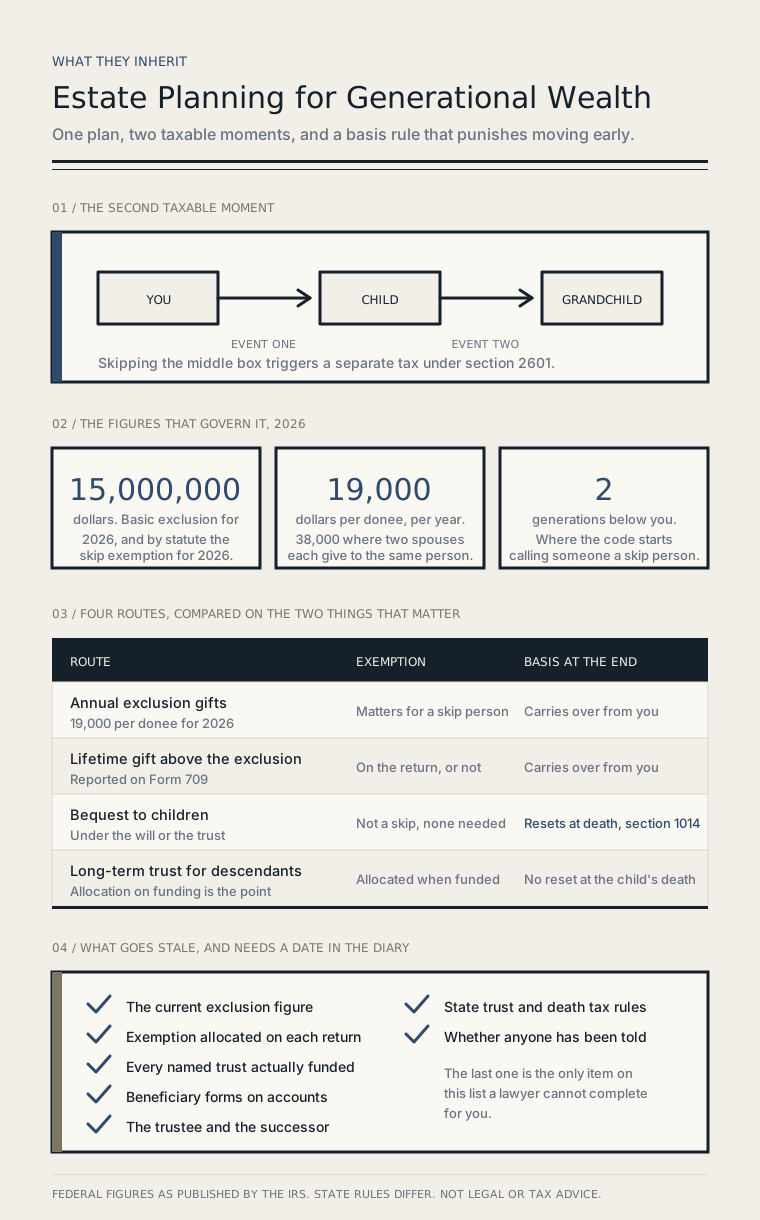
If money passes from you to your child and later from your child to your grandchild, it crosses two potential estate tax events. The obvious way to avoid the second one is to leave the money straight to the grandchild. Congress closed that route. 26 U.S. Code section 2601 states plainly that a tax is imposed on every generation-skipping transfer.
Who counts as skipped is defined, not judged. Under section 2613, a skip person is a natural person assigned to a generation two or more generations below the generation assignment of the transferor. A trust can also be a skip person, in either of two ways. The first is where all interests in the trust are held by skip persons. The second requires both halves of a two-part test to hold: there is no person holding an interest in the trust, and no distribution may be made from it to a non-skip person at any time after the transfer. A grandchild is the ordinary case. A trust written only for grandchildren and their descendants is the case people build on purpose.
The rate is not a separate schedule you can look up and plan around. Section 2641 defines the applicable rate as the product of the maximum federal estate tax rate and the inclusion ratio for the transfer. The inclusion ratio is the part you influence. It is a fraction that runs between zero and one, and it measures how much of the transfer your allocated exemption does not cover. Allocate exemption across the full value and the fraction falls to zero, which drives the rate to zero with it. Allocate none and the fraction stays at one, which leaves the transfer exposed at the top estate tax rate.
This is why generation-skipping planning is mostly an allocation exercise rather than a rate exercise. There is no clever structure that gets a better rate. There is only exemption applied to the right property at the right time, or exemption not applied.
The exemption is per person, and it is claimed rather than granted
The second thing that separates a generational plan from an ordinary one is that its central allowance belongs to an individual and has to be pointed at something.
Section 2631 states that every individual is allowed a generation-skipping transfer exemption which may be allocated by that individual, or by their executor, to any property with respect to which that individual is the transferor. Subsection (c) then sets the amount: the exemption for any calendar year equals the basic exclusion amount under section 2010(c) for the same year.
That cross reference is what ties the whole subject to a single figure. The IRS states that the Working Families Tax Cuts Bill, signed into law on July 4, 2025 as Public Law 119-21, amended section 2010(c)(3) by increasing the basic exclusion amount to $15,000,000 for calendar year 2026. Under section 2631(c), that is also the generation-skipping exemption for 2026.
Three consequences follow, and they are the ones people miss.
The exemption attaches to a transferor, not to a family and not to a pot of money. Two spouses have two exemptions. Neither one is a household allowance that the survivor automatically inherits. The IRS describes a portability election under which estates of decedents survived by a spouse may elect to pass any of the decedent's unused exemption to the surviving spouse, made on a timely filed estate tax return. That description sits on the estate tax page and concerns the exclusion used for estate tax. Section 2631 vests the generation-skipping exemption in the individual and puts allocation in the hands of that individual or their executor. Do not assume the two allowances behave identically. Put the question to a professional before a plan is built on the answer.
Allocation is an act, performed on a return. It is not a status that a trust acquires by being called a dynasty trust. Form 709 is the United States Gift and Generation-Skipping Transfer Tax Return. A transfer into a long-term trust with no allocation recorded is a transfer with an inclusion ratio that is not zero, whatever the trust document is named.
The number is set by statute, and Congress can amend it again as readily as it amended it last. The $15,000,000 exclusion arrived through an act of Congress in July 2025. A plan intended to run for forty years cannot treat the current number as a fixed feature of the landscape, and a plan whose only merit is that it fits under today's threshold is a plan with an expiry date nobody wrote down. This is the single strongest argument for the review cycle set out further down.
The federal layer is also only one layer. States levy their own estate and inheritance taxes under their own thresholds and their own rules, and a state that taxes an estate the federal government never touches is an ordinary situation rather than an unusual one. Confirm the position where the person actually lives and where the assets are held.
The basis trap, which is the cost of moving assets early
The instinct in generational planning is to move appreciated assets out of your estate as early as possible, because an asset that leaves early takes its future growth with it. That instinct is sound on the transfer tax side and expensive on the other side.
Answering a question about gifted property, the IRS states the general rule that your basis in the property is the same as the basis of the donor, and gives the worked example of stock the donor purchased at $10 a share and the recipient later sold at $100 a share, on which the recipient pays income tax on a gain of $90 a share. The agency adds a pointed note in the same answer: the rules are different for property acquired from an estate.
They are different in the direction that matters. 26 U.S. Code section 1014 opens with an exception clause and then sets the general rule: the basis of property acquired from a decedent is the fair market value of the property at the date of the decedent's death. The section itself names alternatives, including an election to value the estate on a later date, so read it as the default rather than the only possibility. The unrealised gain accumulated during a lifetime is not carried forward to the person who inherits.
Read the two rules together and the shape of the decision appears. A gift moves the asset and the entire embedded gain. A bequest moves the asset and resets the measuring point. For a family holding an asset bought decades ago at a fraction of its present value, the difference between those two treatments can be larger than the transfer tax the gift was made to avoid.
The trap has a second floor, and it is the one that catches long-term trusts specifically. A plan that places assets in an irrevocable trust so they are not taxed again at the child's death is a plan that has also removed those assets from the child's estate. Assets that are not in an estate are not property acquired from a decedent. This is the honest trade at the centre of a dynasty structure: one basis reset is being exchanged for the removal of a future transfer tax event, and which side wins depends on the size of the estate, the size of the embedded gain, and how long the asset is actually going to be held. That calculation is specific to the family and it belongs with a tax professional. What belongs on this page is the warning that a structure sold on the transfer tax saving alone has only shown you one side of the ledger.
The vehicles, and what each one actually settles
The instruments are not four routes to the same result. They differ in when the transfer happens, whether an exemption has to be allocated, and what happens to basis.
| Route | When the transfer lands | Generation-skipping exemption | Basis at the far end |
|---|---|---|---|
| Annual exclusion gifts | Each calendar year, up to $19,000 per donee for 2026 | Allocation still matters where the recipient is a skip person | Carryover from the giver |
| Outright lifetime gift above the exclusion | On transfer, reported on Form 709 | Allocated on the return, or not allocated at all | Carryover from the giver |
| Bequest to children under the will or trust | At death | Not a skip transfer, no allocation needed | Fair market value at death, section 1014 general rule |
| Long-term trust for descendants | On funding, then held | Allocation on funding is the whole point of the structure | No reset at the child's death, since the asset is outside their estate |
Two notes on reading that table. The first is that the annual exclusion is per donee and per year, and the IRS table shows $19,000 for both 2025 and 2026, with $38,000 per donee where two spouses each give. It is the only mechanism in the list that does not consume any part of the lifetime exclusion, which makes it the quiet workhorse of long-horizon plans and the one most often left unused because it requires doing the same small thing every year for twenty years.
The second is that the trust row is the only one where the document itself does structural work rather than simply carrying instructions. What that document can do, who has to administer it, and what it costs to run are covered separately in what a family trust actually creates. A trust that is never funded does nothing at all, which is the most common failure in this whole subject and the reason it appears in the review list below.
How long a trust may run is a state question rather than a federal one. The common law rule stops a trust from controlling property indefinitely. It requires an interest to vest, meaning to reach a known and verified individual, within 21 years of a life in being, which is a person who was alive when the interest was created. Cornell's Legal Information Institute notes that many jurisdictions have modified the rule against perpetuities and others have abolished it altogether. A dynasty trust is possible where the rule has been relaxed and constrained where it has not. That is a question for a lawyer licensed in the relevant state, and it is settled before the trust is drafted rather than after.
What the plan cannot reach
None of the routes above answer whether the family that receives the assets can hold them. The failures that actually consume family money over three generations are not failures of allocation, and we set them out separately in why most generational wealth is gone by the grandchildren. The short version worth carrying into any conversation with a lawyer is that a perfectly drafted structure delivered to people who were told nothing about it produces a well-documented handover to an unprepared recipient.
There is also a category of asset the transfer tax rules never touch and the paperwork has nowhere to record. Why a business was kept rather than sold, why one child was given the responsibility of trustee, what the money was originally for. A structure states the decision. It has no field for the reason, which is what a letter written alongside the documents exists to hold, and what the values a household can actually name out loud tend to carry better than any instrument.
The review cycle a multi-generation plan needs
A multi-generation plan has more parts calibrated to numbers that move, which is why it cannot survive being reviewed only once in a while.
| Check | Why it goes stale |
|---|---|
| The current exclusion figure | Set by statute and changed by Congress, most recently in July 2025 |
| Whether exemption was allocated on the return for each funding | Allocation happens on a filed return, not by naming the trust |
| That every trust named in the plan is actually funded | An unfunded trust holds nothing and controls nothing |
| Beneficiary forms on retirement accounts and policies | They pay under the contract and are not redirected by the will |
| The trustee, and the named successor | Trustees age, move, resign and fall out with beneficiaries |
| The state rule on trust duration and state death taxes | Both are state law and both change with a move |
| Whether the next generation has been told anything | The only item on this list a lawyer cannot complete for you |
Two of those rows connect to work already on this site. The beneficiary form row is the same mechanism that makes a beneficiary designation outrank the will, and it is worth re-checking every time an account is opened or rolled over. The funding row belongs with the wider question of what an estate plan actually consists of, where an unfunded trust is the most common join that comes apart.
Set the review on a calendar rather than on an intention, and pair it with the drafting work in how to write a will so the documents are reviewed as a set rather than one at a time. A plan reviewed once a decade is a plan calibrated to a world that has already moved.
Last reviewed by the What They Inherit Editorial Team on September 2, 2026. Our sourcing and AI-use rules are public on the editorial standards page. This is general editorial content and not legal, tax or financial advice. Tax figures cited are the federal position as published by the IRS and are set by statute that Congress has amended before. State estate, inheritance and income taxes, and state rules on how long a trust may run, are separate from these federal rules and vary by state. Speak to a qualified attorney and tax professional licensed in your own jurisdiction, and where your assets are held, before acting on anything here.
FAQ
What is estate planning for generational wealth?
It is estate planning built to survive more than one handover. An ordinary plan moves assets from you to the people you name and its work is finished. A generational plan has to clear a second taxable moment when those people die, which means it deals with the generation-skipping transfer tax under 26 U.S. Code section 2601, the allocation of the exemption under section 2631, and the cost basis of the assets at each stage.
What is the generation-skipping transfer tax?
It is a separate federal tax imposed on transfers that pass down two or more generations. Section 2601 imposes a tax on every generation-skipping transfer. Section 2613 defines a skip person as a natural person assigned to a generation two or more generations below the transferor, and can also treat a trust as a skip person, where all interests in it are held by skip persons, or where nobody holds an interest in it and no distribution to a non-skip person may ever be made from it. It exists so that leaving money straight to a grandchild does not simply bypass a layer of estate tax.
How much can you pass to grandchildren tax free in 2026?
Section 2631(c) sets the generation-skipping exemption equal to the basic exclusion amount under section 2010(c) for the same calendar year. The IRS states that Public Law 119-21, signed on July 4, 2025, increased the basic exclusion amount to $15,000,000 for calendar year 2026. That is the federal figure for 2026 only, it belongs to an individual transferor rather than to a household, and states apply their own separate rules.
Does the generation-skipping exemption apply automatically?
Do not plan on it. Section 2631 says the exemption may be allocated by the individual or by their executor, which makes allocation something that is done, on a filed return, in respect of specific property. Form 709 is the United States Gift and Generation-Skipping Transfer Tax Return. Naming a trust a dynasty trust does not allocate anything to it. Confirm with a tax professional how allocation was made for every funding, because the effect of getting it wrong appears decades later.
Is it better to gift assets during life or leave them in a will?
The two are taxed on different tracks and the answer depends on the asset. The IRS states that with a gift your basis in the property is the same as the basis of the donor, so the whole embedded gain travels to the recipient. Section 1014 sets out a general rule, subject to exceptions named in the section itself, that the basis of property acquired from a decedent is fair market value at the date of death, so that gain is not carried forward. Gifting reduces the estate. Inheriting resets the basis. Which is worth more is specific to the asset and the family, and it is a question for a tax professional.
Do assets in a dynasty trust get a step-up in basis?
Not at the child's death, and that is the trade being made. Step-up is the common name for the basis reset described earlier on this page. Section 1014 applies to property acquired from a decedent. Assets held in an irrevocable trust for the benefit of descendants have deliberately been kept out of the child's estate, which is what avoids the second transfer tax, and the same fact means there is no basis reset when the child dies. The structure buys one thing and gives up another. Ask for both sides in writing before signing.
How much can I give my children each year without filing anything?
The IRS annual exclusion is per donee for the calendar year of the gift, and its table shows $19,000 for 2025 and $19,000 for 2026, with a total of $38,000 per donee where two spouses each give. Gifts within the annual exclusion are not taxable gifts. Where the recipient is a grandchild or another skip person, the generation-skipping rules still need to be considered alongside the exclusion, so check that point rather than assuming a small gift is outside the system.
Can a trust really last forever?
It depends on the state. The common law rule against perpetuities requires an interest to vest, meaning to reach a known and verified individual, within 21 years of a life in being, which is a person who was alive when the interest was created. In plain terms it puts a clock on how long a trust can keep controlling property. Cornell's Legal Information Institute notes that many jurisdictions have modified the rule and others have abolished it entirely. Where the rule has been relaxed a long-running dynasty trust is possible, and where it has not the trust has a legal end date. Settle this with a lawyer licensed in the relevant state before the trust is drafted.
Does a surviving spouse inherit an unused exemption?
Treat this as two questions rather than one. The IRS describes a portability election under which estates of decedents survived by a spouse may elect to pass the decedent's unused exemption to the surviving spouse, made on a timely filed estate tax return, and that description concerns the exclusion used for estate tax. Section 2631 vests the generation-skipping exemption in the individual, with allocation by that individual or their executor. The two allowances are not described in the same terms, so confirm the position for each with a professional rather than assuming they behave alike.
What makes a generational plan go stale?
The numbers and the people. The exclusion figure is set by statute and Congress changed it as recently as July 2025. Trustees resign, move and die. Beneficiary forms are rewritten every time an account is opened or rolled over, and they pay under the contract rather than under the will. Trusts get created and never funded. A plan meant to run for decades needs a review on a fixed schedule, and the item most often skipped is telling the next generation that any of it exists.
Sources
- 26 U.S. Code section 2601 (law.cornell.edu)
- section 2613 (law.cornell.edu)
- Section 2641 (law.cornell.edu)
- Section 2631 (law.cornell.edu)
- Public Law 119-21 (irs.gov)
- estate tax (irs.gov)
- general rule (irs.gov)
- 26 U.S. Code section 1014 (law.cornell.edu)
- rule against perpetuities (law.cornell.edu)