Family Business Succession: The Handover Most Owners Leave to Their Executor
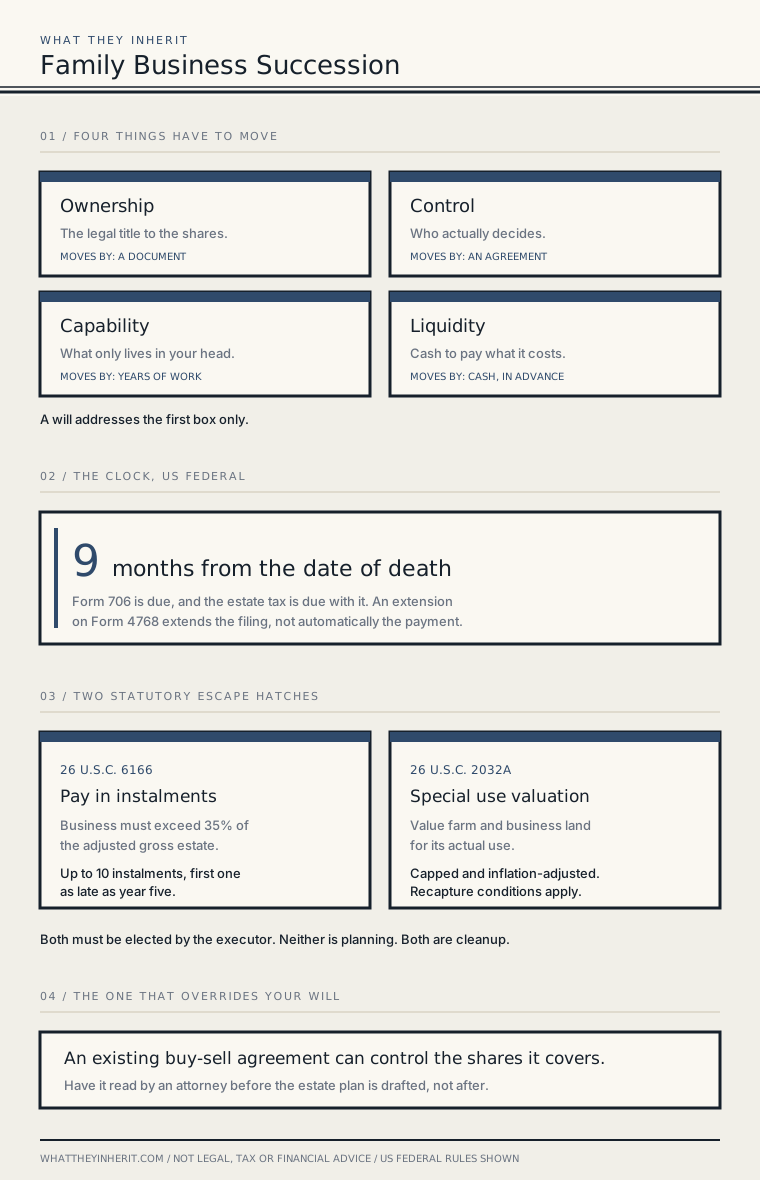
Family business succession is the transfer of four separate things: ownership, control, capability, and the liquidity to pay for the handover. Each of them moves by a different mechanism, on a different timetable, to a person who may or may not be the same person in each case. Owners who treat succession as a single event, to be handled in the will, are handing their family a puzzle with four pieces and instructions for one.
A house transfers itself. Somebody signs, the deed changes hands, and the house carries on being a house regardless of who now owns it. A business does not work like that. It is not one asset. It is four things bolted together.
What succession actually means, and what it is not
Succession is not selling. Selling is an exit: you convert the business to cash, and the cash then behaves like any other estate asset. It has its own difficulties, and the Small Business Administration sets out the practical sequence in its guide to closing or selling a business, but it is a comparatively clean problem because at the end of it there is a number.
Succession is the harder version. The business keeps operating, the family keeps owning it, and the person at the centre of it changes. Nothing converts to cash, so nothing gets simple.
The distinction matters because most of the advice an owner hears is really exit advice wearing succession clothing. Valuation methods, deal structures, tax on the proceeds. Useful if you intend to leave. Close to irrelevant if you intend the thing to carry on without you.
The four things that have to move
Ownership. The legal title to the shares, the partnership interest, the membership units. This is the piece that a will or a trust can genuinely handle, and it is the piece owners concentrate on because it is the one with a document attached. It is also the least difficult of the four.
Control. Who decides. Ownership and control are routinely separated in family firms, deliberately and sensibly, because the child who should receive an equal share of the value is not always the child who should be running the place. If your documents do not distinguish between the two, they have quietly assumed the two always travel together, which is how three siblings end up with equal shares and no way to break a tie.
Capability. What the business knows that only lives in your head. The supplier who will extend terms if you call personally. The reason the pricing is structured that way. The customer whose contract is renewed on a handshake and has been for eleven years. None of this is written down anywhere, none of it appears in any valuation, and all of it walks out with you.
Liquidity. The money to pay whatever the transfer costs. This is the one that surprises people, and it is covered below because it deserves its own section.
The timetables are not comparable. Ownership and control are paperwork, and once the decisions are made the documents can usually be drafted and signed inside a few months. Liquidity has a hard date attached to it, set out below. Capability takes years and cannot be brought forward by hiring anyone.
The tax bill arrives before the business is sorted out
Here is the mechanical problem at the centre of family business succession, and it is the reason so many families sell a firm they wanted to keep.
Everything that follows in this section is United States federal law, administered by the Internal Revenue Service. If you are reading from outside the US, the shape of the problem will be familiar and every figure will be wrong for you.
Federal estate tax is assessed on the value of everything the deceased owned, and the Internal Revenue Service is explicit that business interests are inside the gross estate alongside cash, property and securities. Its overview of the estate tax describes the gross estate as an accounting of everything you own or have certain interests in at the date of death, valued at fair market value, reported on Form 706.
That schedule is what bites. The IRS instructions to Form 706 state that the return is due within nine months of the date of death, and that the tax itself is due within that same nine months. Form 4768 buys an automatic six month extension of time to file. The same form can be used to request more time to pay, but that part is a request rather than an automatic grant, so the nine month clock on the money is the one to plan against.
A business is worth a great deal on paper and produces very little cash on demand. So the estate can be handed a tax liability calculated on the full value of the firm, due nine months after a death nobody scheduled, with no way to raise the money except by selling the thing the tax was calculated on.
Congress recognised this and built two escape hatches, both of which have to be elected and neither of which is automatic.
The first is 26 U.S. Code section 6166, which allows an executor to spread the tax attributable to a closely held business over instalments. The statute permits a first payment up to five years after the normal due date and payment in up to ten instalments, but only where the value of the closely held business interest exceeds 35 percent of the adjusted gross estate. The statute defines adjusted gross estate as the value of the gross estate reduced by the deductions allowable under sections 2053 and 2054, which are broadly the funeral and administration costs, the debts, and casualty losses. In plain terms it is what is left after the estate pays what it owes, and your attorney has to run the number before anyone can say whether you clear the gate. That threshold is a real gate. An owner whose business is a large but not dominant share of a diversified estate can find the relief unavailable precisely because he diversified.
The second is 26 U.S. Code section 2032A, special use valuation, which lets qualifying farm and closely held business real property be valued for the use under which it qualifies rather than at its full fair market value. The statute caps the aggregate reduction at a base figure of $750,000, indexed for inflation for deaths after 1998, with the adjusted amount rounded down to a multiple of $10,000. It is narrow, it comes with a recapture agreement, and it is worth knowing exists.
Both of these are the executor cleaning up afterwards. Planning means the cash exists before any of it is needed.
The routes, and what each one costs
| Route | Ownership goes to | Typical funding | The failure it invites |
|---|---|---|---|
| Outright bequest in the will | Heirs, in shares you set | Nothing, until tax is due | Equal shares, no tie-breaker, no cash |
| Lifetime gifting of shares | Heirs, gradually | Nothing, but value is moved early | Giving up control before you meant to |
| Sale to the next generation | One or more heirs | Seller financing or bank debt | Debt sized to the price rather than to what the business can service |
| Buy-sell agreement, insurance funded | Remaining owners | Life insurance proceeds | A valuation formula last reviewed at founding |
| Trust holding the shares | Trustees, for beneficiaries | Funded before the transfer, by insurance, earlier gifting or retained earnings | Trustees who cannot run a business |
| Sale to a third party | Nobody in the family | The buyer's money | It was never succession |
The row that does the most work for the least attention is the buy-sell agreement. The Legal Information Institute defines a buy-sell agreement as a limit on the ownership rights of a closely held organisation, requiring shares to be resold to the organisation or the current partners when an owner leaves or dies, and it notes that such an agreement blocks transfer of the ownership by any means including in a will.
Read that last clause twice. The definition describes what the agreement restricts, not how a court ranks competing instruments, so treat the practical reading as ours rather than the source's: a restriction of that kind is generally understood to take precedence over conflicting will language covering the same shares, and how far that holds varies by state. If you have an agreement from a previous decade and a will from this one, they may be issuing conflicting instructions, and this is a question to put to an attorney rather than to settle by reading your own documents. Every owner with a buy-sell agreement should know what it says before writing anything into an estate plan, and this is one of the most common places where the will itself turns out to be less powerful than its author assumed.
The timetable is longer than the paperwork
Paperwork moves fast. Capability does not.
Handing over a business is a sequence of decisions made by somebody else while you are still available to be asked. There is no substitute for that and no way to compress it. A successor who has run the firm for two years under your eye is a different proposition from one who inherits the chair and the problems on the same morning.
None of this is glamorous, and it works anyway. Hand the successor one line of the profit and loss account, a product line or a region or a division, with signing authority up to a stated figure and a full year to run it, well before the handover date. Let a decision go badly and stay out of the correction, which is the only part of this that will actually cost you something and the part most owners cannot manage. Then introduce them to the people who matter as the person who will be calling from now on, rather than as your child.
Write down the things you have never written down, including the ones that feel too obvious to record, because obvious is a function of twenty years of context that the next person does not have.
This overlaps almost completely with the broader problem of why family wealth tends not to survive two handovers, which is covered in generational wealth. The business is simply the version where the failure is visible to employees and customers as well as to the family.
The part that is not a legal problem at all
Fairness and equality are not the same thing, and a family business is where the difference stops being philosophical.
One child has worked in the business for a decade. Another built a career elsewhere. Splitting the shares equally is equal, and it hands an active owner a set of passive co-owners with a veto. Splitting them unequally is arguably fairer to the work done, and it is the sentence your family will be reading on the worst day of their year, without you in the room to explain it.
If the shares are going to be held collectively rather than split at all, the mechanism is usually a trust, and the practical consequences of that choice, particularly who is expected to run it, are set out in what a family trust actually creates. Where the business sits inside the wider set of instruments, and how those instruments come apart, is covered in what an estate plan is actually made of.
There is no correct answer here, only an explained one and an unexplained one. The instrument for the explanation is not the will, which is a legal document read aloud in a state of shock. It is the separate written account of what you decided and why, which this publication covers as the legacy letter.
An owner who leaves an unequal split with reasons attached leaves a decision. An owner who leaves an unequal split with no reasons attached leaves a grievance.
Last reviewed by the What They Inherit Editorial Team on August 26, 2026. Our sourcing and AI-use rules are public on the editorial standards page. This is general editorial content and not legal, tax or financial advice. Tax thresholds and statutory reliefs change, and the rules that apply to a business depend on its structure and its jurisdiction. Speak to a qualified attorney and tax professional in your own jurisdiction before acting on any of this.
FAQ
What is family business succession?
It is the transfer of a business from one generation of a family to the next while the business keeps operating. It differs from a sale, where the business converts to cash and the cash is then distributed. Succession requires four separate things to move: legal ownership of the shares, control over decisions, the working knowledge held by the departing owner, and enough cash to cover whatever the transfer costs.
Is a will enough to pass on a family business?
A will can transfer legal ownership of the shares, and for that purpose it works. It does not assign decision-making authority when several heirs receive equal stakes, it does not transfer the operating knowledge, and it does not create the cash needed to pay any tax assessed on the value of the business. Those require separate instruments, and a will can also be overridden on this point by an existing buy-sell agreement.
Can a buy-sell agreement override my will?
On the shares it covers, generally yes. The Legal Information Institute describes a buy-sell agreement as preventing transfer of the ownership except back to the business or the other owners by any means including in a will. An owner who has signed one and later writes conflicting instructions into an estate plan has created a contradiction, and the agreement is the instrument most likely to control the outcome. How that resolves depends on the drafting and on your state, so have the agreement read by an attorney before the estate plan is drafted rather than after.
How does the IRS treat a family business at death?
Business interests sit inside the gross estate and are valued at fair market value rather than at what you paid, alongside cash, securities, property, insurance, trusts and annuities. It is reported on Form 706.
What is the 35 percent rule for a closely held business?
It is the eligibility gate in 26 U.S. Code section 6166. If the business is worth more than 35 percent of the adjusted gross estate, the executor can elect to pay the estate tax in up to ten instalments, starting as late as five years after the normal due date. Below that threshold the election is simply not available.
What is special use valuation?
It is the relief in 26 U.S. Code section 2032A. Qualifying farm and closely held business real property can be valued for the use it is actually put to rather than at full market value. The reduction is capped, the cap is inflation-adjusted, and the relief requires an election, a signed agreement and acceptance of recapture conditions if the use changes.
Should I split the business equally between my children?
Equal and fair are different questions when one child has worked in the business and another has not. Equal shares among heirs with no agreed tie-breaker produce a company where any two owners can block the third, which is a governance problem rather than a fairness problem. Whichever way you decide, the decision survives better when the reasoning is written down separately from the will.
When should I start planning succession?
Earlier than the documents suggest, because the documents are the fast part. Ownership and tax structures can be arranged in months. Transferring the operating knowledge takes years of the successor making consequential decisions while you are still available to be consulted, and that is the component with no shortcut.
What happens if the family cannot afford the tax on the business?
The usual outcome is a forced sale of the business to pay a tax calculated on its value, which is the specific failure the instalment election in section 6166 and the special use valuation in section 2032A exist to soften. Neither is automatic and both must be elected by the executor. The planning answer is to arrange the liquidity in advance, commonly through insurance funding attached to a buy-sell agreement, so that the estate is never forced to choose.
What is the difference between succession planning and exit planning?
Exit planning ends with a number. You convert the business to cash, and the cash then behaves like any other estate asset, so the work is valuation, deal structure and tax on the proceeds. Succession planning assumes the opposite: the business keeps operating, the family keeps owning it, and only the person at the centre of it changes. Nothing converts to cash, so none of the exit machinery helps. Most of the advice an owner hears is exit advice, which is useful if you intend to leave and close to irrelevant if you intend the business to carry on without you.
Sources
- closing or selling a business (sba.gov)
- estate tax (irs.gov)
- instructions to Form 706 (irs.gov)
- 26 U.S. Code section 6166 (law.cornell.edu)
- 26 U.S. Code section 2032A (law.cornell.edu)
- buy-sell agreement (law.cornell.edu)