Family Business and Succession Planning: What Is Actually In the Plan
A family business succession plan is a written document that names the successor, fixes a handover date, and states how the ownership will be paid for. It also lists every licence, account and contract that has to be re-registered in somebody else's name, and says who runs the business next Tuesday if the owner does not come back. It is a set of instructions detailed enough to be carried out by people who cannot ask the author what was meant, not a decision.
Most owners have already made the decision in their own head. The successor's name usually comes quickly when the question is raised. Whether that name is written down anywhere is a separate question, and the answer is usually less confident. The gap between the two is the whole of succession planning, and it is a documentation problem rather than a family problem.
Succession and succession planning are two different things
The word does double duty and it causes real confusion in a first meeting with an attorney.
In law, succession is a description of what happens by default. The Legal Information Institute defines succession as succeeding to the rights of another, and notes the term commonly refers to the distribution of property under a state's intestate succession laws, which determine who inherits when someone dies without a valid will. That is a rule operating on an estate. It happens whether anybody planned or not.
Succession planning is a management practice rather than a legal filing requirement. It is not generally something state law obliges a business to produce, there is no registry, no form number, no deadline, and nobody sends a reminder. Confirm the position for your own state and entity type, because business law is not uniform across jurisdictions. A succession plan has exactly as much force as the separate legal instruments it points at, which is why a plan that is only a plan changes nothing.
That is the trap. The document is optional, so it does not get written, and the instruments it should have coordinated get drafted years apart by different professionals who never see each other's work. What actually moves through those instruments, and why coordinating them is harder than it sounds, is set out in the four transfers a handover requires. This piece is about the file that keeps them pointing the same direction.
What is actually in the document
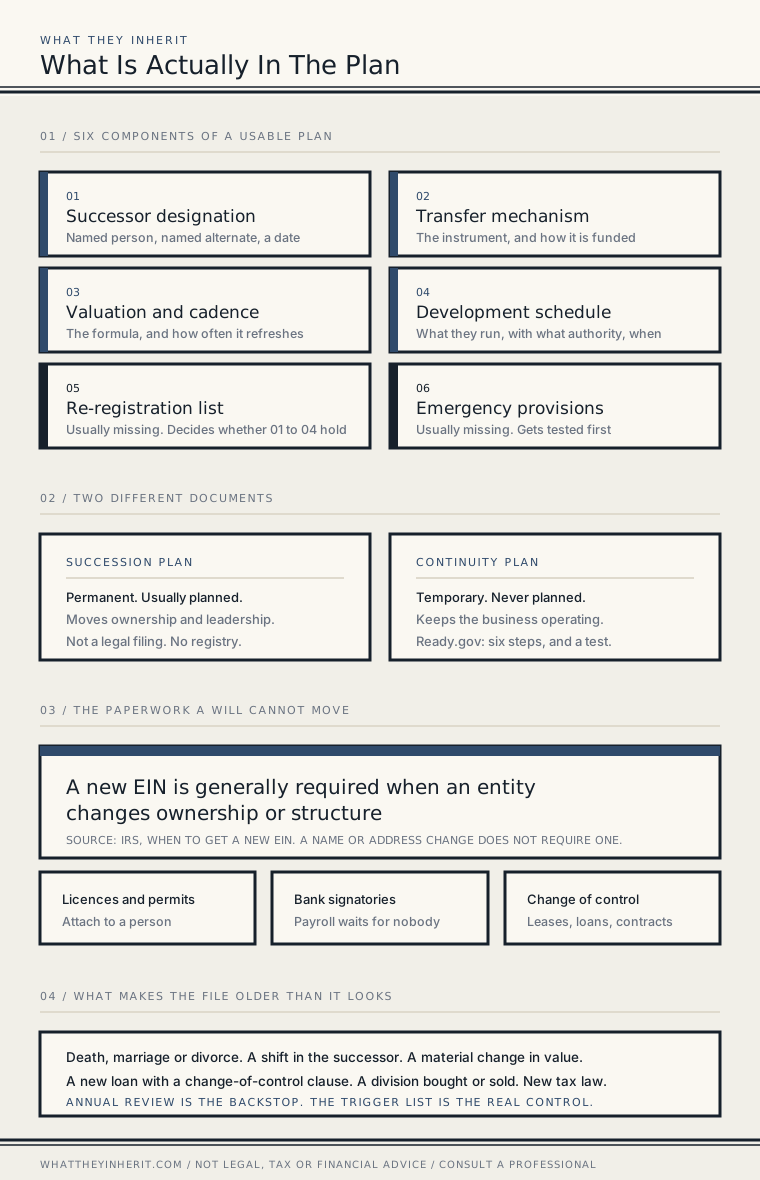
A succession plan that a bank, an attorney or a grieving family can act on has six parts. Anything shorter is a statement of intent.
| Component | What it has to contain to be usable | Usually drafted by | Review cycle |
|---|---|---|---|
| Successor designation | A named person for the operating role, a named alternate, and the date or trigger on which the change takes effect | The owner, in writing | Annual |
| Ownership transfer mechanism | The instrument that actually moves title, meaning a gift, a sale, a trust or a buy-sell agreement, which is a contract setting the price and terms on which one owner's share is bought out, plus the funding behind it | Attorney with the tax adviser | On any tax or family change |
| Valuation method and cadence | The formula or appraisal standard, plus how often it is refreshed | Valuation professional | Every one to three years |
| Development schedule | Which part of the business the successor runs, with what signing authority, starting when | The owner and the successor together | Quarterly against milestones |
| Re-registration checklist | Licences, permits, bank signatories, EIN, insurance, leases, supplier and customer contracts with change-of-control clauses | The owner with counsel | Annual |
| Emergency provisions | Who has authority tomorrow morning if the owner is unavailable, and how they prove it | Attorney, with the bank informed | Annual |
The two rows that get left out are the last two, and they are the two that decide whether the first four survive contact with a bad week. If only one part of this gets written this year, write those two first.
The plan nobody writes is the one for next Tuesday
Succession planning quietly assumes an orderly future. A date is chosen, a successor is trained, everyone gets a year to adjust. The version that gets tested first is usually the other one, where the owner is in hospital and the payroll runs on Friday.
That is a continuity problem rather than an estate problem, and the federal guidance treats it as its own discipline. Ready.gov instructs businesses to organize a business continuity team and compile a business continuity plan to manage a disruption, and breaks the process into six steps with a situation manual and a test exercise planner attached to it. The material is written for generic business disruption rather than for a succession event. The same six-step structure carries over to the sudden absence of the one person who knows the supplier terms.
An emergency provision is short and it is specific. One named person with operating authority from the moment the owner is unavailable. A second name behind the first. A signed durable power of attorney, meaning the version built to stay valid if the owner is incapacitated, which the bank has already seen and accepted. A bank meeting one for the first time in a crisis will take days to be satisfied by it, and payroll does not wait for that. Whether a power of attorney survives incapacity depends on how it is drafted and on the jurisdiction, so this is a question for an attorney rather than a form to download. Written access to the things only the owner can currently reach, which in most firms means the accounting system, the insurance file and the supplier contacts.
Ready.gov's other instruction is the one owners skip. The plan gets tested. A document nobody has rehearsed is a document whose gaps are discovered by the people least able to fix them.
The paperwork that has nothing to do with the will
A will moves ownership. It does not move a licence, and it cannot tell a bank who signs.
The tax registration is the clearest example. The IRS states that a new EIN is generally required when an entity changes ownership or structure, while a change of business name or address does not require one. The EIN is the Employer Identification Number, the federal tax ID the business trades under. The specifics turn on entity type. A sole proprietor who incorporates or forms a partnership gets a new number. A partnership that changes ownership without terminating the partnership keeps the one it has.
The hardest case in that guidance is the one owners assume is the easiest. Where an estate represents a business that is not a legal entity separate from its owner, meaning a sole proprietorship, the IRS states a new EIN is required for the business after the owner's death. A sole proprietorship does not survive its founder as a tax entity. There is nothing to hand over, only assets to transfer and a new registration for whoever picks them up. An owner who has been trading for thirty years under a name customers recognise usually has no idea that the entity behind the name ends with them.
The rest of the re-registration list is unglamorous and it is where handovers stall. Professional and trade licences, which in most jurisdictions attach to a person and not to a company. Bank signatory cards. Insurance policies naming an insured individual. Leases and loan agreements with change-of-control clauses that can be triggered by the transfer itself. Supplier and customer contracts with the same clauses. Domain names, merchant accounts and software licences registered to a personal email address that nobody else can access.
Each item is simple by itself. Doing all of them takes weeks, and those weeks run concurrently with a family trying to keep the business open. The federal small-business guidance groups transferring ownership together with selling and closing in a single step of its manage your business guide, which is a fair reflection of how much administrative overlap the three routes share. The plan's job is to have the list already made.
Who is in the room, and who breaks a tie
Four professionals normally touch a succession plan, and the order matters more than the roster.
The attorney drafts the instruments. The tax adviser tells the attorney which instrument creates the smallest problem. The valuation professional supplies the number both of them are working from. The insurance broker prices the funding for whichever route is chosen. Engage them in that order and each one is working from the previous one's output. Engage them separately, which is common in practice, and the estate plan can end up drafted against a valuation that is already years out of date.
The governance question is separate and it is the one families defer. A succession plan names a successor. It rarely says who decides anything after that, which matters most when ownership has been split among several people. The plan document is where that gap gets closed: a tie-breaking rule, in writing, naming who holds the deciding vote and under what conditions. For how a trust structures that authority when shares are held collectively rather than divided, see what a family trust actually creates.
Both instruments belong to the larger set of documents this plan sits inside, mapped in what an estate plan is actually made of. The reasoning behind an unequal split does not belong in the plan itself. It belongs in the legacy letter, a separate file the plan can reference by name.
What makes a plan go stale
A succession plan is not finished, it is maintained. Every element of it is a snapshot of circumstances that move.
The valuation moves with the business. The tax position moves with legislation. The successor's readiness moves in both directions. The family composition moves with marriages, divorces, births and deaths, and each of those can change who a beneficiary designation, meaning the named-recipient form attached to a life insurance policy or a retirement account, actually pays. The business itself moves, and a plan built around a division that has since been sold is describing a company that no longer exists.
An annual review is the working standard, and the trigger list matters more than the calendar. A death or divorce in the family, a change in the successor's willingness or capability, a material change in the value of the business, a new loan with a change-of-control clause, the sale or purchase of a division, a change in tax law affecting the chosen instrument. Any one of them makes the file older than it looks.
A stale plan fails the way old money fails. It is written in a good year by someone who is well and unhurried, and it is executed in a bad year by people who are neither. Why that pattern repeats well past this one document is covered in generational wealth.
Last reviewed by the What They Inherit Editorial Team on August 27, 2026. Our sourcing and AI-use rules are public on the editorial standards page. This is general editorial content and not legal, tax or financial advice. Entity rules, licensing rules and tax treatment differ by jurisdiction and by business structure, and nothing here establishes what applies to a specific company. Speak to a qualified attorney and tax professional in your own jurisdiction before acting on any of this.
FAQ
What does succession planning mean as opposed to succession?
Succession is what happens to the business, by default or by design. Succession planning is the separate act of writing that down: naming the successor, the transfer mechanism, the valuation, the timeline and the emergency authority in one document specific enough that somebody other than the owner can carry it out. The plan does not replace the transfer described in family business succession, it is the instruction sheet for executing it.
What should a succession plan include?
Six things: a successor designation with an alternate and a date, the ownership transfer mechanism and its funding, a valuation method with a review cadence, a development schedule for the successor, a re-registration checklist covering licences, permits, bank signatories, the EIN, insurance and contracts, and emergency provisions naming who has authority tomorrow. The two that get left out are the last two, the re-registration checklist and the emergency provisions, and they are the ones that decide whether the rest of the plan survives contact with a bad week.
What is the difference between a succession plan and a business continuity plan?
A succession plan describes a permanent, usually planned handover of ownership and leadership. A business continuity plan describes how the business keeps operating through a disruption, which may be temporary and is rarely planned. Ready.gov treats continuity planning as its own discipline with its own team, its own six-step process and its own test exercises. A family business needs both, and the continuity plan is the one that gets used first.
Do I need a new EIN when I hand the business to my child?
It depends on the entity, and the IRS guidance is specific rather than general. The IRS states that a new EIN is generally required when an entity changes ownership or structure, and is not required for a change of name or address. A partnership that changes ownership without terminating does not need a new number. A sole proprietor who incorporates does. Confirm the answer for your own entity type with a tax professional before assuming the number carries over.
What happens to a sole proprietorship when the owner dies?
It does not continue as an entity. The IRS states that where an estate represents a business that is not a legal entity separate from its owner, a new EIN is required for the business after the owner's death. In practical terms the assets, the goodwill and the customer relationships can be transferred, but the registered business itself ends with the person. Owners who have traded for decades under a recognised name are frequently unaware of this.
How often should a succession plan be reviewed?
Annually as a working standard, and immediately on any trigger event. The triggers that matter are a death, marriage or divorce in the family, a change in the successor's willingness or ability, a material change in the value of the business, a new financing agreement with a change-of-control clause, the sale or purchase of a division, and a change in tax law affecting the chosen instrument. The calendar is the backstop. The trigger list is the real control.
Who should help write a family business succession plan?
An attorney to draft the instruments, a tax adviser to establish which instrument creates the smallest tax problem, a valuation professional to supply the number both are working from, and an insurance broker to price the funding. Ask each of them who else is already engaged, because the order they are brought in decides whether they are working from each other's output or from their own assumptions.
Does a succession plan have to be a legal document?
No, and this is the most misunderstood point about it. A succession plan is a management document with no statutory force of its own. Nothing is filed and no authority reviews it. Its power comes entirely from the legal instruments it coordinates, meaning the will, the trust, the buy-sell agreement, the beneficiary designations and the operating agreement. A plan that is not backed by those instruments records an intention and moves nothing.
How long does family business succession planning take?
Assembling the document itself, once the successor decision is made, normally means several rounds between the attorney, the tax adviser, the valuation professional and the insurance broker, because each one's work depends on the last one's output. The re-registration checklist adds its own timeline: licences, bank signatories, the EIN, insurance and contracts each move at the pace of the institution holding them, which is usually weeks per item rather than one afternoon. A plan started only after the successor is already in place still has that whole administrative layer left to clear.
Sources
- succession (law.cornell.edu)
- organize a business continuity team and compile a business continuity plan (ready.gov)
- a new EIN is generally required when an entity changes ownership or structure (irs.gov)
- manage your business guide (sba.gov)